A buffet business plan lives or dies on one number: how many guests you need through the door each day to cover your costs. A regular restaurant plan can lean on average check and menu mix, but a buffet charges one price for an open-ended amount of food, so the plan has to show that the price per head, the food cost per guest, the waste coming off the line and the labor schedule all fit together at a guest count your location can actually deliver. Lenders and landlords who have seen buffet plans before will go straight to that math.
This guide walks through a buffet restaurant business plan section by section, from the executive summary to the risk section, and attaches a buffet-specific worked example to each one: per-head pricing by daypart, food cost per guest, the "pan math" behind waste, staffing, time limits, drink attach and break-even guests per day. All of the numbers below belong to one hypothetical 160-seat Asian buffet and are illustrative only. Replace every figure with your own quotes, lease terms and supplier prices before you show the plan to anyone. For a general walk-through of plan structure, see our restaurant business plan guide; this article stays on what changes when the menu is all-you-can-eat.
The U.S. Small Business Administration describes the executive summary as a brief explanation of what your company is and why it will succeed, with financial information included if you are asking for financing. For a buffet, the reader wants four things in the first paragraph: the format, the price points, the guest count you are planning for and the break-even guest count. Put the gap between those two counts where nobody can miss it.
Worked example (illustrative): "[Restaurant name] will be a 160-seat Asian buffet in a suburban shopping center, serving weekday lunch at $16.99, weekday dinner at $25.99 and weekend all-day service at $27.99, with children's pricing. The plan assumes 2,440 guests per week, or about 349 per day, and break-even at about 300 guests per day. At plan volume, projected monthly sales are about $255,000 with an operating profit near 8% before debt principal and owner draws. We are requesting funding for build-out, kitchen equipment and opening inventory."
Write the summary last, after every number in it has been worked out in the sections below.
The concept section explains what guests experience, and for a buffet that starts with how food reaches the plate. A traditional buffet puts the food on a self-service line of hot wells, cold wells and display cases, and guests serve themselves. An ordered all-you-can-eat format, common in Korean BBQ, hot pot and sushi, charges one price but sends food to the table in small portions that guests order from a menu, a tablet or a QR code. Some restaurants run a hybrid: a self-serve line for salads, desserts and sauces, with grilled or premium items ordered at the table. If you need a primer on the formats, our article on what a buffet restaurant is covers the main types.
The choice changes almost every number later in the plan. A self-serve line needs more food on display and produces more pan waste, but fewer front-of-house staff. Ordered AYCE produces less waste on the line, but more plates and more tickets for the kitchen, and it needs ordering rules so a table cannot order twelve plates of the most expensive item in the first five minutes.
Worked example (illustrative): The example buffet runs a self-serve hot and cold line with about 30 pans at dinner, plus a small made-to-order station for noodles. The concept section lists the cuisines covered, the number of items at each daypart, the seating mix (booths for families, large round tables for groups) and the reason this format fits the trade area.
A buffet needs volume, so the market section should prove the area can supply it. Start with the trade area, often the population within a 10- to 15-minute drive, and use U.S. Census Bureau data for population, household size and income. Then list every buffet and AYCE competitor in that area with its prices, hours and the dayparts where it looks busy. Families with children, office workers within lunch distance and groups celebrating birthdays are the core buffet customers, so note schools, office parks and community centers too.
Worked example (illustrative): 349 guests per day is about 127,000 guest visits a year. If a typical regular comes six times a year, the restaurant needs roughly 21,000 different people; if regulars come four times a year, it needs about 32,000. In a trade area of 150,000 residents, that means reaching somewhere between 14% and 21% of the population every year. Write that reality check into the plan. If the percentage looks unrealistic for your area, the guest count, the price or the location needs to change before anything else does.
Buffet pricing is set by daypart because the cost of the spread changes during the day. Lunch usually offers fewer premium items and a lower price; dinner and weekends add seafood, grilled meats or specialty dishes and charge more. Children's pricing is often set by age band, with the youngest eating free, and some buffets add a senior price. Show the price list and the expected guest mix together, because the price a guest actually pays on average is lower than the adult price once children are included.
Worked example (illustrative): The example buffet charges $16.99 for weekday lunch, $25.99 for weekday dinner and $27.99 on weekends, with children's prices of $8.99, $12.99 and $13.99. If 12% of paying guests are children, the average price per head works out to about $16.03 at lunch, $24.43 at dinner and $26.31 on weekends. Weighted across the week's guest mix, average food revenue is about $22.84 per guest.
Drinks are the other lever, since they are usually priced separately and cost little to serve. If 40% of guests buy a $3.29 soft drink or tea, drinks add about $1.32 per guest. Raising that attach rate to 55% through a visible drink menu and a server who offers refills brings it to about $1.81 per guest, and on this plan that change alone lowers break-even by roughly eight guests per day.
Waste on a buffet line follows a simple pattern. Every pan that is still partly full at the end of a service is food you either carry over safely or throw away. Calculating that number ahead of time is what operators call pan math, and it belongs in the operations section because it drives food cost more than portion size does.
Worked example (illustrative): Say the lunch line holds 24 pans with an average food cost of $16 per full pan, and the dinner line holds 30 pans at $22 per full pan. If pans average 35% full at close-out, each weekday lunch close-out leaves about $134 of food and each dinner close-out about $231, or roughly $365 per weekday. With two dinner-sized close-outs on each weekend day, weekly leftover comes to about $2,750, which is around 13% of the week's food cost. Switching slow-moving items to half-size pans in the last 45 minutes of each service and cooking smaller, more frequent batches could bring the average leftover down to 20% full, saving about $1,180 a week in this example. Track your real close-out levels for the first month and update the plan.
The operations section should also show you understand the food safety rules for self-service. Under the FDA Food Code, hot food on the line is held at 135°F or above and cold food at 41°F or below; food on display must be protected by sneeze guards, display cases or similar barriers; self-service areas need suitable utensils and an employee who monitors them; and guests returning for more must be given clean plates rather than reusing the ones they ate from. Your state or county may follow a different edition with local changes, so confirm the details with your health department.
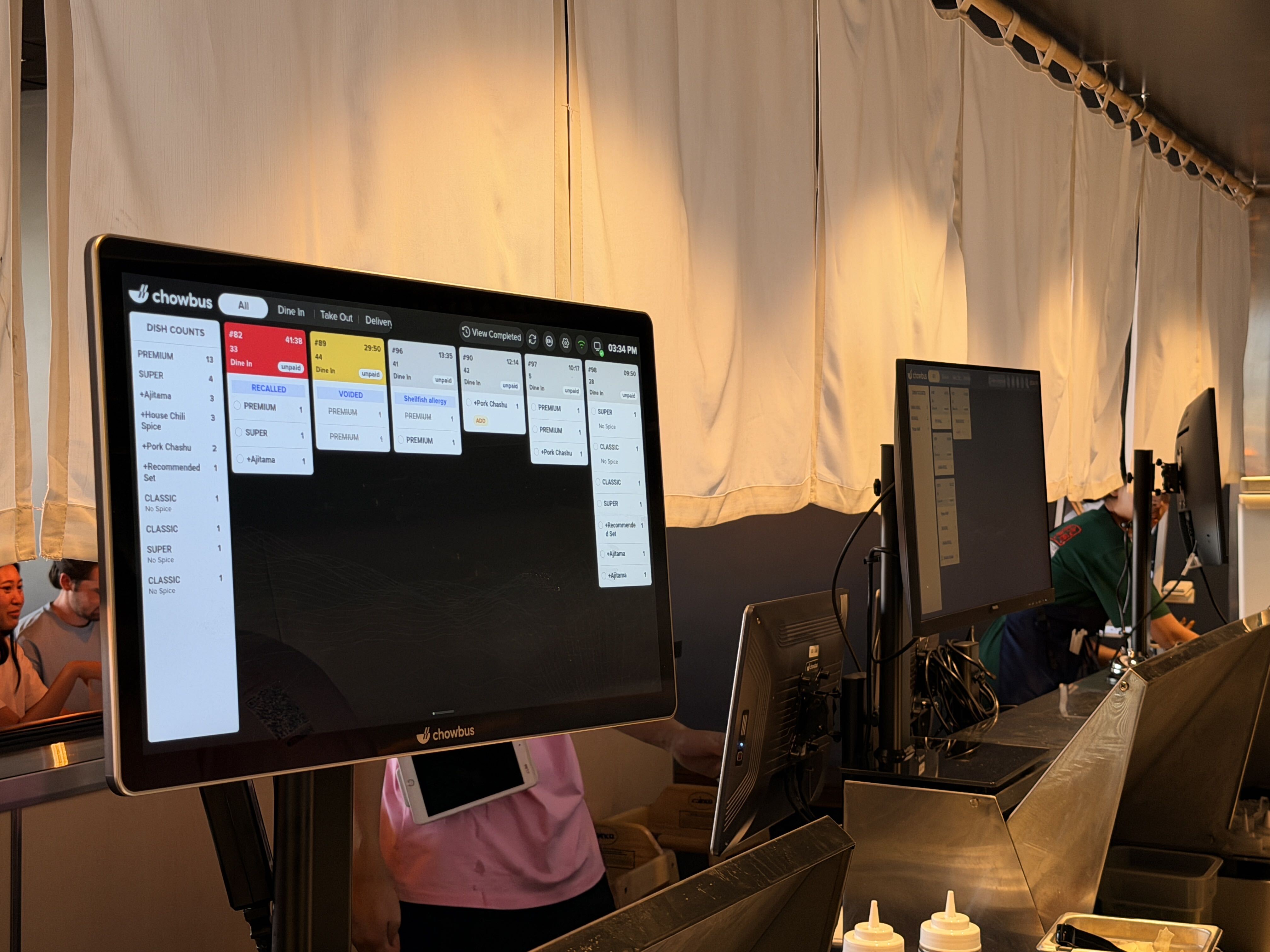
For ordered AYCE, the waste problem moves from the line to the table. The Chowbus buffet POS handles this with ordering controls on tablets and QR codes: a per-person limit on premium items, a cap on items per ordering round, a minimum gap between rounds, and a dining time limit with a countdown that locks ordering when time runs out. It also switches the menu to match the price tier each table paid for. If your concept includes ordered AYCE, list the rules you plan to set in the operations section, because they shape your food cost assumptions.
Buffets move labor from the dining room to the kitchen. Guests serve themselves, so you need fewer servers, but the kitchen cooks continuously in batches, someone has to keep the line full and at temperature, and the dish pit handles several plates per guest because every trip to the line uses a clean plate. The staffing section should show a shift-by-shift schedule and the labor cost it produces.
Worked example (illustrative): For a weekday dinner of about 190 guests, The example buffet schedules one manager, one host who also handles checkout, three servers for drinks and checks, two bussers, two line attendants who refill pans and log temperatures, five cooks and two dishwashers. A similar-size à la carte dining room might schedule six or seven servers instead of three, but would need fewer line attendants and less dish capacity. Across the week, the schedule comes to about $17,800 in labor including payroll taxes, roughly 30% of sales at plan volume. Check your state and local minimum wage, overtime and scheduling rules before you finalize these numbers.
Most buffets are full on weekends and holidays without much help, so the marketing section should focus on the dayparts that are not. Weekday lunch is often the weakest. Office lunch specials, a weekday birthday offer, kids-eat-free nights on slow evenings and a loyalty program that rewards weekday visits all target the gap. Group bookings for birthdays, teams and community organizations fill large tables at once.
Worked example (illustrative): At lunch, each extra guest brings about $16.03 in food plus $1.32 in drinks, minus about $6.10 in food cost, $0.26 in drink cost and roughly 4% for card fees and supplies, leaving about $10.30 toward fixed costs. Lifting weekday lunch from 130 to 150 guests per day adds 100 guests a week and about $1,030 a week in contribution. Put a marketing budget next to that number so the reader can see what each campaign has to deliver. Our article on AYCE restaurant POS systems covers how tier pricing and membership offers can support repeat visits.
The SBA recommends a five-year financial outlook with projected income statements, balance sheets, cash flow statements and capital expenditure budgets, with monthly or quarterly detail in the first year. For a buffet, the most important page in that section is the break-even calculation, and it is built from food cost per guest.
Food cost per guest (illustrative): Estimate how much food a typical dinner guest takes across the meal, multiply by the blended cost of the spread, then add a waste allowance. If a dinner guest takes about 1.5 pounds of food at a blended cost of $5.40 per pound as served, the plate cost is $8.10; a 15% waste allowance brings it to about $9.30. Lunch at about $6.10 and weekends at about $9.90 follow the same method. Weighted across the week, food cost is about $8.65 per guest, or around 38% of food revenue. Test these assumptions in a soft opening and keep tracking them with the methods in our guide on how to control food cost.
Break-even guests per day (illustrative):
At the planned 349 guests per day, the model shows roughly $21,000 a month in operating profit, about 8% of sales. Labor is treated as fixed here because a buffet must staff the line whether 250 or 350 guests arrive. Show monthly projections for year one with lower guest counts in the opening months.
The risk section should list what could go wrong and show its effect on the break-even number, so the reader can see you have tested the plan.

Q1: What is a buffet business plan?
It is a business plan for a restaurant that charges one price per guest for unlimited food, either from a self-service line or ordered at the table. It covers the same sections as any restaurant plan, but its financials are built around price per head, food cost per guest, waste and the number of guests needed each day to break even.
Q2: How do I calculate break-even for a buffet restaurant?
Subtract variable costs per guest (food, drinks, card fees and supplies) from average revenue per guest to get contribution per guest. Divide your daily fixed costs, including scheduled labor, by that contribution. The result is the number of guests you need per day to cover costs.
Q3: Is a self-serve buffet or ordered AYCE better for a new restaurant?
It depends on your cuisine and space. Self-serve lines suit large, varied menus and need fewer servers but carry more pan waste, while ordered AYCE suits grilled, hot pot and sushi concepts and controls waste at the table with ordering limits. Many plans test both and choose based on food cost per guest.
Q4: What food cost percentage should a buffet business plan assume?
Build it from your own menu rather than an industry average. Estimate food taken per guest, multiply by the blended cost of your spread, add a waste allowance and divide by your average price per head. In the illustrative example here, that method gives about 38%, but your figure will depend on your menu, suppliers and prices.
Q5: Should a buffet set a time limit?
Many buffets and AYCE restaurants do, especially at weekend peaks when tables are scarce. A time limit protects seat turns and makes your guest count assumptions realistic. State it clearly on the menu and at seating, and apply it consistently.
Q6: What should I do after the buffet business plan is written?
Replace every illustrative number with real quotes, lease terms and wage rates, then have an accountant review the financials. Share it with lenders or partners along with your build-out budget, and plan a soft opening to test food cost per guest and pan waste before you commit to final pricing.
A buffet plan earns trust when its numbers connect. The price per head, the guest mix, food cost per guest, pan waste, the staffing schedule and break-even guests per day should all come from the same assumptions, so that changing one of them visibly moves the others.
Build the model before you write the prose. Start with the guest count you believe the trade area can support, work out break-even from your real costs, and let the gap between them decide whether the location, the price or the format needs another look. When those numbers hold up, the rest of the plan is straightforward to write.