Most restaurant health inspection write-ups come from a short, predictable list. When the FDA studied fast food and full-service restaurants in 2017 and 2018, the two risk factors found out of compliance most often were improper holding time and temperature, and poor personal hygiene. That is good news for an owner, because both show up in places you can check yourself: a cooler that drifted warm, a rice pot with no discard time, a hand sink blocked by a stack of sheet pans. A restaurant health inspection checklist works best when you use it the way an inspector does, walking the building in the order food moves through it and checking each station before anyone from the county walks through the door.
This guide follows that route from the receiving door to the office filing cabinet, with a short checklist at each stop and extra notes for Asian kitchens, where rice held on the counter, sushi rice, raw fish, live seafood tanks, sauce bars and hot pot tables all draw an inspector's attention. The rules referenced here come from the FDA Food Code. FDA released the 2026 edition on September 17, 2026, but states and counties adopt the code on their own schedule: as of FDA's latest adoption report (data through December 31, 2025), 14 states used the 2022 edition and many others still ran the 2017, 2013 or older versions, and some places, such as California with its Retail Food Code, write their own law. Treat everything below as the national baseline and confirm the details with your local health department.
Food Code inspections sort violations into three levels. Priority items are the ones most directly tied to illness, such as cold food sitting at 50°F or raw chicken stored over salad. Priority foundation items support those controls, such as having no probe thermometer or no soap at the hand sink. Core items cover general sanitation and maintenance, such as a cracked floor tile or a dirty vent hood. Many jurisdictions turn the results into a score, a letter grade or a pass/fail placard, and a priority item usually has to be corrected on the spot or within a short deadline.
Your self-inspection should copy that logic. Download the blank inspection form your health department uses, because it lists the exact items your inspector will mark. Pick a busy service rather than a quiet afternoon, since problems show up when the line is full. Bring a calibrated probe thermometer, sanitizer test strips, a flashlight and a notepad, and have a manager who did not work the shift do the walk so nobody grades their own station. Record every miss with a fix and an owner, then repeat the walk monthly. If you are building a wider routine around this, our guide on how to improve restaurant operations covers the systems side.
Inspectors care about where food comes from and what temperature it arrived at, because a problem that comes in the back door spreads through every station after it. Receiving is also where many kitchens are most rushed, with a driver waiting and cases stacked in the hallway.
The walk-in is where inspectors find the most temperature and labeling violations. Under the Food Code, cold time/temperature control for safety (TCS) food is held at 41°F or below. Every cooler needs a thermometer you can read, and your probe thermometer should be accurate to plus or minus 2°F.
Prep is where raw and ready-to-eat food are closest together, so the checklist here focuses on separation, clean surfaces and the house sauces that sit out longer than anyone notices.
If you serve raw fish, put a consumer advisory on the menu. The Food Code requires a disclosure that marks the raw or undercooked items and a reminder that eating them may increase the risk of foodborne illness. Our guide on how to start a poke bowl business walks through raw fish sourcing in more depth.
Hot food is held at 135°F or above. Cooked food that will be cooled and reused must drop from 135°F to 70°F within two hours and then reach 41°F within a total of six hours. Cooling is one of the hardest steps to prove, so inspectors often ask how you cool soups, braises and stocks, and whether you write it down. Shallow pans, ice baths, ice wands and uncovered cooling in the walk-in all help. A full stockpot of broth left on the floor to cool overnight is a serious violation.
Rice deserves its own line on the checklist. Cooked rice is TCS food, and a big pot sitting at room temperature between lunch and dinner is one of the most common findings in Asian restaurants. You have three options under the Food Code: keep it at 135°F or above in a rice warmer, cool it properly and hold it at 41°F or below, or use time as a public health control. Time control lets you keep rice out of temperature control for up to four hours if you have a written procedure, mark the discard time on the container and throw out anything left at that time. Sushi rice is the special case. Acidifying rice with vinegar so it can sit out longer requires a variance and an approved HACCP plan in most jurisdictions, and FDA added guidance on sushi rice acidification in the 2026 Food Code. Without that approval, sushi rice falls under the same four-hour time control as any other rice.
This is where poor personal hygiene, the other most common risk factor, gets caught. Inspectors watch whether staff wash hands at the right moments, and they check whether the hand sink can actually be used.
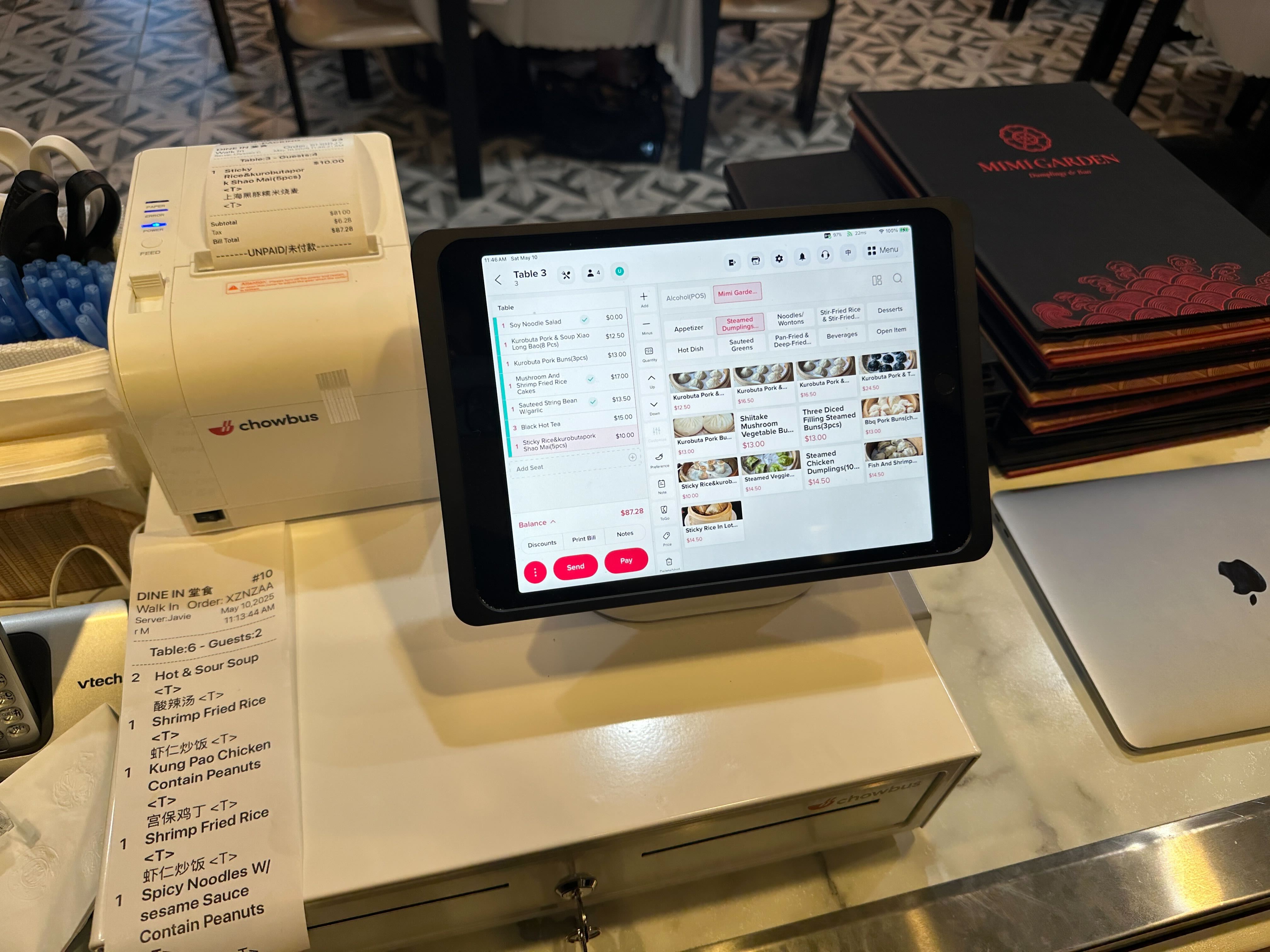
Front of house is where allergen awareness gets tested. The Food Code expects the person in charge to make sure employees are trained in food allergy awareness for their duties, and since January 1, 2023, the federal list of major food allergens has nine items: milk, eggs, fish, crustacean shellfish, tree nuts, peanuts, wheat, soybeans and sesame. Asian menus carry several of these in places guests do not expect, such as wheat in soy sauce, fish in fish sauce, shrimp in dried shrimp paste and sesame in dressings. Servers should know which dishes contain them and how to get an allergy note to the cook in writing. A POS that prints the note on the kitchen ticket helps here; on the Chowbus POS, order notes go straight to the kitchen and the kitchen display sounds an alert when a note is changed after the order is sent.
Hot pot and other tabletop-cooking concepts add a few items. Raw meat, seafood and dumplings plated for the table should leave the reach-in shortly before they are served, not sit on a rack in the dining room. Give guests separate tongs or slotted spoons for raw items so the chopsticks they eat with stay clean. A self-serve sauce bar needs sneeze guards, a serving utensil in every container, an employee who checks it during service, and a plan for anything that needs temperature control. Health departments treat raw food served for guests to cook differently, so ask yours whether it expects a consumer advisory or table sign.
Live seafood tanks need clean water, a working filter and records. If a tank holds oysters, clams or other molluscan shellfish that you plan to serve, the Food Code (section 4-204.110) allows that only with a variance and an approved HACCP plan; otherwise the tank is display only. Keep the shellstock tags for 90 days after the container is emptied.
A serious insect or rodent infestation is one of the conditions the Food Code lists as grounds for an immediate closure, so this part of the walk is about evidence. Look where the inspector will look: under the dish machine, behind the reach-ins, inside the dry storage corners and around the grease trap.
Documentation is where a clean kitchen can still lose points. Keep a binder or shared folder with each item below, and make sure the opening and closing managers know where it is.
If your health department follows up on an illness complaint, it may ask who was working on a given day. Time records that can be exported by date, such as the timesheet exports in the Chowbus POS, make that answer fast.

Q1: What is a restaurant health inspection checklist?
It is a list of the items a health inspector will check, organized so you can review them yourself before an inspection. The most useful version follows your local inspection form, which in most places is based on the FDA Food Code, and adds the specific risks in your kitchen, such as rice held under time control or a live seafood tank.
Q2: How do I prepare for a restaurant health inspection?
Run a self-inspection during a busy service at least once a month, using your health department's own form. Probe food in every cooler and hot holding unit, check every hand sink, look for pests, and confirm your logs and certificates are current. Fix priority items the same day and assign an owner to each remaining issue.
Q3: Is the FDA Food Code the same as my local health code?
Usually not exactly. The FDA Food Code is a model that states and counties adopt, often with their own changes and on their own schedule, so your area may follow the 2013, 2017 or 2022 edition rather than the 2026 one. Some jurisdictions, such as California, write their own retail food law. Always confirm the rule with your local health department.
Q4: How much does a failed health inspection cost a restaurant?
It depends on your jurisdiction. Costs can include re-inspection fees, fines for specific violations, discarded food, lost sales during a closure and a lower posted grade that customers see. Your health department's fee schedule lists re-inspection and penalty amounts, and preventing repeat violations is usually far cheaper than paying for them.
Q5: Can I keep cooked rice at room temperature in my restaurant?
Only under a written time-as-a-public-health-control procedure, which under the Food Code allows up to four hours with a marked discard time. Otherwise rice must be held at 135°F or above or cooled to 41°F or below. Acidified sushi rice held longer usually needs a variance and an approved HACCP plan.
Q6: What should I do right after a health inspection?
Read the report with your managers the same day and correct anything marked for follow-up before the re-inspection date. Add each violation to your self-inspection checklist so it gets checked every month, and retrain the staff involved. Keep the report on file, since many departments and future inspectors will ask for it.
Inspectors tend to find the same things in restaurant after restaurant: food held at the wrong temperature, hands that were not washed when they should have been, and missing paperwork. Walking your own building station by station, with a thermometer in hand and your county's form on a clipboard, catches most of those problems while they are still easy to fix.
Start with the stations that cause the most trouble in your kitchen. For many Asian restaurants that is the rice station and the walk-in. Put those on the list this week, add the rest over the next month, and make the walk part of the manager's routine so that the next inspection is simply another service.