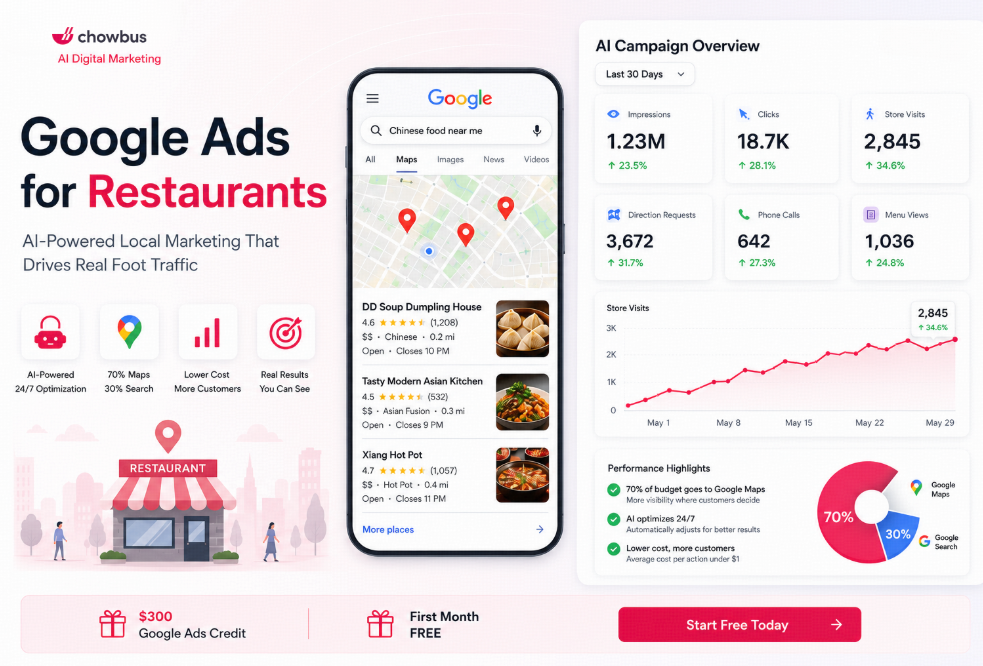
If you've ever tried running Google ads for restaurants and walked away confused, overcharged, or just not sure if anything actually worked, you're not alone.
Most restaurant owners don't have a marketing team. You're managing staff, sourcing ingredients, keeping up with reviews, and making sure every table walks out happy. Figuring out keyword bidding, ad budgets, and campaign settings is nobody's idea of a good time after a double shift.
Chowbus built AI Digital Marketing to solve that problem.
It runs your Google ads automatically, 24/7, using AI to optimize performance so that when a hungry customer searches nearby, your restaurant shows up. No agency. No guesswork. No wasted spend.
This guide covers how it works, what real results look like, and why Google, specifically Google Maps, is the most valuable place for local restaurants to advertise right now.
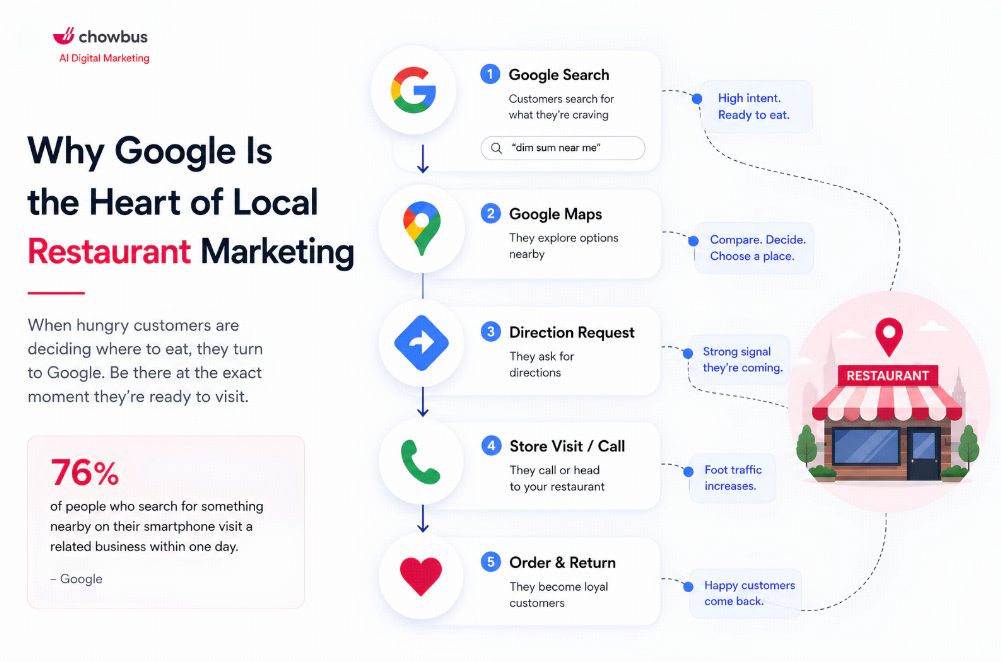
When someone is deciding where to eat tonight, they are not browsing a blog or scrolling social media. They open Google, type in what they are craving, and look at what comes up nearby. That moment is when the decision gets made.
According to Google, 76% of people who search for something nearby on their smartphone visit a related business within one day. For restaurants specifically, that intent is even higher. Someone searching "dim sum near me" or "pho restaurant open now" is not doing research. They are picking a place, right now, and spending money there.
Here's what most restaurant owners don't realize: the majority of those searches resolve not on a website, but on Google Maps. The map results, with photos, reviews, hours, and directions right there, are where customers make the final call. That's why local restaurant marketing that focuses on Google Maps placement tends to outperform traditional search advertising for foot traffic.
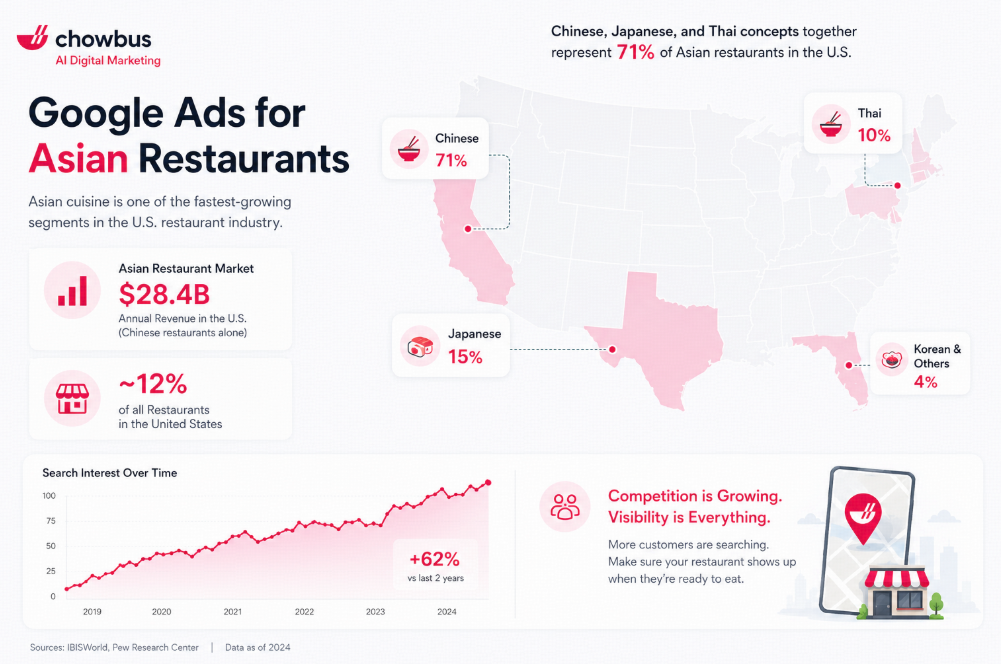
Asian cuisine is one of the fastest-growing segments in the U.S. restaurant industry. Chinese restaurant revenue alone is estimated at $28.4 billion annually, and the broader Asian restaurant market makes up roughly 12% of all restaurants in the United States, according to Pew Research. With Chinese, Japanese, and Thai concepts together representing 71% of that category, restaurant advertising for Asian restaurants has never been more competitive. Google ads for Asian restaurants are becoming essential for any owner who wants to stay visible when customers search nearby.
The restaurants that win are the ones that show up first. And most restaurants are not running any restaurant advertising at all. Want a full breakdown of restaurant marketing strategies? Read our complete guide.
Chowbus AI Digital Marketing is a restaurant marketing tool that runs Google ads for restaurants automatically. You connect your Google Business Profile for restaurants, set a monthly ad budget, and the AI handles everything else: building the campaign, choosing keywords, splitting spend between Google Maps and Google Search, and continuously optimizing based on real customer behavior.
It is designed to be completely hands-off. If you can run a restaurant, you can use this. There's nothing to learn about advertising.
Chowbus has served over 10,000 merchants and processed more than $4 billion in transaction volume. This tool is built with that same understanding of how restaurants actually operate, not how an agency thinks they do.
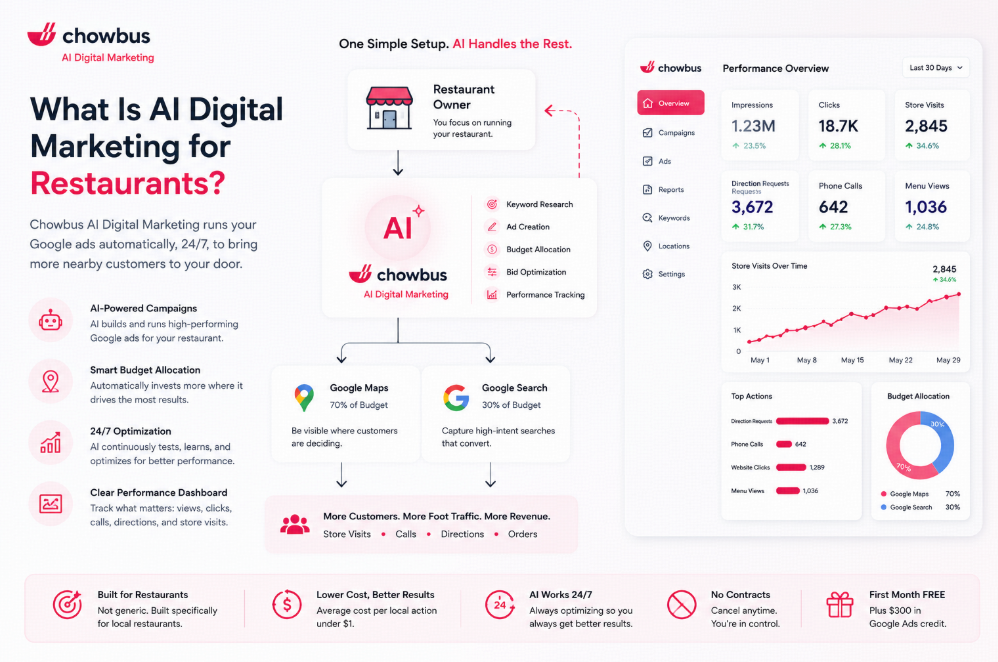
The platform allocates roughly 70% of your ad spend toward Google Maps placements and 30% toward Google Search. That weighting is intentional.
Google Maps is where customers are when they are actively deciding where to eat. They are already looking at a map, comparing options nearby, and about to pick a place. That's the moment your ad needs to appear. Search is useful too, but Maps is where foot traffic decisions actually happen.
Traditional Google Search ads for restaurant keywords typically run $1.50 to $2.00 per click, sometimes higher in competitive cities. Google Maps placements tend to operate in a less crowded auction. Many restaurants see cost-per-click rates under $1.00. That efficiency adds up fast when campaigns run every day.
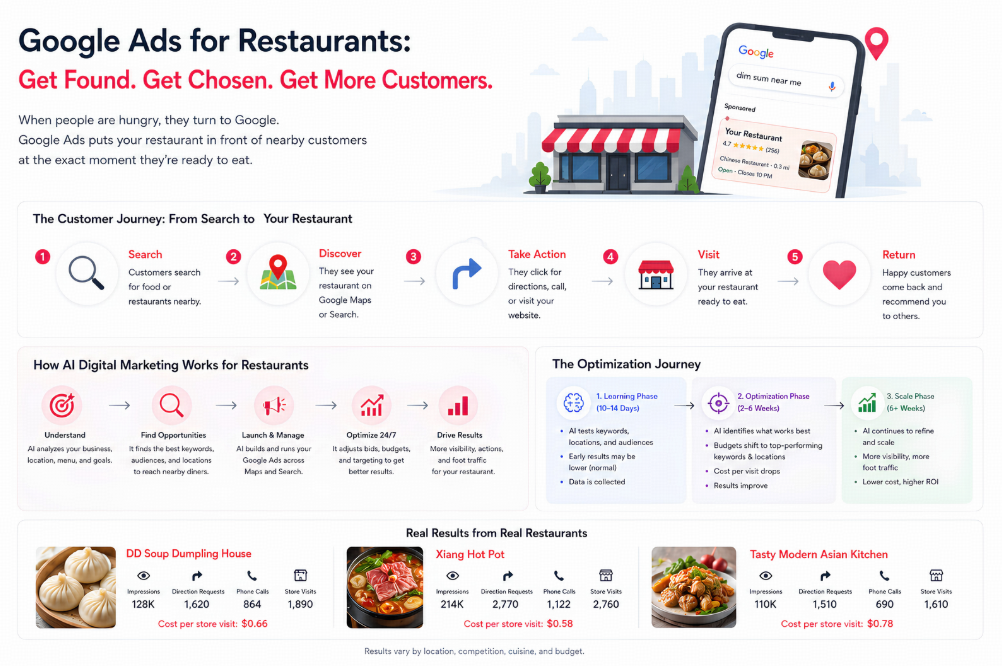
After launch, the AI spends the first 10 to 12 days in an optimization phase. It is testing keywords, figuring out which nearby customers are most likely to act, and refining targeting based on real behavior. Early numbers may look low, and that is completely normal. Performance stabilizes after the optimization phase and typically gets strongest after six to eight weeks of continuous optimization.
For a restaurant, a click on a website is nice. What actually matters is what happens next. The platform tracks:
The average cost per local action, a direction request, phone call, or website visit, is often under $1 with well-optimized campaigns. The industry average for traditional restaurant advertising is closer to $10 or more per customer action. That gap is significant when you're watching every dollar.
These are actual numbers from live campaigns on the platform.
DD Soup Dumpling House
3 months. $1,045 in ad spend. 1,576 total store visits. 1,796 direction views. 315 phone calls. Average cost per customer: $0.66. Store visits grew from 321 in month one to 611 by month three, a 90% increase, while cost per visit dropped 51% as the AI kept learning.
Tasty Modern Asian Kitchen
4 months. $1,312 in ad spend. 1,288 total store visits. 2,225 direction views. 221 phone calls. Cost per store visit: $1.02. Cost per click: $0.09. Foot traffic climbed steadily every month at sub-$1 cost per visit, sustained for four months running. 90% more cost efficient than the industry average.
Xiang Hot Pot, Brooklyn, NY
3 months. $1,096 in ad spend. 780 total store visits. 1,965 direction views. 459 orders driven by ads. Average cost per store visit: $1.41. Cost per click: $0.14. Month one is the learning phase at $10.00 per visit. By month two the AI finds its rhythm and cost per visit drops 90% to $1.01. Month three holds at $0.95.
The pattern is consistent across all three: performance improves as the AI learns, cost per visit drops over time, and direction views signal real customers who are ready to walk in. The learning phase is real, and so is what comes after it.
There are other ways to run Google ads for restaurants. Here is what makes the Chowbus approach different.
Most Google Ads tools are designed for e-commerce or lead generation. They optimize for clicks and form fills. Restaurant advertising is a different problem. It requires local targeting, proximity bidding, and optimization toward foot traffic signals, not website conversions. This tool is built specifically for that.
A digital marketing agency typically charges hundreds to thousands of dollars per month in management fees on top of your ad spend. Chowbus AI digital marketing for restaurants is $59 per month for the platform, free for your first month, with zero markup on what goes to Google. Every ad dollar you put in goes directly to your campaign. That's 95% cheaper than working with an agency.
Because this is part of the Chowbus platform, your ad performance sits alongside your order and operations data. You can see how marketing connects to actual business results, not just clicks on a dashboard.
Month-to-month. Cancel anytime. You set the budget and control the timeline.
Looking for more ways to market your restaurant beyond ads? See our restaurant marketing guide.
Getting started with Chowbus takes less than 15 minutes, and this is genuinely one of the fastest answers to how to get more customers to my restaurant without hiring anyone or learning anything new about marketing.
What you need:
What happens after you sign up:
New customers get $300 in Google Ads credit and a free first month on the platform.
One thing worth doing before you launch: if you're still figuring out how to show up on Google Maps, start with your Google Business Profile. Owner-level access is required (not manager). Aim for at least 15 reviews, accurate hours and address, and photos of your food and space. A strong profile gives the AI better signals and helps your ads perform better from day one.
Interested in optimizing your online presence? Read our guide to online marketing for restaurants.
How quickly will I see results?
Most campaigns show early signs within the first month. The strongest, most consistent performance typically comes after six to eight weeks as the AI continues to optimize for your location and customer base.
Will this interfere with my existing Google Ads?
No. Your Chowbus campaign runs in a separate ad account, so it does not conflict with anything you or another agency is already running.
I have multiple locations. Does this work for all of them?
Yes. Each location connects to its own Google Business Profile and runs its own campaign. Onboarding takes about 10 to 15 minutes per location.
Why don't I ever see my own ads when I search?
Google shows ads to people most likely to take action based on location, timing, and search intent. Advertisers rarely see their own ads. Always evaluate performance using your dashboard, not personal searches.
My results look low in the first week. Should I be worried?
No. Low early numbers are normal during the learning phase. The system needs 10 to 12 days to gather enough data to optimize well. If performance is still low after several weeks, common reasons include an incomplete Google Business Profile, too few reviews, or strong local competition. Your Chowbus Customer Success Manager can help figure out what's going on.
Google ads for restaurants don't have to be complicated, expensive, or something you need an agency for. The customers you want are already searching on Google every day. The question is whether your restaurant shows up when they do.
Chowbus AI Digital Marketing handles the ads automatically so you can stay focused on running your restaurant. The AI optimizes around the clock, the cost per customer is a fraction of what traditional restaurant advertising runs, and the results from live campaigns speak for themselves.
Your first month is free. $300 in Google Ads credit is ready to go.
Sign up for Chowbus AI Digital Marketing and start showing up where your customers are looking.
Resources
• IBISWorld: Chinese Restaurants Industry in the U.S.
• Pew Research Center: 71% of Asian restaurants in the U.S. serve Chinese, Japanese, or Thai food
• Chowbus: AI Ads Optimization