Every time a customer taps "order" on a third-party delivery app, somewhere between a quarter and nearly a third of that ticket never reaches your register. On a $40 order, that can be $10-12 gone before you've paid for food cost, labor, or rent — and most owners only notice the damage when they look at a full month of statements side by side.
Chowbus works with 9,000+ restaurants across all 50 U.S. states, and the online ordering conversation comes up in almost every one of them, especially among Asian restaurant owners juggling bilingual menus, complex modifiers, and thin margins. Delivery marketplaces aren't going away, and they do bring in new customers — but relying on them as your only ordering channel quietly caps how much of your own revenue you actually keep.
In this guide, you'll see exactly how commission costs add up over a year, what a direct online ordering system actually does differently, and how to start shifting order volume back to a channel you control — so more of every order stays in your business.
"Online ordering system" gets used loosely, so it helps to separate the two very different things restaurants actually mean by it.
Third-party marketplace ordering is what most diners think of first: DoorDash, Uber Eats, Grubhub. A customer opens the app, browses restaurants near them, and orders. The platform owns the customer relationship — their contact info, order history, and loyalty — and charges the restaurant a commission, typically 25-30% per order, for the privilege of showing up in their search results and handling the delivery logistics.
Direct (branded) online ordering is a system that lives on your own website, your own branded app, or a QR code on your own tables — built and hosted for your restaurant specifically. The order still gets placed online, but it comes straight to your POS and kitchen, the customer data belongs to you, and there's no 25-30% toll on the way in. Some restaurants pay a flat monthly platform fee, a small per-order fee, or a processing fee only — nowhere close to marketplace commission rates.
Both channels can coexist. The mistake is treating marketplace ordering as your entire online strategy when it's really just one acquisition channel among several — and usually the most expensive one.

Numbers make this concrete faster than any explanation. Here's an illustrative example — not a Chowbus statistic, just simple math any owner can check against their own POS reports.
Say a restaurant does $30,000 a month in orders through third-party delivery apps, at an average commission of 28%.
That's before factoring in packaging costs, promotions the platforms often push restaurants to run, or the payment processing the restaurant may still cover separately. For a small or mid-size operation, six figures a year is often close to the entire annual profit margin — gone before it ever hits the bank account.
Now compare that to the same $30,000 in monthly volume routed through a direct ordering system with a flat monthly fee or a low per-order fee. Even if a restaurant only shifts a third of that volume — say $10,000/month — from marketplace apps to its own ordering page, that's roughly $2,800/month, or about $33,600/year, that stays with the restaurant instead of leaving with the platform. That's the math that makes a direct ordering channel worth setting up properly, not just as a nice-to-have.
A standalone ordering page that isn't connected to anything else just creates a new system to babysit. The value of a direct online ordering system shows up when it's tied into the tools you already run the restaurant on:
This is the practical difference between "we have online ordering" and "our online ordering actually reduces our workload and grows repeat business."
Generic online ordering tools are usually built around a burger-and-fries mental model: a few modifiers, a simple menu tree, English-only. That doesn't hold up well for the kind of ordering complexity common in Chinese, Japanese, Korean, Vietnamese, Thai, and bubble tea businesses.
A few specifics that matter here:
This is a big part of why the Asian restaurant sector — 16% of the U.S. restaurant market, on track to reach $240B by the end of 2026 after growing 135% over the past 25 years — often gets underserved by mainstream ordering tools that were never designed with this menu complexity or this bilingual customer base in mind.
Most major POS providers now offer some version of online ordering, so it's worth knowing what differentiates a genuinely useful setup from a checkbox feature:
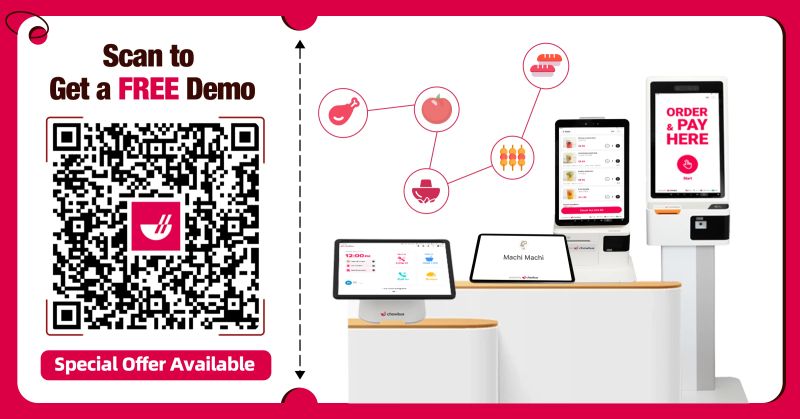
Chowbus's Online Ordering, part of the same platform as the POS, KioskPRO, TablePRO, Loyalty & CRM, and Branded App, was built specifically to close these gaps: bilingual (and beyond) ordering pages, modifier logic that handles hot pot and bubble tea-level complexity, QR ordering for dine-in, and a branded app that keeps the customer relationship with the restaurant instead of a delivery platform. Because it's integrated with the POS and Loyalty & CRM, orders, customer data, and repeat-visit marketing live in one system instead of three. It's the kind of setup a restaurant owner can point a manager to and say "this is how we take orders now" without a stack of workarounds — backed by 24/7 bilingual (EN/ZH/ES) support with a 2-minute average response time.
What exactly is an online ordering system for restaurants?It's software that lets customers place food orders online — through a website, branded app, or QR code — and have them sent directly to the restaurant's POS and kitchen. It can be run through a third-party marketplace like DoorDash, or through a restaurant's own direct/branded channel; the underlying commission structure and customer data ownership are what differ most between the two.
Is a direct ordering system better than using DoorDash, Uber Eats, or Grubhub?Neither fully replaces the other for most restaurants. Marketplaces bring new-customer discovery but charge 25-30% commission per order and keep the customer relationship. A direct system costs far less per order, gives you the customer's contact info for repeat business, but doesn't bring in the same volume of first-time diners on its own — most owners run both, while working to shift a growing share of repeat orders to their direct channel.
How much does an online ordering system for restaurants cost?Marketplace commissions typically run 25-30% per order. Direct/branded ordering systems are usually priced as a flat monthly platform fee, sometimes with a small per-order or payment processing fee — a fraction of marketplace commission rates, especially once volume grows. Exact pricing depends on the provider and the size of your restaurant.
How do I get customers to order through my own site instead of a delivery app?Put the QR code and ordering link on receipts, tables, packaging, and social posts; offer a small direct-order discount or loyalty points that only apply to direct orders; and make sure the direct ordering page is genuinely as fast and easy to use as the apps customers already know. A branded app with loyalty built in gives customers a reason to come back to your channel specifically.
A restaurant does $30,000/month in delivery orders through apps — how much is commission really costing them?At a typical 28% commission, that's about $8,400/month, or roughly $100,800/year. Shifting even a third of that volume to a direct ordering system with a flat fee can save tens of thousands of dollars annually — money that would otherwise leave the business on every single order.
How do I get started setting up a direct online ordering system?Start by looking at your POS and loyalty setup — an ordering system that connects to both will save the most labor and capture the most repeat business. Chowbus's Online Ordering, integrated with its POS and Loyalty & CRM, is one option built specifically for Asian restaurant menus and bilingual customer bases; most providers, Chowbus included, will walk you through setup rather than leaving you to configure it alone.
Third-party delivery apps aren't the enemy — they bring in orders a restaurant might not get otherwise. But when 25-30% of every one of those orders goes to commission, and the customer relationship goes with it, a restaurant that depends entirely on marketplaces is capping its own margin and handing its repeat business to someone else's app.
If you've never actually run the math on what commissions cost your restaurant over a full year, it's worth ten minutes with last year's statements — the number is usually higher than owners expect, and it's the clearest argument for building a direct ordering channel that sends orders straight to your POS, your kitchen, and your own customer list.
A direct online ordering system won't replace delivery marketplaces overnight, and it doesn't need to. Start by making it easy for existing customers — the ones already in your dining room or already on your loyalty list — to order directly next time, and let that channel grow from there. Every order that moves off a 25-30% commission and onto your own system is margin back in your business, not someone else's platform.