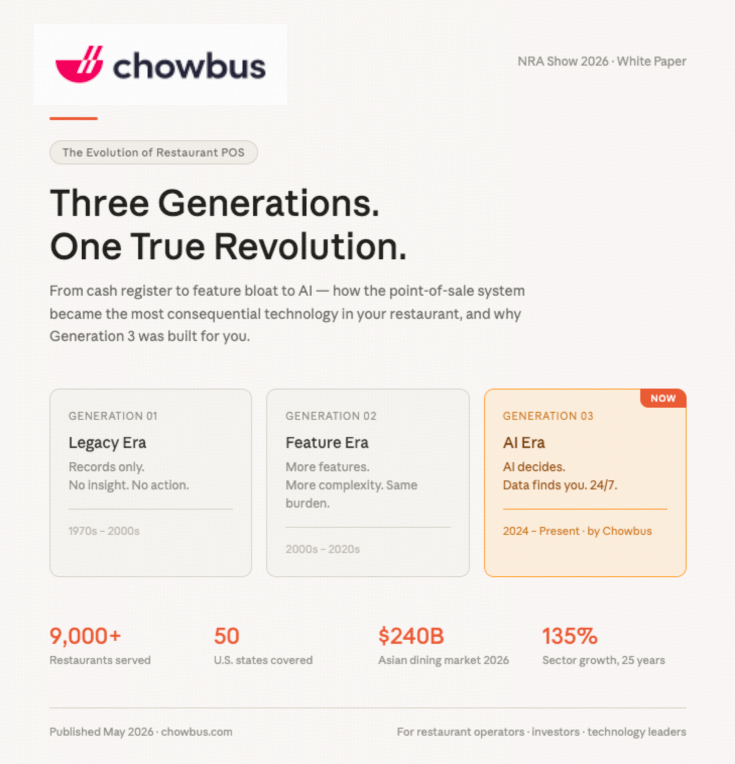
The Chinese restaurant is one of the most familiar fixtures of North American life and one of the least understood as a business. There are tens of thousands of them — sit-down Sichuan houses, neighborhood takeout counters, hot pot halls, dim sum palaces, regional specialists serving Hunan, Cantonese, Northeastern, Xinjiang, and Yunnan cuisines — and together they anchor a share of an Asian restaurant sector projected to reach $240 billion by the end of 2026, a sector that has grown 135% over the past 25 years. By almost any measure, this is a thriving, expanding, culturally central part of the industry.
And yet the technology most of these restaurants run on was never built for them. The dominant point-of-sale (POS) platforms in North America were designed around a particular template of American full-service and quick-service dining — single-language menus, à la carte ordering, tip-driven server workflows, predictable item structures. Chinese restaurants violate nearly every assumption in that template. They run bilingual kitchens. They serve family-style and all-you-can-eat. They build menus with hundreds of items, modifiers, and combinations. They depend heavily on takeout and delivery. They are frequently owner-operated by immigrant entrepreneurs who manage front-of-house, back-of-house, payroll, and marketing personally — often in Chinese.
The result is a structural mismatch that costs money every single service. Operators stitch together four or more disconnected software systems that do not share data. Orders are lost in translation between an English-speaking floor and a Chinese-speaking kitchen. Third-party delivery apps skim 25–30% off the top of an order channel these restaurants cannot afford to ignore. Customer relationships that should compound into loyalty evaporate into anonymous transactions.
This whitepaper makes three arguments. First, that Chinese restaurants are operationally distinct enough that generic POS systems are not merely suboptimal but actively value-destroying for them. Second, that the disconnected, multi-system status quo carries quantifiable costs — in labor, in error rates, in commission leakage, in lost repeat business — that compound as a restaurant grows. Third, that a unified, purpose-built digital operations platform is no longer a luxury or an efficiency play but the competitive dividing line in a maturing, high-value market: the operators pulling ahead are the ones who replaced the patchwork with a single system built around how their restaurants actually run.
The evidence base for this argument is now substantial. Across 9,000+ restaurants in all 50 U.S. states, processing roughly $4 billion in annualized transaction volume, one platform — Chowbus — has been built specifically around the operational reality of Asian and Chinese dining. This document draws on that operating footprint, on publicly available market data, and on the search behavior of restaurant operators themselves to lay out, in practical terms, what digital operations should look like for a Chinese restaurant in North America, and why the cost of staying on the wrong stack is higher than most owners realize.
It is written for restaurant owners and operators first, and for the investors, partners, and industry observers trying to understand a segment that is far larger and more sophisticated than its strip-mall reputation suggests. The chapters that follow move from the size and shape of the opportunity, through the specific ways generic technology fails this segment, into the architecture of a system that does not — and finally to a practical framework any operator can use to evaluate the return on changing course.
This document is structured to be read in order, but it is also built so that an operator can go straight to what is most useful to them. Chapters 1 through 3 make the case for why the problem matters — the size and structure of the opportunity, the specific ways generic technology fails Chinese restaurants, and the real, quantifiable cost of the disconnected status quo. An operator who already feels the pain daily may move quickly through these and treat them as ammunition for a decision they are leaning toward.
Chapters 4 through 7 describe the solution and its value — what a unified, purpose-built platform actually contains, how to quantify the return on adopting it, how the prescription differs by restaurant format, and the strategic advantage of a single source of truth. The ROI framework in Chapter 5 and the sub-segment playbooks in Chapter 6 are the most directly actionable: an operator can populate the framework with their own numbers and find the playbook that matches their format.
Chapters 8 through 10 are about execution — the bilingual and cultural fit that determines whether a platform is usable for this segment, the practical roadmap for switching without disruption, and a clear-eyed guide to the vendor landscape and how to choose within it. An operator at the point of decision should read these closely. Throughout, the figures used are either publicly available market data or clearly labeled illustrative models; the Methodology note at the end states exactly what is sourced and what is illustrative.
Ask most people to picture the North American restaurant industry and they will picture burgers, pizza, coffee chains, and casual-dining franchises. The Chinese restaurant rarely makes the mental list, despite being one of the most numerically common and geographically distributed restaurant types on the continent. Almost every town of any size has at least one. Major metros have hundreds. The cuisine is so woven into the fabric of North American eating that its ubiquity has rendered it nearly invisible as a business category.
That invisibility is a mistake — and increasingly an expensive one for anyone trying to serve, finance, or compete in this market. The Asian restaurant sector, of which Chinese restaurants are the largest single component, is on track to reach $240 billion by the end of 2026. It has grown 135% over the past 25 years, a rate that has consistently outpaced the broader restaurant industry. This is not a declining heritage category subsisting on nostalgia. It is one of the most dynamic growth stories in food service, and it is doing it largely without technology built for its needs.
The reasons for the growth are structural and durable. Immigration has continuously refreshed both the talent pool and the customer base. A generation of North American diners has grown up treating regional Chinese cuisine — not the Americanized chop-suey template, but Sichuan, Hunan, Cantonese, Northern, and increasingly Yunnan and Xinjiang cooking — as everyday food rather than exotic occasion dining. Hot pot and Chinese barbecue have become social-dining destinations for younger consumers. Delivery culture, accelerated permanently by the pandemic years, plays directly to a cuisine that travels well and has always had a strong takeout tradition. Each of these trends points in the same direction: more Chinese restaurants, serving more diners, generating more revenue, with more operational complexity than ever.
"Chinese restaurant" is a category label that conceals enormous operational diversity. Understanding the digital needs of the segment requires understanding that it is really several distinct businesses wearing one cuisine label, each with a different operating model.
Full-service regional restaurants — the Sichuan, Hunan, Cantonese, and Northern-cuisine houses — run the most complex operations. Large menus often running to two or three hundred items, family-style ordering where dishes are shared rather than plated per person, lazy-Susan round tables, tea service, and a dinner rush that depends on accurate, fast communication between an English-or-bilingual front of house and a Chinese-reading kitchen. These restaurants live and die on table turnover and order accuracy.
Hot pot and all-you-can-eat (AYCE) establishments are a category unto themselves. The economics are per-person rather than per-item; the service model involves continuous rounds of ordering throughout a long seating; the kitchen and floor must track what each table has ordered against AYCE rules and time limits; and premium add-ons and à la carte upgrades layer on top of the base price. This is one of the fastest-growing and most technologically demanding Chinese dining formats, and it is precisely where generic POS systems fail most visibly.
Chinese quick-service and takeout operations — the neighborhood counters, the mall food-court stalls, the fast-casual concepts — are throughput businesses. They depend overwhelmingly on speed, on takeout and delivery volume that can reach 50% or more of revenue, and on keeping order errors near zero when tickets are flying. For these operators, every percentage point of delivery commission and every mis-keyed modifier is a direct hit to thin margins.
Multi-location groups — the regional chains and expanding brands — add a layer of cross-location complexity: centralized menu and pricing management, consolidated reporting, inventory and labor visibility across sites, and the ability to maintain brand and operational consistency while still adapting to local conditions. As successful single-location operators expand, they hit a technology ceiling that single-store tools were never designed to break through.
A single platform serving this segment, then, cannot be a one-size product. It has to bend to a full-service Sichuan house on Friday night and a takeout counter at lunch and a hot pot hall on a Saturday and a four-location group's head office on Monday morning. That flexibility — within a deep understanding of one culinary world — is the entire design challenge.
The operational profile of the segment is inseparable from the human profile of its operators. Chinese restaurants in North America are overwhelmingly owner-operated, and a large share of those owners are immigrant entrepreneurs who are bilingual or primarily Chinese-speaking. This is not a peripheral demographic detail. It shapes every technology decision the restaurant makes.
An owner-operator does not have an IT department, a marketing team, or a finance back office. They are the person reconciling the day's sales at midnight, scheduling staff, deciding whether to run a promotion, fielding the angry call about a wrong delivery order, and negotiating with the POS vendor whose support line does not speak their language. When a system breaks during Saturday dinner service, there is no escalation path — there is the owner, a phone, and a dining room full of guests.
For this operator, software is not a strategic technology investment in the abstract. It is a daily operational partner that either reduces the number of fires they have to put out or adds to them. The language in which that partner communicates — both its interface and its human support — is not a nice-to-have. A POS whose support team cannot diagnose a problem in Mandarin or Cantonese at 9pm on a Saturday is, for a meaningful share of this market, effectively no support at all.
This is the context in which 24/7 bilingual support in English, Chinese, and Spanish stops being a marketing line and becomes the difference between a system that works for this segment and one that merely sells to it. It is also why the cultural fluency of a technology partner — understanding why a hot pot table orders in rounds, why a family-style check splits the way it does, why a kitchen ticket needs to print in Chinese — translates directly into operational outcomes.
The Chinese restaurant operates inside the broader restaurant industry, and it faces the same structural pressures as every other operator — pressures that make the efficiency and capability of its technology more consequential, not less. Three are worth naming because they bear directly on the argument of this whitepaper.
The first is the persistent labor shortage. Restaurants across North America have struggled to hire and retain staff, and the pressure falls hardest on operations that are labor-intensive by design — which describes the round-based service of hot pot, the high-touch service of full-service regional dining, and the speed demands of takeout at peak. When labor is scarce and expensive, technology that lets the same team do more — self-service ordering, accurate digital capture, automated coordination — shifts from a nice-to-have to a survival tool.
The second is margin pressure from every direction: rising food costs, rising wages, rising rents, and the commission tax on delivery. In an environment where input costs climb and pricing power is limited, the margin that technology protects — through commission recovery, waste reduction, and labor efficiency — is margin the operator cannot find anywhere else. Defending the bottom line operationally becomes one of the few levers fully within the operator's control.
The third is rising customer expectations. Diners now expect the conveniences they get everywhere else — easy online ordering, QR menus, loyalty rewards, fast and accurate delivery. A Chinese restaurant that cannot offer these is increasingly at a disadvantage against those that can, regardless of how good the food is. Meeting modern expectations is no longer optional, and meeting them on a fragmented stack is far harder and more expensive than meeting them on an integrated one.
These headwinds do not create the case for purpose-built technology; the operational fit does that. But they sharpen it, by raising the cost of every inefficiency and the value of every capability. In an easier industry, an operator might absorb the friction of the wrong technology. In this one, the friction is increasingly the difference between a healthy restaurant and a struggling one.
For most of the past two decades, a Chinese restaurant could succeed on food and location alone. The technology question was secondary because everyone was running the same outdated tools, or no real tools at all, and the competitive bar was low. That era is ending.
As the segment grows and professionalizes, the operators who adopt modern, integrated operations are opening a gap that food quality alone cannot close. They turn tables faster. They lose fewer orders. They keep more of every delivery dollar. They actually know who their regulars are and can reach them. They open second and third locations without the wheels coming off. And they do it while spending less management time fighting their own systems. In a maturing market, these operational advantages compound into market share.
The Chinese restaurant footprint in North America is both densely concentrated and broadly distributed, which has direct implications for technology. On one hand, dense clusters exist in and around major metropolitan areas and their established and emerging Chinese communities — the New York metro and its Flushing and Brooklyn hubs, the San Gabriel Valley east of Los Angeles, the Bay Area, Chicago, Toronto and Vancouver, Houston, Seattle, and a growing list of secondary markets. In these clusters, competition is intense, customers are discerning, and the operational bar is high; a restaurant that turns tables slowly or loses orders is quickly punished by neighbors who do not.
On the other hand, the cuisine's distribution reaches into virtually every market on the continent, including towns where a single Chinese restaurant may be the only option for miles. These operators face a different challenge: relative isolation, thinner local labor pools, and less access to the specialized vendors and support that cluster in the big cities. A cloud-based platform with remote management and strong remote support is disproportionately valuable for exactly these operators, because it brings metropolitan-grade technology and help to a restaurant that could never attract an on-site specialist. The fact that a single platform now operates across all 50 U.S. states speaks to this reach: the technology is no longer confined to the coastal clusters where the segment is densest.
The defining feature of the segment's technology landscape is a gap between how fast the business has grown and how slowly its tools have kept pace. The cuisine has modernized — regional authenticity, social-dining formats, delivery-native concepts — but the back-of-house technology of a great many restaurants has not. A substantial share of the segment still runs on legacy systems, closed ecosystems built years ago, or a patchwork of consumer tools never intended to run a restaurant. The POS technology most of these restaurants use has simply not advanced at the rate the cuisine, the customer base, and the revenue have.
This gap is the opportunity. It means that the operational advantages of modern, integrated technology are still unevenly distributed across the segment — which is precisely what creates a competitive edge for the operators who adopt them. In a market where everyone had already modernized, technology would be table stakes; in a market with a wide adoption gap, it is a differentiator. That window does not stay open forever. As more operators close the gap, the advantage shifts from being an edge for early adopters to being a requirement for everyone — and the laggards, rather than gaining an edge, simply fall behind.
This is the strategic backdrop for everything that follows. The Chinese restaurant segment is large, growing, high-value, operationally distinct, and — critically — at an inflection point where technology is shifting from a back-office afterthought to a primary competitive lever. The rest of this whitepaper examines why the incumbent technology fails this moment, and what a system built for it looks like instead.

Every general-market POS platform encodes a set of assumptions about how a restaurant works. Those assumptions are not malicious or careless — they reflect the dominant template of the American dining market the platforms were built to serve: a single-language operation, an à la carte menu of discrete plated items, a server-and-tip workflow, a check that maps cleanly to a table, and a kitchen that reads the same language as the floor. For a great many restaurants, that template is a reasonable fit.
Chinese restaurants break it at almost every point. The mismatch is not a matter of missing features that could be bolted on later; it is foundational, because the data model and workflow underneath a generic POS were shaped by a different kind of restaurant. Understanding the specific fracture points is the key to understanding why operators on these systems feel a constant low-grade friction they often cannot name — and why the fix is a platform designed from a different starting template, not a generic system with translations pasted on top.
The Chinese menu is where generic systems fail first and most visibly. A full-service regional restaurant routinely carries two to three hundred items. Those items are not flat, independent SKUs; they are organized in deep structures of categories, variations, and modifiers — a single protein available across a dozen preparations, dishes offered at lunch and dinner pricing, spice levels, combination plates, family banquet sets, and seasonal specials. Hot pot and AYCE menus layer on tiered base prices, per-person rules, premium add-ons, and broth and ingredient selections.
Modeled correctly, this complexity stays manageable: proper variants and modifiers keep ordering fast and reporting clean. Modeled the way a generic system encourages — flat menu items, one button per permutation — it produces a sprawl of hundreds of buttons that slows order entry, multiplies training time, and corrupts the sales reporting the owner needs to make decisions. Operators on generic systems frequently abandon the attempt to model their menu accurately and instead resort to generic "misc" buttons and manual price entry, which destroys item-level data entirely.
Then there is language. A Chinese menu in a bilingual operation needs to exist in at least two languages simultaneously — the customer-facing language and the kitchen's language — without doubling the maintenance burden. On a generic system, the typical workaround is to create duplicate items with translated names, which doubles the menu, doubles every price change, and doubles the opportunity for error. A purpose-built system instead carries multiple names on a single item, so that one menu item prints in Chinese on the kitchen ticket, displays in English on the customer's QR menu, and reports as one unified item to the owner.
The gap between an English-speaking or bilingual front of house and a Chinese-reading kitchen is the single most expensive operational fault line in many Chinese restaurants, and generic POS systems do nothing to bridge it. When a server rings in an order in English and the ticket prints in English, a kitchen that reads primarily Chinese must translate it under time pressure during a rush. Every translation is an opportunity for error, and every error is a remade dish, a longer ticket time, a frustrated table, and wasted food cost.
This is not a training problem that can be solved by hiring better or drilling staff harder. It is an infrastructure problem. The correct solution is a system where each menu item carries names in multiple languages and the kitchen ticket prints in the language each station reads — Chinese for the wok line, perhaps, while the floor operates in English — regardless of the language in which the order was entered. The staff-facing interface, likewise, should let each employee work in their own language: English, Chinese, Korean, Japanese, or Spanish, switchable per user.
Order accuracy in a bilingual operation, in other words, is something the technology either delivers structurally or fails to address at all. Generic systems, built for single-language operations, simply do not have this concept. They can print a ticket; they cannot print the right ticket in the right language for the right station. For a Chinese restaurant, that gap is felt in the kitchen every night.
The à la carte, one-plate-per-guest assumption baked into generic systems collides directly with how Chinese restaurants actually serve food. Family-style dining means dishes are shared across the table, ordered in waves, and added throughout the meal — and the check has to reflect shared consumption, frequently splitting in ways that have nothing to do with who ordered what. A system that assumes each guest has their own seat-tracked check makes this harder, not easier.
Hot pot and AYCE go further still. The format is built on continuous rounds of ordering across a long seating, per-person pricing rather than per-item, time limits, and rules about what is and is not included in the base price. The kitchen and floor need to track each table's orders against AYCE limits; the system needs to handle premium upgrades and à la carte additions on top of a per-head base; and the whole thing needs to stay accurate through a loud, busy, two-hour meal. Generic systems have no native concept of any of this. Operators force-fit it with workarounds — manual tracking, separate notebooks, honor-system limits — that leak revenue and create disputes.
A platform built for Asian dining treats these as first-class service models, with built-in AYCE and hot pot controls rather than improvised workarounds. The difference is the difference between a system that fights the restaurant's service model and one that runs on it.
Chinese cuisine travels well, and takeout has been central to the business for as long as it has existed in North America. For many operators, off-premise — takeout plus delivery — represents 30%, 50%, or more of total volume. This makes the segment uniquely exposed to two related problems that generic systems handle poorly.
The first is third-party delivery commission. The major delivery platforms commonly take 25–30% of each order. For a cuisine this dependent on delivery, that commission is not a marketing expense; it is a structural tax on a huge share of revenue, levied on restaurants whose margins are already thin. Generic POS systems typically treat delivery integration as a bolt-on, leaving operators fully dependent on commission-heavy platforms and offering no native path to commission-free direct ordering.
The second is channel synchronization. When a dish sells out — a daily special, a fresh-fish item, a limited ingredient — that change has to propagate instantly across every channel: the in-store menu, the QR table menu, the kiosk, and the online ordering page. On a stitched-together stack of separate systems, it does not. The online menu keeps selling an item the kitchen can no longer make, producing canceled orders, refunds, and angry customers. On an integrated platform, an item is "86'd" once and disappears everywhere simultaneously.
The final fracture point is not in the software's features but in everything around it. Generic POS vendors build their sales, onboarding, and support operations around their core market — which does not include a Mandarin-speaking owner-operator who needs help reconfiguring a hot pot menu at 9pm on a Saturday. Onboarding assumes English fluency and an à la carte menu. Support is generic, English-only, and slow. Menu setup is left to the operator, who must somehow translate a three-hundred-item bilingual menu into the system themselves.
Each of these is a barrier that compounds. The English-only sales process misjudges the restaurant's needs from the first conversation. The self-serve menu build either does not get done correctly or consumes days of the owner's time. And when something breaks — as it inevitably does during the busiest, highest-stakes hours — the operator is alone with a support line that cannot speak their language or understand their service model.
A platform built for this segment inverts all of it: bilingual sales staff who understand the operation, hands-on menu rebuilds done for the operator in both languages, and 24/7 support in English, Chinese, and Spanish with a stated 2-minute average response time and 95% issue-resolution rate. These are not features in the product; they are the conditions under which the product is actually usable by the people who run these restaurants.
The abstraction of "fracture points" becomes concrete in the difference between two Friday-night services at otherwise identical restaurants — same menu, same neighborhood, same quality of food — running different technology.
In the first restaurant, on a generic stack, the evening is a series of small frictions that accumulate into a hard night. A party of eight orders family-style; the server keys it into a system that wants to assign items to seats, so they improvise. The ticket prints in English and the wok line, reading Chinese, pauses to translate two items, getting one slightly wrong — a dish comes back, is remade, and the kitchen falls a few minutes behind, which ripples across every table seated in the next half hour. A QR order from table twelve does not exist, because there is no QR ordering, so that table waits for a server who is buried. The online ordering page, run on a separate system, is still selling the fish special that sold out an hour ago; two delivery orders come in for it and have to be canceled, generating refunds and a bad review. At close, the owner spends forty minutes reconciling the POS against the delivery tablet and the online orders, and still does not have a clean number. None of these events is a catastrophe. Together they are a tax on the entire service.
In the second restaurant, on a unified platform, the same events resolve invisibly. The family-style order is just an order; the check will split however the table wants at the end. The ticket prints in Chinese at the wok station because the item carries both names, so there is no translation and no remake. Table twelve orders their next round by QR without flagging anyone down. When the fish special sells out, it is marked out once and disappears from the in-store menu, the QR menu, and the online ordering page simultaneously, so no delivery order for it is ever placed. At close, the owner glances at one report that already reconciles every channel. Same food, same neighborhood — a materially different operation, and over a year, a materially different business.
This is what the fracture points mean in practice. They are not theoretical limitations; they are the texture of every busy service, and they are exactly the texture a purpose-built platform smooths.
Taken individually, each fracture point looks like a manageable annoyance — a clunky menu here, a translation error there, a delivery fee that everyone pays. Taken together, and repeated across every service, every day, for years, they constitute a permanent drag on the business: slower service, higher error rates, thinner margins, more management time consumed, and a ceiling on growth. The operator on a generic system is not failing; they are succeeding despite their technology, and paying a continuous tax for the privilege. The next chapter puts numbers to that tax.

The defining feature of the technology status quo in this segment is fragmentation. A typical Chinese restaurant does not run one system; it runs a patchwork. There is the POS for in-store orders and payments. There is a separate online ordering setup, or reliance on third-party apps. There is perhaps a standalone loyalty or punch-card scheme, a separate reservation or waitlist tool, a delivery tablet or three, and a marketing effort run manually through social media and word of mouth. Inventory and labor live in spreadsheets or in the owner's head.
The average Asian restaurant in North America runs four or more software systems, and the central problem is not the number — it is that they do not share data. Each system holds a fragment of the truth about the business, and no system holds the whole. Sales data lives in one place, customer data in another, delivery data on a tablet, labor data in a spreadsheet. The owner who wants a single honest answer to "how did we actually do this month, and why" has to assemble it manually, if at all. The gap between these systems is where money quietly disappears, and this chapter walks through where.
Labor is typically the largest controllable cost in a restaurant, and a disconnected stack inflates it in two ways. The first is direct: workflows that should be automated are done by hand. Re-keying online orders into the POS. Manually reconciling delivery-app sales at end of day. Tracking AYCE rounds on paper. Translating tickets in the kitchen. Each of these is labor spent on coordination rather than on cooking or serving — labor that an integrated system reclaims.
The second is the owner's own time, which is the scarcest resource in an owner-operated business and the easiest to overlook because it does not show up on a payroll line. Every hour the owner spends reconciling systems, fighting the menu setup, chasing a support line, or assembling a picture of the business from four data sources is an hour not spent on food, guests, staff, or growth. Across a year, this is hundreds of hours of the most valuable labor in the building, consumed by the friction between systems that should have been one system.
In the context of a persistent industry-wide labor shortage, the inefficiency is doubly costly: operators cannot simply hire their way out of it, so the coordination burden falls on a team that is already stretched, accelerating burnout and turnover — which in turn raises hiring and training costs in a vicious loop.
Order accuracy is where the bilingual-kitchen fracture point turns into hard dollars. Every mistranslated or mis-keyed order produces a cascade of cost: the wasted ingredients in the wrong dish, the comped or remade item, the labor to redo it, the delay that slows the whole kitchen during a rush, and — least visible but most damaging — the guest experience that produces a bad review or a customer who does not return.
In a high-volume Chinese restaurant pushing hundreds of orders through a bilingual operation every night, even a low error rate compounds into meaningful waste. The food cost of remakes, the labor cost of redos, and the table-turnover cost of kitchen delays are all real, recurring, and directly attributable to the order-communication gap that generic systems leave open. The restaurants that close this gap structurally — through multilingual tickets and accurate digital order capture from QR and online channels — convert a chronic source of waste into a non-issue.
For a delivery-dependent cuisine, the 25–30% commission charged by major third-party platforms is the single largest, most visible margin leak in the business. Consider the arithmetic an operator faces: on an order channel that may represent half of total revenue, roughly a quarter to a third of every dollar is handed to the platform before any food cost, labor, or rent is paid. There are restaurants whose entire net margin is smaller than the commission they pay on their delivery volume.
The disconnected stack offers no escape from this, because it provides no credible alternative. Without a strong, owned, commission-free direct ordering channel — one that customers actually use because it is convenient and integrated — the operator has no leverage and no choice but to keep feeding the third-party platforms. A unified platform with native, commission-free online ordering and a branded ordering presence changes the equation: it does not eliminate third-party apps, but it gives the restaurant a channel it controls, where the margin stays in the building. Every order shifted from a 25–30% commission channel to a direct channel is close to pure margin recovery.
The most insidious cost of the disconnected stack is the one that never appears as a line item because it is an opportunity that simply never materializes: the customer relationship that should compound into loyalty but instead evaporates into an anonymous transaction.
Chinese restaurants, especially neighborhood and regional ones, run on regulars. The same families, the same office lunch orders, the same Friday-night tables, week after week. In a fragmented system, all of that repeat business is invisible. The POS sees a payment, not a person. The delivery app owns the customer relationship and the data that comes with it. The restaurant has no way to know who its best customers are, no way to reach them, and no way to turn a satisfied one-time guest into a habitual one.
This is an enormous, silent waste of the restaurant's most valuable asset. A unified platform with integrated loyalty and CRM captures the customer relationship across every channel — dine-in, QR, online — and turns it into something the restaurant owns and can act on: knowing who the regulars are, reaching them with a targeted promotion, winning back a lapsed customer, announcing a new dish to the people most likely to want it. The disconnected stack leaves all of this value on the table, every single day, and the loss is invisible precisely because it is an absence rather than an expense.
The four costs above are recurring drains on an operating restaurant. There is a fifth cost that is structural rather than operational, and it is the one that ultimately matters most to an ambitious operator: the disconnected stack imposes a ceiling on growth.
A single-location restaurant can, with enough effort and owner hours, paper over the gaps in a fragmented system. The owner holds the missing integration together personally — reconciling the numbers, translating the tickets, remembering the regulars. But this is precisely the work that does not scale. The moment the operator opens a second location, the personal glue that held the first one together is stretched across two sites, then three, and the cracks become structural. There is no single view of the business. Menus and prices drift out of sync between locations. Problems at one site are invisible from another until they show up in the accounting. The owner cannot be in two dining rooms at once, and the systems offer no substitute for their presence.
This is why so many successful single-location Chinese restaurants stall when they try to expand: not because the food or the concept fails to travel, but because the operating infrastructure cannot. The disconnected stack works, barely, for one location held together by an owner's heroics, and then breaks under the weight of the second. A unified, cloud-based platform with native multi-location management removes this ceiling — one source of truth across every site, centralized menu and pricing control, and remote visibility that does not depend on the owner being physically present. For an operator with any ambition beyond a single store, the cost of the disconnected stack is not just the daily leaks; it is the growth that never happens because the foundation could not bear it.
Add the four costs together — inflated labor and consumed management time, the recurring waste of order errors, the structural tax of delivery commission, and the compounding value of customer relationships that never form — and the picture is of a business losing money continuously through gaps it cannot see, on a technology stack that was never designed to close them. None of these leaks is dramatic on any given night. All of them are large over a year, and they grow with the business: the more successful the restaurant, the more it loses to the friction in its own systems.
This is the real cost of the disconnected stack, and it is the baseline against which the return on a unified platform should be measured. The next chapter describes what that unified platform actually is.
The alternative to the disconnected stack is not a better POS. It is a different category of thing: a single platform that runs the whole restaurant, where every function shares one set of data because it was built as one system rather than assembled from parts. The distinction matters, because "all-in-one" has become a marketing cliché that many vendors claim while delivering little more than a POS with a few loosely integrated add-ons. True platform unification means that the point of sale, the kitchen, the ordering channels, the customer database, and the marketing engine are not integrated — they are the same system, looking at the same data, in real time.
For a Chinese restaurant, this is the architectural answer to every problem described in the previous two chapters. The menu exists once and is correct everywhere. An item sells out once and disappears everywhere. A customer is recognized across every channel. A sale, wherever it happens, lands in one report. The owner manages the entire operation — multiple locations included — from one place, in their own language, from anywhere. What follows is a tour of what that platform contains and, more importantly, why each component matters specifically for this segment.
At the center sits the point of sale, but a point of sale built from a different template than the general-market norm. It models deep, multi-hundred-item menus with proper variants and modifiers rather than button sprawl. It carries multilingual names on every item so the same dish prints in Chinese for the kitchen and shows in English for the guest. It treats family-style, hot pot, and AYCE as native service models with built-in controls rather than workarounds. It is cloud-based, so the owner can see and manage the business from a phone anywhere, and so there is no on-premise server to fail. And because it is cloud-native, it carries no proprietary hardware lock-in — a meaningful contrast with competitors whose business models depend on expensive, locked-down, single-vendor hardware.
This is the foundation, and it is the part most operators think of when they think "POS." But in the unified model it is only the core of something much larger.
Labor is the binding constraint in this industry, and self-service ordering is the most direct lever against it. Self-ordering kiosks let quick-service and fast-casual Chinese operations capture orders accurately, upsell consistently, and redeploy staff from order-taking to food and service — particularly powerful during lunch rushes where line speed determines revenue. Table-side ordering technology and QR-code ordering serve the full-service and hot pot formats: guests scan, browse a menu in their preferred language, and order round after round without waiting for a server to become free. For hot pot and AYCE especially, where ordering happens continuously across a long meal, QR ordering is not a convenience but a structural fit — it keeps the rounds flowing and the check accurate without tying up staff.
Crucially, in a unified platform these channels are not separate products bolted on; they read the same menu and write to the same check as the POS, which is why an 86'd item vanishes from the kiosk and the QR menu the instant it is marked out in the kitchen.
The answer to the delivery-commission tax is an owned, commission-free direct channel that customers actually use. Native online ordering, integrated directly into the platform rather than stitched on, gives the restaurant a path to take orders directly — keeping the 25–30% that would otherwise go to a third-party platform. A branded app extends this further, giving the restaurant a presence on the customer's phone that belongs to the restaurant, not to a delivery marketplace, and that ties directly into loyalty and reordering.
The point is not to abandon third-party delivery, which remains a real source of demand. The point is to give the restaurant a channel it controls, so that every regular who can be moved to direct ordering becomes a recovered margin and a customer relationship the restaurant owns. Because online ordering shares the platform's single menu, the chronic problem of out-of-sync channels — selling food the kitchen can no longer make — simply does not arise.
If the customer relationship is the most valuable asset the disconnected stack wastes, integrated loyalty and CRM is the component that captures it. Loyalty that accrues across every channel — dine-in, QR, kiosk, online — turns anonymous transactions into known customers. The CRM that sits underneath turns those known customers into something the restaurant can act on: identifying the regulars, segmenting the lapsed from the frequent, and reaching them with targeted, relevant communication.
For a business that runs on repeat custom, this is the engine that compounds. A loyalty program tied to a phone number that the customer uses whether they dine in on Friday or order delivery on Tuesday builds, over time, a database of exactly the people most likely to come back — and a direct line to them. This is the asset the third-party apps have spent years taking from restaurants. The unified platform gives it back.
The newest and, for many owner-operators, most transformative layer is automated marketing. Most Chinese restaurant owners are not marketers and have neither the time nor the specialized knowledge to run sophisticated Google and Meta advertising campaigns, yet that is increasingly where new customers are won. AI-driven advertising tools automate the optimization of Google and Meta campaigns, and AI social media tools help maintain the consistent online presence that drives discovery — both without requiring the owner to become a digital-marketing expert.
This matters disproportionately for this segment precisely because of the owner-operator profile described in Chapter 1. A marketing capability that would otherwise require hiring an agency or a specialist — out of reach for most single-location operators — becomes something the platform does automatically. It lowers the barrier to growth for exactly the operators who have historically been least equipped to market themselves, and it does so using the sales and customer data the rest of the platform is already capturing.
A point worth drawing out, because it shapes both cost and risk over the life of the relationship, is the difference between a cloud-native, hardware-flexible platform and the proprietary, locked-down alternatives common in the market. Several factors make the cloud-native approach particularly well suited to this segment.
The first is management from anywhere. An owner-operator who is rarely in one place — covering the floor, running to a second location, managing from home after close — needs to see and control the business from a phone, not from a terminal physically wired into the restaurant. A cloud platform makes the entire operation, including multiple locations, visible and manageable remotely. The second is resilience: there is no on-premise server that becomes a single point of failure, and updates and improvements arrive continuously rather than requiring a technician visit. The third is flexibility and freedom from lock-in. Platforms built on proprietary hardware bind the operator to one vendor's equipment, with the switching cost and ongoing expense that implies; a hardware-flexible, cloud-based platform avoids that trap and keeps the operator's options — and data — portable.
For a segment characterized by owner-operators, multi-location ambitions, and geographic spread into markets far from any vendor's service center, these architectural choices are not technical trivia. They determine whether the platform fits the way these businesses are actually run and grown.
It would be possible to buy a kiosk from one vendor, online ordering from another, loyalty from a third, and advertising help from a fourth — and many operators have effectively done exactly that, which is how they ended up with the disconnected stack in the first place. The value of the unified platform is not that it offers these capabilities; it is that they are one system sharing one set of data.
That shared data is what makes the whole greater than the sum of the parts. Loyalty works across channels because there is one customer record. The online menu is never out of sync because there is one menu. The owner gets one honest report because there is one source of truth. Marketing targets the right customers because it can see the actual purchase history. AYCE controls work because the ordering channels and the POS are the same system. Remove the integration and you are back to a patchwork; the integration is the product. For a Chinese restaurant, with its deep menus, multiple channels, bilingual operation, and relationship-driven economics, that integration is not a luxury tier — it is the only architecture that actually fits the business.
The return on moving from a disconnected stack to a unified platform is real, but it is also specific to each restaurant — its volume, its format, its delivery mix, its labor structure. Rather than assert a single headline number that could not honestly apply to every operation, this chapter offers a framework: the categories in which return accrues, the levers within each, and an illustrative model an operator can populate with their own numbers. The figures used in the worked example below are clearly labeled as illustrative assumptions for a hypothetical restaurant, not measured results; the purpose is to show the structure of the return, so an operator can run the same arithmetic on their own business.
The costs identified in Chapter 3 map directly onto four categories of return. Closing each leak is a source of value; together they constitute the ROI case.
Labor efficiency. The return here comes from eliminating coordination work — re-keying orders, manual reconciliation, paper AYCE tracking — and from self-service ordering that lets the same staff handle more covers, or the same covers with fewer staff. In a tight labor market, the value is not only in dollars saved but in capacity created: the ability to run a busy service without the order-taking bottleneck. The owner's reclaimed time, while harder to price, is often the most valuable single component.
Order accuracy. The return is the elimination of the remake-and-waste cycle: fewer comped dishes, less wasted food, fewer kitchen delays, and — downstream — better reviews and higher retention. Multilingual tickets and accurate digital order capture convert a chronic, recurring loss into a non-issue.
Commission recovery. The largest and most visible return for delivery-heavy operations. Every order moved from a 25–30% third-party channel to a commission-free direct channel recovers nearly the entire commission as margin. For a restaurant with substantial delivery volume, even a modest shift of orders to direct ordering produces a large annual number.
Revenue growth from retention and marketing. The hardest to predict but potentially the largest over time: the compounding value of a loyalty program that increases visit frequency, a CRM that wins back lapsed customers, and automated marketing that brings in new ones. Unlike the first three categories, which are about stopping losses, this one is about growing the top line.
To make the structure concrete, consider a hypothetical full-service Chinese restaurant. Every figure below is an illustrative assumption, not a measured result — its only purpose is to demonstrate the arithmetic. Suppose this restaurant does $1,500,000 in annual revenue, with 40% of that ($600,000) coming through third-party delivery at an average 28% commission. Suppose further that the operator, with a strong owned online-ordering channel and an integrated branded app, is able over time to shift a quarter of that delivery volume to commission-free direct ordering.
That shift — $150,000 of orders moving from a 28% commission channel to a near-zero-commission direct channel — recovers on the order of $42,000 a year in commission that previously left the building. That single line, in this illustrative scenario, would on its own exceed the all-in annual cost of a unified platform for most single-location restaurants. And it is only the commission-recovery category; the labor, accuracy, and retention categories stack on top.
The point of the example is not the specific dollar figure, which will differ for every restaurant. The point is the shape of the return: the largest single restaurant cost categories — labor, food waste, delivery commission, and customer churn — are precisely the categories a unified platform addresses, and for a delivery-dependent, relationship-driven, labor-constrained Chinese restaurant, the commission and retention levers alone frequently justify the investment several times over. An operator can take their own revenue, delivery mix, and commission rate and run exactly this arithmetic to size their own return.
The same four categories apply to every Chinese restaurant, but their relative weight shifts by format — which is why the highest-return lever differs across the segment. Recognizing where the return concentrates helps an operator prioritize. The scenarios below remain illustrative, meant to show where value clusters rather than to quantify any specific business.
For a hot pot or AYCE operation, the return concentrates in labor and accuracy. The round-based service model is enormously labor-intensive when run manually, so QR ordering that lets guests drive their own rounds reclaims significant server time and lets the floor handle more tables. Accurate AYCE tracking also closes a revenue leak specific to the format: premium upgrades and à la carte additions that, on paper-based honor systems, frequently go uncharged. The commission lever is smaller here because hot pot is more dine-in-weighted, but the labor and revenue-capture levers are unusually large.
For a quick-service or takeout operation, the return concentrates overwhelmingly in commission recovery and throughput. With off-premise volume that can exceed half of revenue and margins that are structurally thin, every order shifted to a commission-free direct channel is decisive, and kiosk-driven throughput lets the operation handle peak volume without proportional labor. For this format, the commission lever alone is often the entire ROI case.
For a full-service regional restaurant, the return is more balanced — meaningful accuracy gains from multilingual kitchen tickets, meaningful commission recovery on a substantial takeout business, and meaningful retention value from a loyalty program that turns frequent diners into a reachable database. No single lever dominates, but the combination is substantial.
For a multi-location group, the return adds a category the single-location models do not capture: the management leverage of running every site from one source of truth. The value of seeing labor and sales across all locations in real time, pushing a menu change everywhere at once, and maintaining consistency without travel is a head-office efficiency that grows with each location added — and it compounds with all the single-location returns realized at every site.
The practical takeaway is that an operator should size their return by starting with the lever that matters most for their format — commission for takeout, labor and capture for hot pot, the balanced combination for full service, management leverage for groups — and then add the others on top.
The ROI conversation is incomplete without addressing cost honestly. The relevant number is never the monthly software fee in isolation; it is total cost of ownership across the whole stack. On a disconnected stack, the operator pays for a POS, plus separate online ordering, plus a loyalty tool, plus delivery commissions, plus whatever marketing help they buy — and pays again, in time and error, for the gaps between them. A unified platform consolidates these into one ecosystem, which usually wins on total monthly cost precisely because it replaces several separate subscriptions and the integration tax between them.
There is also a hardware dimension. Platforms built on proprietary, locked-down hardware impose switching costs and ongoing expense that cloud-native, hardware-flexible platforms do not. An operator evaluating cost should look past the headline monthly price to the full picture: what does the entire current stack cost, in subscriptions and commissions and lost margin and consumed time, versus what does a single platform cost that does all of it. Measured that way, the unified platform is frequently not an added expense at all but a net reduction in total cost — while delivering capabilities the disconnected stack never had.
Not every return fits neatly into the four quantifiable categories, and an operator who evaluates only what is easy to measure will undercount the true value. Several of the most important returns are real but resist a spreadsheet.
The first is risk reduction. A single, supported, cloud-based platform with no on-premise server to fail and a support line that answers in the operator's language during service is materially less risky than a patchwork of consumer tools and an unsupported legacy system. The cost of a catastrophic failure during a peak Saturday — a POS that goes down with a full dining room and no help available — is enormous and unpredictable, and reducing the probability of it has real value even though it never appears as a line item until the disaster it prevents.
The second is the owner's quality of life. The reclaimed hours, the reduced stress of fighting one's own systems, the confidence of seeing the business clearly — these are not soft luxuries for an owner-operator who is personally absorbing the friction of a fragmented stack every day. For many operators, the relief of a system that simply works is among the most valued outcomes of switching, even though it never shows up in a return calculation.
The third is optionality and resilience. A modern, integrated platform positions the restaurant to adopt whatever comes next — new ordering channels, new customer expectations, new marketing capabilities — because it is built to extend, whereas a closed legacy system or a brittle patchwork forecloses options. In a fast-moving industry, the ability to adapt without re-platforming is itself a return, paid out over years.
An honest ROI case, then, sizes the four quantifiable categories carefully — and then acknowledges that the full value also includes risk reduction, owner well-being, and strategic optionality that the arithmetic cannot fully capture but that operators consistently report as central to their satisfaction with the change.
Finally, the return compounds over time and with growth. The labor and accuracy gains are immediate. The commission recovery grows as the owned ordering channel matures and more customers adopt it. The retention and marketing gains compound as the customer database grows and the loyalty flywheel turns. And for an operator who intends to expand, the platform's multi-location capability means the second and third locations open onto an operating system that already works, rather than multiplying a single-store problem. The ROI of a unified platform, in other words, is not a one-time efficiency bump; it is a structurally higher-margin, more scalable business.
The Chinese restaurant segment is not monolithic, and neither is the digital-operations prescription. This chapter translates the platform model into concrete playbooks for the distinct formats introduced in Chapter 1, because the priorities — and the highest-return levers — differ meaningfully across them.
Hot pot and all-you-can-eat establishments are the format where purpose-built technology matters most and where generic systems fail most completely. The defining requirements are AYCE and round-based ordering controls, time management, and accurate per-person and premium-upgrade tracking across a long, busy seating.
The highest-return configuration leans heavily on QR table ordering, which is a near-perfect fit for the round-based service model: guests order round after round directly from the table, in their preferred language, without waiting for a server, while the system tracks every order against the AYCE rules and the per-head base price. Built-in hot pot and AYCE controls handle the time limits, the included-versus-premium distinctions, and the upgrades that layer on top. The kitchen display sequences the continuous flow of orders. And because hot pot diners are highly social and habitual, integrated loyalty turns a great Saturday night into a database of repeat customers worth reaching for the next promotion. For this format, the playbook is: QR ordering plus native AYCE controls plus loyalty, on one platform.
The Sichuan, Hunan, Cantonese, and Northern-cuisine full-service houses live on menu depth, order accuracy, and table turnover. Their defining challenge is the deep bilingual menu and the front-of-house-to-kitchen communication gap.
The highest-return levers here are the multilingual menu and kitchen-ticket capability — modeling the full menu correctly with variants and modifiers, and printing each ticket in the kitchen's language to eliminate the translation-error tax — and the family-style-aware check handling that makes shared ordering and complex splits a non-issue. QR ordering can accelerate table turnover for the casual end of full service; the higher-end houses may keep human-led service and use the platform for accurate coursing and reporting. Across all of them, the commission-free online ordering channel captures the substantial takeout business this format does. The playbook: accurate bilingual menu modeling plus multilingual kitchen tickets plus owned online ordering.
The neighborhood counters, food-court stalls, and fast-casual concepts are throughput businesses where speed and off-premise volume are everything. Their margins are thin and their delivery dependence is high, which makes them the format most exposed to the commission tax and most sensitive to order-entry speed.
The highest-return levers are self-service kiosks and fast counter ordering to maximize throughput and redeploy labor, and an aggressive push toward commission-free direct online ordering to recover the delivery margin that thin-margin QSR operations cannot afford to surrender. Accurate digital order capture from every channel keeps the error rate near zero even at high volume. Loyalty drives the repeat frequency that is the lifeblood of a neighborhood operation. The playbook: kiosks and fast ordering plus direct online ordering plus loyalty, all tuned for speed and margin recovery.
The regional chains and expanding brands face a different problem entirely: consistency and control across sites. Their defining requirement is centralized management — menu and pricing pushed across locations, consolidated reporting, and cross-location visibility into sales, labor, and performance.
The highest-return capability is the cloud platform's multi-location management itself: one source of truth across every site, the ability to update a menu or price everywhere at once, and head-office visibility without a site visit. On top of that, the group benefits from every single-location lever — bilingual operations, owned ordering, loyalty that follows the customer across locations, and consolidated marketing. For the expanding operator, the strategic value is that growth runs on an operating system that already scales, rather than on a single-store tool stretched past its limits. The playbook: centralized multi-location management plus consolidated data plus brand-wide loyalty and marketing.
Many Chinese restaurant operators and groups also run, or are adjacent to, bubble tea — a high-volume, modifier-heavy, youth-driven, repeat-purchase business with its own operational demands around customization, speed, and loyalty. The same unified-platform logic applies: deep modifier handling for drink customization, fast ordering for high throughput, and loyalty for the frequent repeat custom that defines the category. For operators spanning both restaurants and bubble tea, a single platform across the whole portfolio is the natural extension of everything this whitepaper argues.
Operators sometimes hesitate at the prospect of adopting a full platform all at once, picturing a single overwhelming change. In practice, the unified model is best adopted with a clear sense of sequence — leading with the lever that delivers the fastest, largest return for the format, then layering the rest as the operation absorbs each step.
For most formats, the natural starting point is the core POS and the menu modeled correctly, because everything else depends on a clean, accurate, bilingual menu as its foundation. With that in place, the next layer is the one that addresses the format's biggest leak: commission-free online ordering first for takeout-heavy operations, QR ordering and AYCE controls first for hot pot, kiosks first for high-throughput quick service, multi-location management first for groups. Loyalty and CRM come naturally next, since they begin capturing customer data the moment the channels are live and compound from there. Automated marketing layers on once the customer and sales data exist for it to act on.
The advantage of a unified platform in this sequencing is that each layer adds to a system that already shares data, rather than introducing a new silo. The operator is not integrating a series of separate purchases; they are switching on additional capabilities of one system. This makes phased adoption genuinely low-risk: each step delivers value on its own, and every step makes the next one more valuable, because it is feeding the same single source of truth.
The thread running through every playbook is that the same unified platform serves all of these formats — which is exactly what a segment this internally diverse requires, and exactly what operators who run multiple concepts or expand across formats need. The prescription differs by format in emphasis, not in architecture: which levers to pull first, not which system to buy. That single architecture, flexible enough to run a hot pot hall and a takeout counter and a four-location group, is the practical embodiment of building for the segment rather than selling to it.
The disconnected stack does not only leak money operationally; it fragments the information an owner needs to run the business well. When sales live in the POS, customer behavior in a loyalty app, delivery performance on a tablet, and labor in a spreadsheet, no one can see the whole. The owner is forced to make decisions — what to put on special, when to schedule staff, which dishes to cut, whether a promotion worked — on partial information and instinct. A unified platform changes this not by adding a report but by creating, for the first time, a single accurate picture of the entire business.
This is a quieter benefit than commission recovery or labor savings, and it is easy to undervalue because it does not show up as a line item. But over time it may be the most strategically important advantage of all, because better information compounds into better decisions across every part of the operation.
Accurate, item-level sales data — the kind a properly modeled menu produces and a "misc button" workflow destroys — tells an owner what truly drives the business. Which dishes are the real volume leaders. Which high-margin items underperform and could be promoted. Which menu items are rarely ordered and merely add complexity in the kitchen. Which combinations and modifiers customers actually choose. On a fragmented stack with a poorly modeled menu, this information is corrupted or absent. On a unified platform with a clean menu, it is simply there, and it turns menu engineering from guesswork into evidence.
The same data reveals demand patterns over time: the rhythm of lunch versus dinner, weekday versus weekend, the seasonal swings, the effect of weather or local events. An owner who can see these patterns clearly can staff to them, prep to them, and plan promotions around them — reducing both the overstaffing that wastes labor and the understaffing that wastes revenue and goodwill.
The integrated CRM does for customer data what clean item reporting does for sales data: it turns fragments into understanding. Who are the regulars, and what do they order? How often does a typical customer return, and which customers have lapsed? What is the difference in behavior between dine-in guests and delivery customers? Which promotions actually changed behavior, and which simply gave discounts to people who would have come anyway? These are the questions that separate a restaurant marketing on instinct from one marketing on evidence, and they are answerable only when the customer data is unified across every channel rather than scattered across, or captured by, separate systems and third-party apps.
For the owner-operator who has never had this visibility, the effect can be clarifying. Decisions that were previously made by gut — and often made wrong — become grounded in what customers actually do. And because the platform captures this continuously and automatically, the understanding deepens over time without adding to the owner's workload.
For multi-location operators, the data advantage becomes a control advantage. A single dashboard spanning every location turns what would otherwise be a set of separate, opaque businesses into one visible operation. The owner or head office can compare performance across sites, identify which location is lagging and why, push a menu or price change everywhere at once, and spot problems early rather than discovering them weeks later in the accounting. This visibility is what makes disciplined multi-location growth possible; without it, each new location adds opacity and risk, and the organization's ability to manage degrades with every site it opens.
The throughline is that information quality compounds into decision quality, and decision quality compounds into competitive advantage. The operator who knows their real sellers, their demand rhythms, their best customers, and their cross-location performance simply makes better choices, week after week, than the operator working from fragments and instinct. Over a year, those better choices show up in margin, in retention, and in growth. The data advantage is not a feature anyone buys a platform for; it is a dividend the unified architecture pays continuously, and it is one of the clearest expressions of why integration — one system, one source of truth — is the heart of the value.
It is tempting to treat language support as one feature among many — a checkbox that says "multilingual" on a comparison chart. For this segment, that framing badly understates its importance. Language runs through every layer of a Chinese restaurant's operation, and a platform's fluency in it determines whether the platform fits the business or fights it.
Consider where language appears. It appears in the menu, which must exist in the customer's language and the kitchen's language at once. It appears on the kitchen ticket, which must print in the language the station reads. It appears in the staff interface, where a bilingual or Chinese-speaking team needs to work in the language they are comfortable in. It appears in the customer-facing ordering channels — the QR menu, the kiosk, the online ordering page — which serve a diverse customer base in multiple languages. And it appears, critically, in support: the human on the other end of the line when something breaks. A platform that handles language structurally across all of these layers removes friction the operator experiences constantly; a platform that handles it superficially, or not at all, leaves that friction in place everywhere.
This is why the right framing is that language is infrastructure. The platform that carries multiple names on every menu item, prints station-appropriate kitchen tickets, offers a per-user multilingual staff interface across English, Chinese, Japanese, Korean, and Spanish, and presents customer ordering channels in the diner's language has built language into its foundation. That is a fundamentally different thing from a generic system with a translated interface bolted on top.
The clearest expression of the cultural advantage is support. As established in Chapter 1, a large share of this segment is run by owner-operators who are bilingual or primarily Chinese-speaking, and who are personally on the hook when a system fails during peak service. For them, the question "who answers the phone at 9pm on a Saturday, and in what language" is not rhetorical. It is the single most practical test of whether a technology partner actually serves them.
A platform built for the segment answers that question with 24/7 support in English, Chinese, and Spanish, a 2-minute average response time, and a 95% issue-resolution rate — and, in the case of Chowbus, with channels that meet operators where they already are, including WeChat group support familiar to the Chinese-speaking community. The cultural fluency goes beyond language: a support team that understands why a hot pot table orders in rounds, how a family-style check splits, or why a kitchen ticket needs to print in Chinese can diagnose and resolve an issue that a generic, English-only support line would not even understand.
Language fluency is usually discussed in terms of staff and kitchen, but it extends to the customer too, and this is a growing advantage as ordering shifts to self-service channels. A Chinese restaurant's customer base is itself often multilingual — Chinese-speaking diners who prefer to order in Chinese, English-speaking diners, and increasingly Spanish-speaking diners in many markets. When ordering moves to QR menus, kiosks, and online channels, the language those channels present becomes part of the customer experience.
A platform that presents customer-facing ordering in the diner's preferred language removes friction at exactly the moment of the transaction, and signals to the customer that the restaurant is for them. For a Chinese-speaking regular ordering hot pot rounds from a QR menu in Chinese, or an English-speaking newcomer navigating an unfamiliar regional menu with clear English descriptions, the same underlying menu serves both well. This is only possible because the multilingual capability is built into the platform's foundation rather than approximated with a single translated layer — and it turns what is an operational necessity in the kitchen into a customer-experience advantage on the floor.
The deepest form of the advantage is organizational. A platform whose team is bilingual and culturally embedded in the community it serves makes different product decisions, runs a different onboarding process, and provides a different kind of support than a general-market vendor pursuing Asian restaurants as a target demographic. The difference shows up in a thousand small ways — in the menu rebuild done for the operator in both languages, in the onboarding that assumes the actual service model, in the product roadmap shaped by the segment's real needs — and it accumulates into a fundamentally better fit. For an operator choosing a partner they will depend on every day, that organizational fluency is worth as much as any single feature, because it is the thing that ensures the features keep matching the business as it grows.
Many Chinese restaurant owners know their current technology is holding them back and still put off changing it, for an understandable reason: the menu rebuild looks terrifying. Hundreds of items, variants, and translations represent days of work and a real risk of a botched go-live during service. The fear of a chaotic transition keeps operators on systems that cost them money every day. The irony is that the delay is itself the most expensive choice — every month on the disconnected stack is another month of the leaks described in Chapter 3.
The fear is also, with the right partner, misplaced. A platform built for this segment treats migration as its own responsibility, not the operator's. Understanding the implementation path turns "someday" into a concrete, low-risk plan.
A well-run transition for a Chinese restaurant has a few defining characteristics. The vendor rebuilds the menu, in both languages. This is the single most important de-risking step: rather than leaving the operator to translate and enter a three-hundred-item bilingual menu themselves, the partner does the rebuild, with bilingual names included, as part of onboarding. The new system runs in parallel before cutover, so the operation is validated against real service before anyone depends on it. Go-live is supported by real people who understand the operation, available in the operator's language, during the actual hours the restaurant is open. And the data and customer relationships carry forward, so the switch does not mean starting the loyalty and CRM flywheel from zero.
The questions an operator should ask any vendor are therefore specific and revealing: Who rebuilds my menu, and in which languages? How long does the parallel run last? Who supports go-live, in what language, and during which hours? What happens to my existing customer data? The answers separate the vendors who genuinely serve this segment from those who simply sell to it — and they turn the migration from a feared unknown into a managed, bounded project.
It helps to picture the transition not as a single switch-flip but as a bounded project with a clear arc. In the first phase, before anything goes live, the partner builds the menu in both languages, configures the service models the restaurant actually uses, and sets up the channels — POS, ordering, loyalty — against the restaurant's real operation. This is the phase that, done by the operator alone on a generic system, is the source of all the dread; done by a partner who understands the cuisine, it is largely off the operator's plate.
In the second phase, the new system runs alongside the old or in a controlled validation against real service, so that issues surface before anyone depends on the system during a rush. Staff are trained in their own language, on the workflows they will actually use, which for a bilingual team is far faster than training on a system that fights them. Go-live itself is supported by real people available in the operator's language during operating hours, so that the inevitable first-week questions are answered in minutes rather than left to fester.
In the third phase, with the core running smoothly, the operator begins switching on the layers that compound — pushing direct online ordering to customers, activating loyalty, letting the customer and sales data accumulate, and eventually turning on automated marketing. By the end of the first ninety days, a well-run transition has not only replaced the old stack but begun delivering the returns — commission recovery, labor relief, customer capture — that justified the move. The point is that the path is known and bounded. It is a project with a beginning, a middle, and an end, not an open-ended risk.
Before committing to any platform, an operator can pressure-test it against the realities of their own restaurant rather than a generic demo. Bring the three hardest things the restaurant does and watch each vendor handle them: the deepest, most variant-heavy part of the menu modeled correctly; a mid-service sell-out propagating instantly to every channel; a kitchen ticket printing in the kitchen's language; the restaurant's signature service flow — hot pot rounds, family-style coursing, a lunch-rush throughput test, or a multi-location menu push; a complex check split; and the off-premise channel handling real takeout and delivery volume. Then call the support line on a weekend evening and time the response, in the language the restaurant actually operates in. A platform that handles all of this is built for the restaurant. A platform that stumbles on any of it is built for someone else.
An operator evaluating technology today is really choosing among three broad approaches, each with a distinct trade-off profile. Understanding the categories — rather than comparing individual brand names feature by feature — is the most useful way to make the decision, because the category an option belongs to predicts its strengths and weaknesses better than any spec sheet.
The general-market leaders. These are the large, well-known restaurant POS platforms that dominate the broad North American market. Their strengths are real: scale, polish, large feature sets, deep payment-processing capabilities, and the reassurance of a widely adopted brand. Their weakness, for this segment, is the template problem described in Chapter 2 — they were built for mainstream American dining, not for bilingual operations, deep Chinese menus, or hot pot and AYCE service models. They typically lack native multilingual menu and kitchen-ticket capability, have no built-in AYCE or hot pot controls, and provide generic, English-centric support. For a Chinese restaurant, choosing a general-market leader means accepting a constant fit gap in exchange for brand familiarity, and often paying for advanced features the restaurant cannot fully use while lacking the segment-specific features it needs most. Some of these platforms also tie operators to proprietary hardware, adding switching cost and expense.
The Asian-restaurant legacy specialists. A second category consists of vendors who have served Asian restaurants for years and have large installed bases in the segment. Their strength is familiarity with the cuisine and an established community presence. Their weakness is that many were built on older technology and closed ecosystems, and have not kept pace with the modern capabilities operators increasingly need. Common gaps in this category include the absence of QR-code ordering, limited or no third-party delivery integration, older interfaces, closed ecosystems that resist integration, per-order or per-transaction charges that add up, and onboarding and support models built for an earlier era. An operator choosing a legacy specialist gets cultural familiarity but may inherit a technology ceiling — and may pay transaction-based fees that a flat-rate modern platform avoids. This is the category from which a meaningful share of switching activity originates, as operators outgrow the older tools.
The modern purpose-built platform. The third approach is a platform built natively for Asian and Chinese dining on modern, cloud-based technology — combining the segment fit of the specialists with the modern capabilities and integration of the leaders. This is the category this whitepaper has described throughout: native multilingual operation, built-in AYCE and hot pot controls, the full ecosystem of POS, kiosks, table and QR ordering, online ordering, loyalty and CRM, and AI-driven marketing in one integrated system, cloud-based with no hardware lock-in, and supported by a bilingual team. The trade-off here is essentially the inverse of the other two: rather than choosing between segment fit and modern capability, the operator gets both — which is the entire point of a platform designed for the segment from the start rather than adapted to it.
The most common evaluation mistake is to compare options on a feature checklist, because checklists flatter the general-market leaders (who have many features) and obscure the fit gap (which checklists rarely capture). A better comparison method is the one introduced in Chapter 9: bring the restaurant's three hardest realities to each vendor and watch them handle the actual operation. A platform's ability to model your deepest menu category correctly, print a kitchen ticket in your kitchen's language, run your signature service flow, and answer the phone in your language on a Saturday night tells you more than any feature matrix.
A second principle is to compare total cost of ownership honestly, as Chapter 5 argued — the whole stack and all its fees, including transaction charges and the cost of the gaps between systems, not just the headline monthly price. A platform that appears cheaper on a sticker basis can be more expensive in total once per-order fees, separate add-on subscriptions, and integration friction are counted; a platform that consolidates the stack can be cheaper in total while doing more.
A third principle is to weigh switching cost and lock-in. Proprietary hardware, closed ecosystems, and data that is hard to export all raise the cost of ever leaving — which is a cost an operator pays for the entire life of the relationship, not just at signup. A cloud-based, hardware-flexible platform that lets the operator's data and customer relationships move with them is structurally lower-risk.
Beyond testing the platform directly, an operator can learn a great deal from those who have already made a change — particularly operators who switched away from the legacy specialists or the general-market leaders, because their experience reveals what the gaps actually cost and what closing them actually delivered. The questions worth asking another operator are concrete: What were you running before, and what specifically pushed you to switch? How did the migration actually go — who did the menu, and how long was the disruption? What changed operationally once you were live — in your labor, your order accuracy, your delivery margin, your repeat business? And would you do it again?
The answers tend to cluster around the themes this whitepaper has developed. Operators leaving older Asian-specialist systems frequently cite the absence of modern capabilities — no QR ordering, weak or no delivery integration, closed ecosystems, per-order fees that accumulated — as the breaking point, and report meaningful savings once those gaps closed. Operators leaving general-market leaders cite the fit gap — the bilingual friction, the missing AYCE and hot pot controls, the generic support — as the reason the polished, well-known platform never quite worked for their restaurant. In both cases, the recurring pattern is that the cost of the wrong system was larger and more pervasive than the operator had appreciated while they were inside it, and the relief of a system that fits was correspondingly larger than expected. This is consistent with the central argument here: the leaks of the disconnected or ill-fitting stack are real but invisible, and their scale becomes clear only once they are closed.
For most Chinese restaurant operators, the practical decision comes down to a simple question: do you want a platform that was built for restaurants like yours, or one that was built for someone else and adapted? The general-market leaders were built for someone else. The legacy specialists were built for restaurants like yours, but in an earlier era. The modern purpose-built platform is the only category built for restaurants like yours, now — and for a segment whose operational demands are as specific as this one's, and whose competitive stakes are rising as fast, that fit is the decision that matters most. The track record of a platform operating across 9,000+ restaurants in all 50 states is evidence that the purpose-built approach is not a niche bet but a proven model at scale.
The Chinese restaurant in North America stands at an inflection point. The segment is large, growing, and high-value — anchoring a share of an Asian restaurant sector headed for $240 billion by the end of 2026 after 135% growth over 25 years. It is also operationally distinct in ways that the dominant technology has never accommodated: deep bilingual menus, family-style and hot pot and AYCE service, heavy off-premise dependence, relationship-driven economics, and owner-operators who run everything personally, often in Chinese.
For most of the segment's history, the technology mismatch was a shared handicap — everyone ran the same outdated tools, and food and location decided who won. That is no longer true. The operators adopting unified, purpose-built digital operations are opening a gap their competitors cannot close on food alone: they turn tables faster, lose fewer orders, keep more of every delivery dollar, know and reach their regulars, market themselves without becoming marketers, and expand onto a system that scales. In a maturing market, those advantages compound into market share. Digital operations have shifted from a back-office efficiency to the competitive dividing line.
The argument of this whitepaper has been that the disconnected stack most Chinese restaurants run is not merely outdated but actively value-destroying — leaking labor, accuracy, commission, and customer relationships continuously and invisibly — and that the answer is not a better POS but a different architecture: a single platform, built around how these restaurants actually run, where every function shares one set of data. For this segment, that integration is not a premium tier; it is the only design that fits the business. And the return on adopting it — across labor, accuracy, commission recovery, and retention — frequently justifies the move several times over, especially for the delivery-dependent, relationship-driven operations that define the category.
The evidence that this model works is now operating at scale. A platform built specifically for Asian and Chinese dining runs across 9,000+ restaurants in all 50 U.S. states, processing roughly $4 billion in annualized transaction volume, supported by a bilingual organization and backed, as of March 2026, by $81 million in new funding. The infrastructure, the support, and the track record exist. What remains is the operator's decision — and in a segment moving as fast as this one, the cost of that decision is measured not in the price of the platform but in the price of staying on the wrong one.
For the investor or partner reading this to understand the segment, the takeaway is parallel: the Chinese and broader Asian restaurant market is large, fast-growing, high-value, and structurally underserved by general-market technology — a combination that has historically produced durable opportunities for purpose-built platforms. The segment's defining characteristics, far from being niche complications, are exactly the moat: the operational specificity that makes it hard for general-market players to serve is also what makes a platform built for it difficult to displace once established. A footprint of 9,000+ restaurants across all 50 states, roughly $4 billion in annualized transaction volume, $120 million+ in ARR, and $81 million in fresh funding as of March 2026 is evidence of both the size of the opportunity and the defensibility of the purpose-built approach within it.
For the owner-operator reading this between services, the practical next step is small and concrete: take the ROI framework in Chapter 5 and run the arithmetic on your own delivery mix and commission rate; take the evaluation checklist in Chapter 9 and pressure-test whatever you are considering against the three hardest things your restaurant does. The segment's winners are already making the change. The data — and the market — point clearly in one direction.
The Chinese restaurant in North America has spent decades proving its resilience and its appeal, growing into one of the most dynamic categories in food service largely on the strength of its food and its operators' relentless work. The next decade will reward something additional: the operational leverage that comes from technology built for how these restaurants actually run. That leverage is available now, proven at scale, and waiting on a decision. The restaurants that make it will not merely keep up; they will define the leading edge of a segment that is finally getting the tools it has always deserved.
This whitepaper draws on publicly available market data and on the operating footprint of Chowbus, a digital operations platform built specifically for Asian and Chinese restaurants. Market-level figures — the Asian restaurant sector reaching approximately $240 billion by the end of 2026, and 135% sector growth over the past 25 years — reflect publicly reported industry projections. Third-party delivery commission rates of 25–30% reflect widely reported industry ranges. Platform-scale figures — 9,000+ restaurants served across all 50 U.S. states, approximately $4 billion in annualized transaction volume, $120 million+ in ARR, $81 million in funding raised in March 2026, and 24/7 bilingual support in English, Chinese, and Spanish with a 2-minute average response time and 95% issue-resolution rate — are drawn from Chowbus company information and public announcements.
The ROI model in Chapter 5 is explicitly illustrative. The dollar figures used in the worked example are hypothetical assumptions chosen to demonstrate the structure of the return, not measured results or guaranteed outcomes; actual returns vary by restaurant according to volume, format, delivery mix, labor structure, and execution. Operators are encouraged to populate the same framework with their own figures. No performance statistic in this document should be read as a promise of specific results for any individual restaurant.
© 2026 Chowbus. This document is provided for informational purposes and reflects market conditions and company information as of mid-2026.