How the Point-of-Sale System Became the Most Important Piece of Technology in Your Restaurant — and Why Most Operators Are Still Running the Wrong Generation
Published by Chowbus | NRA Show 2026 Edition
The restaurant point-of-sale system has undergone two complete generational shifts in the past five decades — and is now entering a third. Each transition was driven not merely by hardware improvements or new software features, but by a fundamental redefinition of what a POS system is supposed to do.
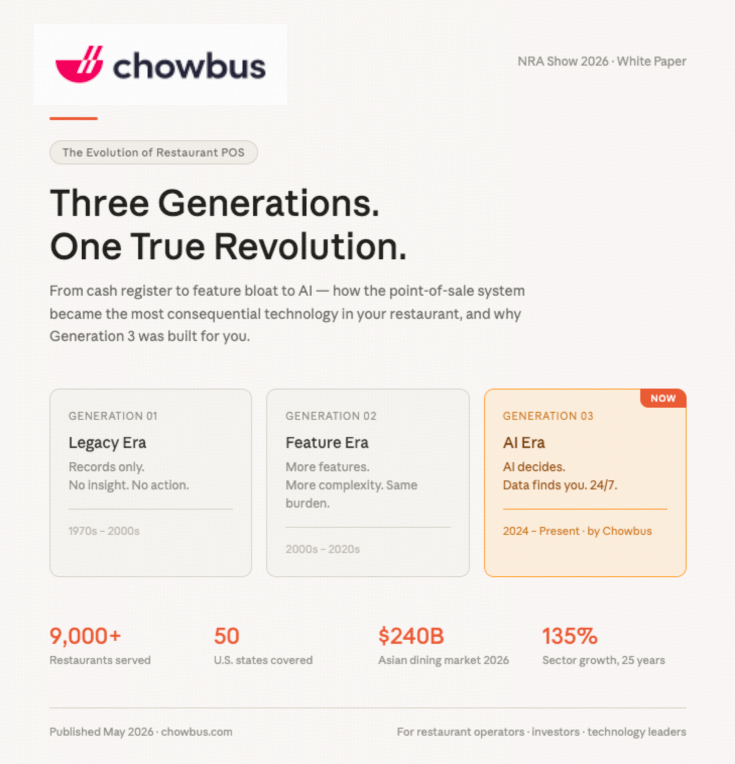
Generation 1 — the Legacy Era — asked the POS to record what happened. Generation 2 — the Feature Era — asked the POS to connect more of what happened. Generation 3 — the AI Era, pioneered by Chowbus — asks the POS to decide what should happen next.
This white paper documents the full arc of that evolution: the technological drivers behind each generational shift, the operational failures that exposed each era's limitations, and the emerging capabilities that define the AI-native restaurant operating system. It is written for restaurant operators, industry investors, and technology leaders who need to understand not just where restaurant technology stands today, but where it is irreversibly headed.
The Asian restaurant sector — projected to reach $240 billion by end of 2026, having grown 135% over the past 25 years — sits at the center of this transformation.¹ It is a sector that has been systematically underserved by two generations of POS technology built for a different kind of restaurant. The third generation was built for them.
¹ National Restaurant Association, State of the Restaurant Industry 2025; IBISWorld, Asian Restaurants in the US, 2025.
Walk into any high-performing restaurant today and the technology stack looks radically different from what it did ten years ago. QR codes have replaced paper menus in thousands of dining rooms. Kitchen display systems have replaced handwritten tickets. Customer data flows from online ordering platforms into loyalty programs, from loyalty programs into marketing automation, from marketing automation back into the guest experience.
But here is the paradox: despite this proliferation of tools, most restaurant operators report feeling more overwhelmed, not less. Labor costs continue to rise — the U.S. restaurant industry faces an estimated average employee turnover rate of 74.9% annually, a structural challenge that predates and will outlast any single economic cycle.² Food and beverage costs remain volatile, squeezed by supply chain disruptions that have persisted since 2020. Third-party delivery platforms, which now account for a significant share of off-premise revenue, charge commissions averaging 25–30% per transaction — a margin structure that makes delivery profitable for the platform, not the restaurant.³
The POS system sits at the center of all of this. It is the single piece of technology through which every transaction flows, every table is managed, every kitchen ticket is fired, and — increasingly — every marketing decision is made. Getting the POS right has never been more consequential. Getting it wrong has never been more expensive.
² Bureau of Labor Statistics, Job Openings and Labor Turnover Survey, 2024; National Restaurant Association, 2024 Workforce Report. ³ Bloomberg Second Measure, Restaurant Delivery Platform Commission Analysis, 2024; Gordon Haskett Research Advisors, 2024.
The story of the modern restaurant POS begins not with software, but with electromechanical engineering. The first dedicated restaurant cash registers — systems capable of itemizing orders and calculating totals automatically — emerged in the mid-1970s alongside the broader commercial deployment of electronic cash registers (ECRs).
The landmark moment came in 1973, when McDonald's partnered with engineers to develop the first microprocessor-controlled cash register designed specifically for quick-service restaurant environments.⁴ The device was revolutionary not because it was sophisticated, but because it was specialized — a machine built to do one thing in a restaurant context, and to do it reliably. It printed receipts. It tracked transaction totals. It organized sales by category. For the era, this was transformational.
By the mid-1980s, IBM had entered the restaurant technology space with its own POS hardware, bringing mainframe-derived reliability to hospitality environments. Dedicated POS terminals from companies like NCR and Micros Systems (later acquired by Oracle) followed, establishing the hardware-first paradigm that would define POS infrastructure for the next three decades: proprietary terminals, closed architectures, and on-premise servers as the backbone of the system.⁵
⁴ Schindler, E. (2010). The History of the POS System. CIO Magazine. ⁵ MICROS Systems corporate history; Oracle Hospitality acquisition documentation, 2014.
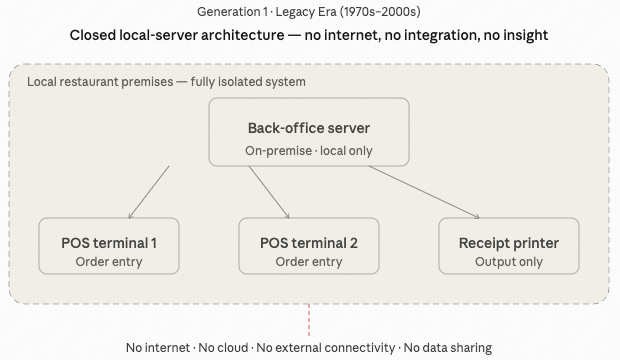
Generation 1 POS systems shared a consistent architectural profile regardless of manufacturer or era. They were built around a local server — often a physical machine installed in the restaurant's back office — that stored all transaction data locally. Terminals communicated with this server over a closed local area network (LAN), and the system was explicitly designed to operate without any internet connectivity. This was a feature, not a limitation: in an era when internet connectivity was expensive, unreliable, and largely irrelevant to restaurant operations, local processing was the rational design choice.
The user interface reflected the operational logic of the time. Generation 1 systems were optimized for speed at the point of transaction: large buttons, minimal navigation, workflows designed for order-taking in a noisy, high-pressure environment. The trade-off was inflexibility. Changing a menu item required a technician visit. Adjusting pricing required accessing the back-office server. Generating a sales report meant physically printing it or manually transcribing data from a terminal.
What Generation 1 did well:
What Generation 1 could not do:
For the majority of independent restaurants operating in the 1980s and 1990s, these limitations were acceptable — not because operators did not want more capability, but because no alternative existed at a reasonable cost. The enterprise restaurant chains that could afford sophisticated technology built proprietary systems. Everyone else ran a cash register.
The Generation 1 era was particularly challenging for Asian restaurant operators, for reasons that go beyond technological capability. The hardware and software of the era were designed around Western dining conventions: fixed menu items with simple modifiers, single-language interfaces, tipping workflows calibrated to American service customs.
Chinese, Japanese, and Korean restaurant operations — with their complex modifier systems, rotating seasonal menus, table-sharing customs, and multilingual staff — were forced to adapt their operations to fit the technology, rather than the reverse. This was an early instance of a structural mismatch that would persist through all three generations and only begin to be corrected in the third.
The consequence was not merely inconvenience. It translated into measurable operational friction: longer order entry times, higher error rates on complex customizations, and the persistent risk of a miscommunicated order reaching the kitchen — or, worse, reaching the table — in a format the customer had not requested.
The transition from Generation 1 to Generation 2 was not a single event. It was a decade-long migration driven by two converging forces: the commoditization of broadband internet access, which made always-on connectivity economically viable for small businesses, and the emergence of cloud computing infrastructure that made it possible to deliver software as a service rather than as installed, on-premise hardware.
The pivotal moment came in 2009–2010, when a new generation of POS companies — including Square, which launched its card reader product in 2009, and Toast, which was founded in 2012 — began building restaurant technology on cloud infrastructure from the ground up.⁶ These companies recognized that if a POS system could communicate with a remote server over the internet, it could do things that were impossible in the closed, local-server architecture of Generation 1: real-time reporting accessible from any device, automatic software updates, remote configuration, and — critically — integration with other software systems.
⁶ Square Inc. corporate history; Toast Inc. founding documentation; Crunchbase funding data.
The defining characteristic of Generation 2 was the proliferation of features. Starting from a baseline of transaction recording and basic reporting, the leading POS platforms of the 2010s rapidly expanded their capability surface across multiple dimensions:
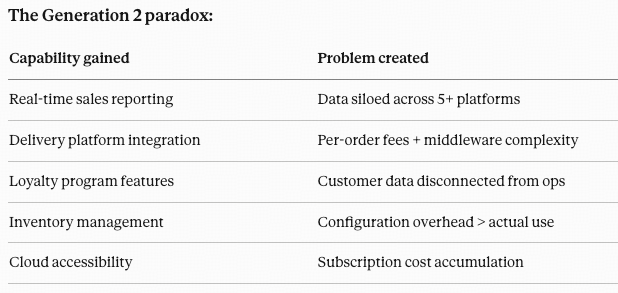
Online ordering integration. As delivery platforms including Grubhub (founded 2004), DoorDash (founded 2013), and Uber Eats (launched 2014) grew to represent a significant share of restaurant revenue, POS systems were forced to integrate with these platforms to avoid the operational chaos of managing parallel order streams.⁷ By the late 2010s, a well-equipped restaurant might be receiving orders from a POS terminal, a kiosk, a first-party website, and three or four third-party delivery platforms simultaneously — with each order needing to flow into the same kitchen.
Inventory management. Generation 2 systems introduced the concept of inventory tracking within the POS, linking menu item sales to ingredient consumption and generating alerts when stock levels dropped below defined thresholds. For chains with complex supply chains, this was transformative. For independent operators, it added a configuration burden that often went underutilized.
Customer relationship management. Loyalty programs, email marketing integration, and customer data collection became standard POS features during this era. The foundational insight — that a restaurant could build a direct relationship with its customers if it could identify them and communicate with them — was correct. The execution was often clumsy, hampered by technical complexity and the challenge of integrating loyalty data with broader marketing systems.
Table management and floor planning. Digital table maps, waitlist management, and reservation integration became standard in full-service restaurant POS systems, replacing the paper diagrams and physical boards that had served the same function in Generation 1.
Analytics and reporting. The shift to cloud infrastructure made it possible to generate detailed operational reports — sales by hour, item, server, and location — and to access these reports in real time from any connected device. This was a genuine leap forward in operational visibility.
⁷ Second Measure, Delivery Platform Market Share, 2024; National Restaurant Association Digital Ordering Study, 2023.
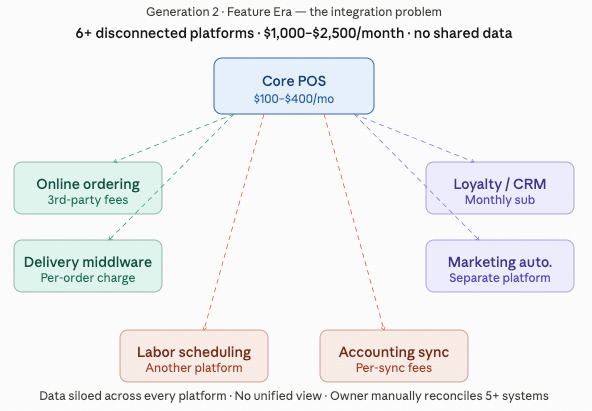
The expansion of Generation 2 capabilities solved one set of problems and created another. As POS platforms accumulated features, they also accumulated complexity. By the early 2020s, the average full-service restaurant was managing a technology stack that included:
The total monthly technology spend for a mid-size independent restaurant — before any per-transaction fees or hardware amortization — could easily reach $1,000–$2,000. More significantly, none of these systems shared a common data model. Sales data lived in the POS. Customer data lived in the loyalty system. Marketing performance data lived in the advertising platform. Employee data lived in the scheduling tool. The restaurant owner who wanted to understand the full economics of their business needed to manually reconcile data across four or five platforms — assuming they had the time and the technical literacy to do so, which most did not.
This is the central failure of Generation 2: it solved the feature problem while creating the integration problem. Restaurants had more tools than ever before and less operational clarity than the tools promised.
For Asian restaurant operators, Generation 2 delivered a further, compounding disadvantage. The major POS platforms of this era — Toast, Square, Clover, Lightspeed — were built for the median American restaurant: a single-concept, English-language operation with a relatively standardized menu and a relatively standard service model.
The operational requirements of Asian restaurants diverge from this median in multiple dimensions:
Menu complexity. A typical Chinese restaurant menu may have 150–300 items across multiple categories, with extensive modifier options — spice level, cooking method, portion size, protein substitution — many of which are described in Chinese and have no accurate or natural English translation. Entering and maintaining this menu in a system designed for a 60-item American casual dining restaurant creates ongoing operational friction.
All-you-can-eat and hot pot management. AYCE restaurants and hot pot establishments operate under business rules — per-person pricing, time-limited seatings, ingredient replenishment tracking, and the management of shared-table cooking equipment — that simply do not exist in Western dining formats. Generation 2 POS systems had no native support for these workflows. Operators were forced to build workarounds using the POS's generic modifier and pricing systems, creating fragile configurations that broke whenever the platform released a software update.
Multilingual staff operations. In many Asian restaurants, kitchen staff communicate primarily in Mandarin, Cantonese, Korean, or Japanese. A kitchen display system that shows orders only in English creates a meaningful friction point — not a catastrophic one, but a persistent source of minor errors that compound over thousands of service interactions.
Support access. When a technical problem occurred during a dinner service, the ability to reach a support representative who could understand the restaurant's operational context — and communicate with the owner in their native language — was not a luxury. It was an operational necessity. Generation 2 support models were built for English-speaking operators and offered no accommodation for the linguistic reality of the Asian restaurant sector.
Before examining Generation 3, it is important to understand the precise nature of the gap that persisted across both prior eras. This gap has three dimensions: data, decision-making, and cultural alignment.
Both Generation 1 and Generation 2 POS systems are, at their core, data-recording systems. They capture what happened: a transaction occurred, an item was sold, a table was occupied, an order was delivered. They do not, in any meaningful sense, analyze what happened or synthesize what is about to happen. The data they generate is backward-looking.
The restaurant industry generates an enormous volume of operationally relevant data in every service period. Sales velocity by item and time window tells an operator what to prep and how much. Table turn times by section tell a manager where service is breaking down. Modifier frequency tells a chef which customizations are most popular and might warrant becoming standard items. Customer ordering history tells a loyalty program which offers are likely to drive repeat visits.
In a Generation 2 system, all of this data exists — but it exists in a form that requires the operator to go looking for it. The POS generates a report. The operator opens the report. The operator interprets the data. The operator decides what to do. The cycle takes time that most restaurant owners do not have during service, and requires analytical skills that were never part of the job description.
The result is that most of the data generated by Generation 2 systems is never actually used to make decisions. It sits in a database, accessible in principle, but operationally inert.
Related to but distinct from the data problem is the decision-making gap. Restaurant operations require dozens of micro-decisions in every service period: Which tables to turn in which order. When to push a fast-moving item before it runs out. How to staff the weekend shift given reservation volume. Whether a marketing promotion drove the dinner traffic spike or a review went viral. Which customers are at risk of churning.
In Generations 1 and 2, all of these decisions were made by humans — specifically, by the owner or manager — based on intuition, experience, and whatever imperfect data they could access in real time. This placed a significant cognitive burden on restaurant leadership that increased in proportion to the restaurant's complexity. As a restaurant added locations, menu items, service formats, and channels, the decision-making burden scaled accordingly. The POS provided no relief.
This is not a criticism of the people who built Generation 1 and 2 systems. The computational tools required to automate decision-support in real time — machine learning models capable of processing operational data at inference speed, natural language interfaces that could surface insights without requiring technical literacy, predictive algorithms trained on restaurant-specific data — simply did not exist at commercial scale until the early 2020s.
They exist now.
The third dimension of the structural gap is the one that is hardest to quantify and easiest to overlook in a technical analysis: the persistent cultural misalignment between POS technology built for the Western restaurant mainstream and the operational, linguistic, and cultural reality of the Asian restaurant sector.
This misalignment is not merely a feature gap that can be addressed by adding a language option to an existing system. It is a design philosophy gap. Systems built for Western restaurants reflect Western dining conventions at every level: menu structure, modifier logic, tipping calculation, receipt formatting, customer data collection consent frameworks, and support interaction models.
Correcting this gap requires not just translation, but reconstruction. A POS system built for the Asian restaurant sector from the ground up will make different default choices at every design decision point: how menus are structured, how modifiers cascade, how kitchen communication is formatted, how customer relationships are managed, and how support is delivered.
This reconstruction is what Generation 3 represents.
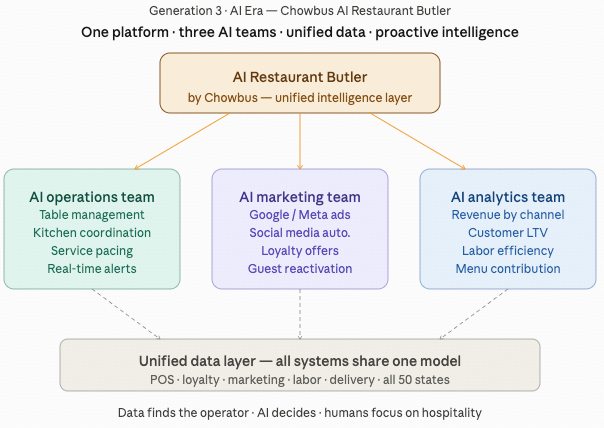
The term "AI-powered" has become so broadly applied in technology marketing that it requires careful definition in the context of restaurant POS systems. Adding a chatbot to a dashboard interface does not make a system AI-native. Training a recommendation model on sales data does not transform a Generation 2 system into a Generation 3 one.
A genuinely AI-native restaurant operating system has the following distinguishing characteristics:
Proactive intelligence. The system surfaces insights and recommendations without being asked. Rather than generating a report that an operator must interpret, it generates an action: "Your top-selling item — Mapo Tofu — is trending toward stockout based on current reservation volume. Consider prepping an additional 40 portions." The data finds the operator, rather than the operator finding the data.
Automated decision execution. For a defined class of decisions — marketing spend allocation, menu item promotion sequencing, loyalty offer targeting — the system can execute autonomously within parameters set by the operator. This is the difference between a dashboard that shows advertising performance and a system that adjusts bidding strategy in response to that performance.
Cross-system data synthesis. An AI-native POS integrates not just operationally (passing orders from front-of-house to kitchen) but analytically (synthesizing data across ordering, loyalty, marketing, and labor management to generate a unified view of restaurant economics). This requires a fundamentally different data architecture than Generation 2 systems, which were built around point integrations between siloed platforms.
Natural language accessibility. An AI-native system makes its analytical capabilities accessible to operators who are not data analysts — and, in the context of the Asian restaurant sector, who may be more comfortable in Mandarin, Cantonese, Korean, or Japanese than in English. Natural language interfaces that respond to operational questions in the operator's preferred language are not a convenience feature; they are an accessibility requirement.
Continuous learning. The system improves its recommendations over time based on the outcomes of past decisions. A marketing campaign that underperforms updates the model that generated it. A staffing recommendation that led to a service breakdown is weighted against the next forecast. This feedback loop is what separates a static analytical tool from a genuinely intelligent operating system.
Chowbus was founded in 2016 with a specific mandate: to build restaurant management technology for the Asian restaurant sector in North America, designed from the ground up for the operational, linguistic, and cultural realities of that sector. The company's trajectory — growing to serve 9,000+ restaurants in all 50 U.S. states and Canada, raising $281M in total funding including an $81M round in March 2026, and reaching $120M+ in ARR — reflects the size of the unmet need it identified and the precision with which it has addressed it.⁸
The announcement of Chowbus's AI Restaurant Butler at the NRA Show 2026 represents the company's full articulation of the Generation 3 vision: a restaurant operating system in which artificial intelligence does not augment the operator's decision-making process, but actively participates in it — managing the routine, surfacing the exceptional, and enabling the operator to focus on what human judgment is genuinely required for: hospitality, culture, and culinary creativity.
⁸ PR Newswire, Chowbus Raises $81M Series C, March 2026; Chowbus.com, company data 2026.
The AI Restaurant Butler architecture is organized around three functional AI teams, each addressing a distinct dimension of restaurant operations:
AI Operations Team. This team manages the real-time operational intelligence of the restaurant: table management, kitchen coordination, order routing, and service-pacing recommendations. Its function is to reduce the cognitive burden on floor managers by surfacing the right information at the right time — before a table turn is delayed, before a kitchen backup develops, before a service breakdown occurs. The system operates on a continuous feedback loop, updating its recommendations in response to actual service conditions.
AI Marketing Team. This team manages the restaurant's external communications and customer acquisition activities: Google and Meta advertising, social media content, loyalty program offer targeting, and customer reactivation campaigns. The core capability is automated optimization — the system adjusts advertising bids, creative rotation, and audience targeting in response to real-time performance data, without requiring the operator to manage a marketing dashboard. For independent restaurant operators who lack dedicated marketing staff, this represents a capability previously available only to enterprise restaurant chains with agency support.
AI Analytics Team. This team synthesizes data across all operational and marketing systems to generate the unified economic picture of the restaurant that Generation 2 systems could never provide. Revenue by channel, customer lifetime value by acquisition source, labor efficiency by time period, menu item contribution margin — all presented in a unified interface, updated in real time, and surfaced proactively when significant patterns emerge.
The practical implication of this architecture is that the Chowbus AI Restaurant Butler effectively functions as three specialized employees who work simultaneously, around the clock, without error, and without turnover. In an industry characterized by 74.9% annual staff turnover and persistent labor shortages, this is not a product feature. It is an operational transformation.⁹
⁹ Bureau of Labor Statistics, Job Openings and Labor Turnover Survey, 2024.
One of the most operationally significant — and most frequently underappreciated — capabilities of the Chowbus platform is its native multilingual architecture. The system supports English, Mandarin Chinese, Japanese, Korean, and Spanish across the full interface stack: customer-facing menus, kitchen display systems, management dashboards, and support interactions.
This is not a translation layer applied to an English-language system. It is a multilingual-first design, in which the system was built to operate natively in multiple languages from the outset. The distinction matters because translation layers introduce latency, ambiguity, and gaps — particularly for restaurant-specific terminology that does not have clean equivalents across languages.
For an Asian restaurant operator managing a bilingual or trilingual staff, this means kitchen tickets that communicate accurately to Chinese-speaking cooks, customer-facing menus that represent dishes in the language the customer is most comfortable reading, and management interfaces that can be operated by an owner who is more fluent in Mandarin than in English. The 24/7 bilingual support team — reachable in English, Mandarin, and Spanish — extends this capability to the support interaction that is often most critical: the one that happens at 7 PM on a Saturday when something breaks.
The Chowbus platform includes native support for all-you-can-eat (AYCE) and hot pot restaurant operational formats — a capability that reflects the degree to which the system was designed specifically for the Asian restaurant sector rather than adapted from a general-purpose platform.
AYCE and hot pot operations present POS challenges that have no equivalent in Western dining formats:
In a Generation 2 system, these requirements forced operators to build complex workarounds using generic modifier and pricing tools — configurations that were fragile, difficult to maintain, and frequently broken by software updates from a platform vendor who did not understand why the configuration existed. In the Chowbus platform, these are native features, designed and tested against the actual operational requirements of AYCE and hot pot restaurants.
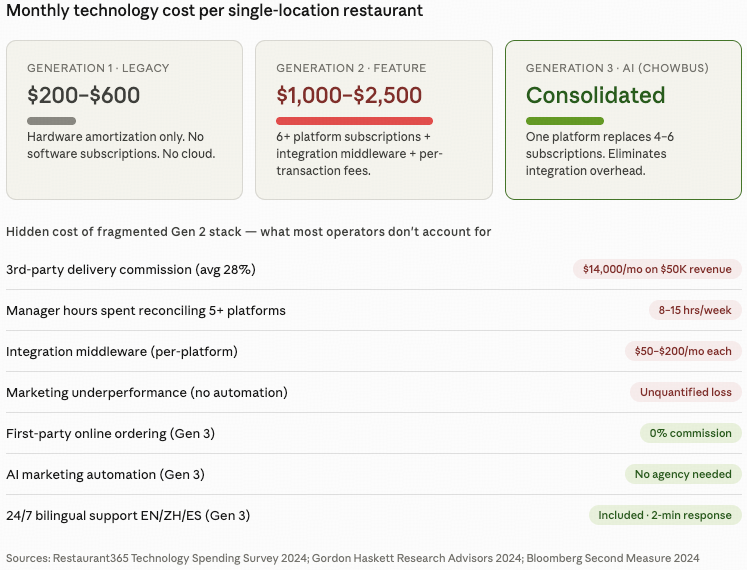
The decision to move from Generation 2 to Generation 3 is not primarily a technology decision. It is an economics decision. The relevant question is not "what does the new system cost?" but "what does the current system cost?"
For a typical Asian restaurant currently running a fragmented Generation 2 stack, the costs are distributed across multiple categories:
Direct technology spend. The aggregate cost of maintaining separate subscriptions for POS software, online ordering, loyalty, marketing automation, labor scheduling, and accounting integration typically runs $1,000–$2,500 per month for a single-location operator. For a multi-location group, these costs scale with location count and the overhead of maintaining separate vendor relationships for each.¹⁰
Labor allocated to system management. In a fragmented technology stack, a meaningful amount of management time is consumed by the work of reconciling data across systems, troubleshooting integration failures, and training staff on multiple platforms. This is labor that is not available for hospitality, training, or strategic operations.
Third-party delivery commissions. At 25–30% per transaction, the commission structure of major delivery platforms represents one of the largest margin pressures facing independent restaurants. A restaurant that generates $50,000 per month in delivery revenue at a 28% average commission rate is paying $14,000 per month to platforms — before any other cost. First-party online ordering, integrated natively into a platform like Chowbus, eliminates the delivery commission on orders placed directly with the restaurant and captured through its own ordering channels.¹¹
Opportunity cost of data not used. The most significant economic cost of running a Generation 2 system is the hardest to measure: the value of decisions not optimized because the data required to optimize them was inaccessible or incomprehensible. A marketing campaign that runs at suboptimal audience targeting because no one has time to manage the dashboard. A staffing schedule that doesn't reflect the actual demand pattern because the reporting is too complex to consult weekly. A loyalty program that doesn't drive repeat visits because the customer segmentation hasn't been updated in six months.
¹⁰ Restaurant365, Restaurant Technology Spending Survey, 2024; Hospitality Technology, 2024 POS Software Trend Report. ¹¹ Gordon Haskett Research Advisors, Restaurant Delivery Economics, 2024; Bloomberg Second Measure, 2024.
Quantifying the return on a platform transition requires accounting for both cost reduction and revenue enablement. For a restaurant moving from a fragmented Generation 2 stack to the Chowbus platform, the economic case typically has three components:
Technology consolidation savings. Replacing 4–6 separate platform subscriptions with a single integrated platform eliminates not just redundant subscription costs, but the integration overhead — third-party middleware, manual data reconciliation, and the IT support burden — that comes with maintaining a fragmented stack.
Labor efficiency gains. AI-driven operations management can meaningfully reduce the labor required to run the same volume of covers: optimized table management increases seat utilization, automated kitchen coordination reduces ticket time variance, and predictive staffing models reduce overstaffing costs during slow periods while preventing understaffing during peak volume.
Revenue enablement. AI-driven marketing automation enables the kind of consistent, optimized customer acquisition and retention effort that previously required dedicated marketing staff. For an independent operator who has never had the capacity to run a systematic loyalty or reactivation program, this represents genuine revenue upside — customers who would otherwise have lapsed, re-engaged; customers who would otherwise have discovered the restaurant through a delivery platform at a 28% commission, acquired through first-party channels at zero commission.
The AI Era is not a destination. It is an infrastructure layer on which further capability will accumulate. The operators who build their restaurant on Generation 3 infrastructure now are the ones who will be positioned to access the capabilities that come next.
Several technology trends will shape the evolution of AI-native restaurant operating systems over the next 3–5 years:
Ambient intelligence. The integration of computer vision and IoT sensor technology will enable POS systems to observe the physical state of the restaurant in real time — table occupancy, queue length, kitchen workflow — and incorporate this observational data into operational recommendations without any human data entry. The camera becomes the input device; the AI becomes the analyst.
Hyper-personalized guest experiences. As customer data accumulates within a unified platform, AI systems will become capable of delivering genuinely individualized guest experiences at scale: a returning customer's preferred table automatically held, their usual modifications pre-loaded into the ordering interface, a loyalty offer calibrated to their specific ordering history. This is the difference between a loyalty program that offers everyone the same discount and an operating system that remembers every guest.
Predictive supply chain integration. The integration of POS demand data with supplier ordering systems will enable predictive procurement — an AI system that forecasts ingredient needs based on reservation volume, historical sales patterns, and seasonal trends, and places supplier orders automatically before stockouts can occur.
Cross-restaurant network intelligence. As AI-native platforms scale across thousands of restaurant locations, the aggregate data generated by the network becomes a strategic asset: sector-wide demand trends, ingredient price signal leading indicators, and competitive positioning data that no single restaurant could generate independently. The platform that serves the most restaurants learns the most from the aggregate — a compounding competitive advantage for operators on the leading platform.
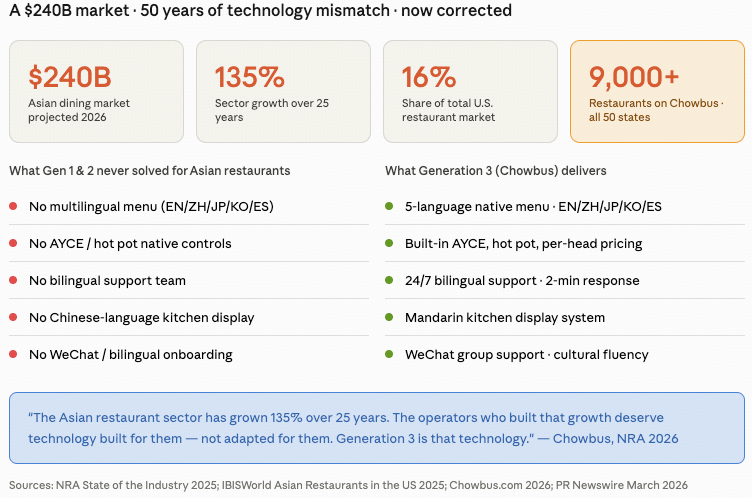
The Asian restaurant sector is uniquely positioned to benefit from the transition to Generation 3, for reasons that are structural rather than incidental.
The sector has been systematically underserved by two generations of POS technology. The Generation 1 systems were designed for Western dining formats. The Generation 2 systems extended those designs with additional features, but did not fundamentally rethink the design assumptions. The result was a persistent mismatch between the technology available and the technology required — a mismatch that manifested as operational friction, lost revenue, and the accumulated cost of running workarounds.
The $240 billion Asian restaurant market projected for end of 2026 — generated by a sector that has grown 135% over the past 25 years — represents both the scale of the opportunity and the scale of the underservice.¹² Operators in this sector have been growing despite their technology, not because of it. Generation 3, designed specifically for them, changes the equation.
The implications extend beyond individual restaurant economics. As the Asian restaurant sector continues to grow — in size, geographic distribution, and operational complexity — the technology infrastructure that supports it will become increasingly consequential for the sector's competitive position in the broader U.S. restaurant market. Operators who transition to Generation 3 infrastructure will gain efficiency, marketing, and customer relationship advantages that will compound over time. Those who remain on Generation 1 or 2 infrastructure will face an accelerating competitive disadvantage.
¹² National Restaurant Association, State of the Restaurant Industry 2025; IBISWorld, 2025.
The three-generation arc of restaurant POS technology is not simply a story about software features or hardware improvements. It is a story about what we believe a restaurant management system is supposed to do.
Generation 1 believed the POS should record. Generation 2 believed the POS should connect. Generation 3 — the era we are entering now, and that Chowbus is helping to define — believes the POS should decide: proactively, intelligently, and in service of the operator's time, attention, and profitability.
For the Asian restaurant sector specifically, this generational transition represents something larger than a technology upgrade. It represents the first time in the sector's history that the dominant restaurant management technology was built for them — in their languages, for their formats, by a team that understands their operational reality from the inside. The 9,000+ restaurants currently operating on the Chowbus platform are the early evidence of what that alignment produces.
The operators who recognize this moment and act on it will enter the next decade of Asian restaurant growth with a structural advantage: a platform that learns from their operations, amplifies their marketing, and frees them to do what no algorithm can replace — create the hospitality and culinary experiences that make a restaurant worth going back to.
The cash register recorded the sale. The feature-packed POS reported it. The AI Restaurant Butler is what comes next: a platform that works while you cook.
Q1: What is the fundamental difference between a Generation 2 and a Generation 3 POS system? A: Generation 2 systems collect and display data; Generation 3 systems act on it. In a Generation 2 system, the operator must access reports, interpret findings, and make decisions manually. In a Generation 3 system like Chowbus, the AI proactively surfaces insights, generates recommendations, and — for a defined class of routine decisions — executes automatically. The practical result is that the system reduces the cognitive and administrative burden on restaurant owners and managers, freeing them to focus on hospitality and operations rather than data reconciliation.
Q2: How does an AI POS system handle the complexity of Asian restaurant menus? A: An AI-native system built for Asian restaurants, such as Chowbus, maintains multilingual menu databases natively — supporting English, Mandarin Chinese, Japanese, Korean, and Spanish — with modifier structures designed for the complexity of Asian culinary formats: spice-level cascades, protein substitution matrices, portion-size variants, and the rotating seasonal menu structures common in Chinese and Japanese restaurants. The system's AI layer can surface menu optimization recommendations — items trending toward high-margin upsell opportunities, items underperforming relative to similar items in the broader restaurant category — based on aggregated ordering data.
Q3: What is the total cost comparison between a fragmented Generation 2 stack and a Generation 3 platform like Chowbus? A: A fragmented Generation 2 stack — comprising a core POS, online ordering platform, loyalty program, marketing automation, and labor scheduling tool — typically costs $1,000–$2,500 per month for a single-location operator, before hardware amortization and per-transaction fees. A consolidated Generation 3 platform eliminates the majority of these redundant subscriptions, reduces the labor allocated to system management, and enables first-party online ordering that can reduce or eliminate third-party delivery commissions on a portion of delivery revenue. The economic case for transition typically becomes compelling within the first 6–12 months of operation on a consolidated platform.
Q4: What support does Chowbus provide for operators transitioning from an existing POS system? A: Chowbus offers 24/7 bilingual support in English, Mandarin, and Spanish, with an average response time of 2 minutes and a 95% first-contact issue resolution rate. Menu migration from existing platforms, staff training, and hardware setup support are included in the onboarding process. The company's support team includes personnel who are operationally fluent in Asian restaurant formats — AYCE management, hot pot configurations, multilingual kitchen display setup — and who can troubleshoot issues in the language the operator is most comfortable using.
Q5: Is a Generation 3 AI POS appropriate for a single-location independent restaurant, or is it designed primarily for restaurant groups? A: The economic and operational case for a Generation 3 platform is strong for single-location independent restaurants, and in some ways stronger than for restaurant groups. Independent operators are disproportionately burdened by the administrative and analytical work that a fragmented technology stack imposes, because they lack the management overhead to distribute that work. An AI-native platform that automates marketing optimization, synthesizes operational data, and surfaces actionable recommendations effectively gives a single-location independent operator the analytical capability of a larger organization's management team — at a cost that is comparable to, or less than, the fragmented stack it replaces.
Q6: What should a restaurant owner look for when evaluating whether a POS system is genuinely AI-native versus simply AI-marketed? A: Three questions cut through the marketing noise. First: does the system surface insights proactively, or does it require the operator to go looking for them? Second: can the system execute routine decisions — marketing spend allocation, loyalty offer targeting, staffing recommendations — autonomously, or does it only display data for human review? Third: does the AI capability improve over time based on the restaurant's own data, or is it a static feature set? A genuinely AI-native system answers yes to all three. A Generation 2 system with an AI label typically answers no.

%20(1)%20(1).png)