How the way you assemble your restaurant technology — not just which tools you pick — decides your total cost, your data, and your ability to grow.
A Chowbus Whitepaper · 2026
Most restaurant owners think the technology decision is "which POS should I buy?" The more consequential question is "should I run one connected platform, or stitch together separate best-of-breed tools?" That single architectural choice shapes your total cost of ownership, who owns your customer data, how much of your week disappears into reconciliation and vendor management, and how easily you can grow.
The core finding of this whitepaper: for the typical owner-operated restaurant — especially Asian restaurants running 1–10 locations with limited IT support — an all-in-one platform usually wins on total cost of ownership, data ownership, and operational simplicity, while best-of-breed makes sense mainly when a single specialized capability is so central to the business that no integrated suite can match it. The reason is not that any individual best-of-breed tool is worse; it's that assembling several of them creates costs that never appear on a single invoice: the integration tax, data silos, reconciliation labor, multiplied subscriptions, and the "who do I even call?" problem when something breaks at peak.
Three arguments run through the pages that follow. First, best-of-breed has a hidden cost structure — the sticker price of each tool understates the real total once you add the work of connecting them, the errors when they don't sync, and the operational drag of managing four vendors. Second, all-in-one wins on the dimensions owner-operators actually live with — one source of truth across counter, online, kiosk, and delivery; one bill; one support line; faster onboarding; and customer data that compounds instead of fragmenting. Third, integration matters even more for Asian restaurants, where multilingual menus and kitchen tickets, AYCE and hot pot controls, family-style checks, a heavy delivery mix, and bilingual support are not edge cases but daily requirements that disconnected tools handle poorly.
This is not a one-sided argument. There are real situations where best-of-breed is the right call, and real risks to all-in-one — vendor lock-in, the chance that a bundled feature is weaker than a specialist's. We lay those out honestly in Chapter 4, and give you a total-cost-of-ownership framework (Chapter 5) and an evaluation rubric (Chapter 7) so you can decide based on your own numbers rather than a vendor's pitch.
The practical takeaway for most operators: evaluate the total cost and operational reality of each path, not the monthly sticker price of individual tools; weight data ownership and integration heavily, because they compound over years; and for Asian restaurants, treat multilingual operation, format-specific controls, and bilingual support as requirements, not nice-to-haves. Read on for the full breakdown — or skip to Chapter 7 for the decision rubric you can take into any vendor demo.
Before comparing costs, it helps to define the two approaches precisely, because the terms get used loosely.
Best-of-breed means assembling your restaurant technology from separate, specialized products — picking the "best" tool in each category and connecting them. In practice that often looks like one company's point-of-sale, a different company's online ordering, a third party's loyalty program, a separate reservation or waitlist tool, a standalone kitchen display, and one or more delivery-integration middleware products, all wired together (or not) through integrations. The appeal is obvious: each tool is chosen for being excellent at its one job.
All-in-one means running most or all of those capabilities on a single connected platform from one provider. The point-of-sale, online ordering, loyalty, kitchen display, QR ordering, self-ordering kiosks, and delivery integration all share one menu, one customer record, and one source of truth. The appeal here is coherence: the parts are built to work together.
The distinction matters because it's not really about features — it's about architecture. A best-of-breed stack is a set of independent systems that must be made to communicate; an all-in-one platform is one system with many functions. Everything downstream — cost, data, reliability, support, your time — flows from that structural difference.
Owners often spend their evaluation energy comparing brand names — this POS versus that POS — and far less on the architecture question. That's backwards. Two restaurants can run the same brand of POS and have completely different outcomes depending on whether they bolted three other tools onto it or ran everything on one platform. The brand decision determines the quality of one tool; the architecture decision determines how the whole operation behaves: whether a price change propagates everywhere instantly or has to be entered four times, whether a customer who orders online shows up in your loyalty data, whether an 86'd item disappears from every channel at once, and whether a problem at Friday dinner means one phone call or four.
Few real restaurants are purely one or the other. Even "all-in-one" platforms integrate with some outside services (payment networks, accounting, certain delivery marketplaces), and even committed best-of-breed operators consolidate some functions. The question is not absolute purity but center of gravity: is your stack designed to be one connected system with a few external integrations, or a collection of independent tools you're responsible for holding together? This whitepaper is about that center of gravity — and why, for most owner-operated restaurants, pulling it toward "one connected system" is the higher-leverage choice. The chapters ahead quantify why.
Most best-of-breed stacks were never chosen; they accumulated. Understanding how that happens explains why so many restaurants end up in an architecture they wouldn't pick on purpose — and why stepping back to decide deliberately is valuable.
A typical story: an owner opens with a basic POS because that's what the sales rep showed them. A year later, online ordering matters, so they add a separate online-ordering product — it was easy to sign up and the POS didn't do it well. Then a third-party delivery app brings volume, so a delivery-integration tool gets bolted on to stop the tablet chaos. A consultant suggests loyalty, so a loyalty app joins. Reservations get busy, so a reservation tool appears. At no point did the owner decide to build a six-tool best-of-breed stack; each addition was a sensible, local response to a real need. But the cumulative result is an architecture no one designed, held together by integrations no one owns, generating reconciliation work no one budgeted for. The stack is the sum of a dozen reasonable small decisions that added up to an unreasonable whole.
Once assembled, the accidental stack resists change for understandable reasons. Each tool holds some data and some workflow the team has learned, so replacing any one feels disruptive. The integrations, however fragile, currently work, and "if it isn't completely broken" discourages action. And the true cost is hidden — spread across invoices, buried in the owner's hours, and showing up as errors no one traces back to architecture — so the pain rarely presents as a clear, urgent problem with an obvious cause. The result is inertia: a stack that's quietly expensive but never quite painful enough on any single day to force a rethink, even as the cumulative drag grows.
The argument of this whitepaper isn't that every accidental stack is a disaster — it's that an architecture worth running is worth choosing on purpose. When you step back and evaluate the whole rather than adding the next tool reactively, you can compare the true total cost, weigh data ownership and integration, and decide whether the center of gravity should be one connected platform or a maintained collection of tools. That deliberate step — done at a natural decision point like opening a location, hitting a scaling wall, or a contract renewal — is how operators escape the accidental stack and choose an architecture that actually serves the business. The rest of this whitepaper is the toolkit for making that deliberate decision well.
The case for best-of-breed rests on a reasonable premise: pick the best tool for each job and you get the best of everything. The problem is that the costs of assembling those tools are real, recurring, and largely invisible on any single invoice. This chapter makes them visible.
The first hidden cost is integration itself. Separate tools only deliver on their promise if they're connected — your online ordering has to push orders into your POS, your loyalty program has to recognize customers across channels, your delivery middleware has to sync menus and 86s. Those connections are never free. Sometimes you pay for them directly (integration fees, middleware subscriptions); sometimes you pay in setup time and ongoing maintenance; and sometimes you pay in the gaps where two tools almost connect but not quite, leaving a manual step a human has to perform every shift. Every integration is also a point of failure: when one vendor changes an API or has an outage, the connection can break, and you're the one who discovers it mid-service. This is the integration tax — and it scales with the number of tools you stitch together.
The second hidden cost is data fragmentation. When your sales live in one system, your online orders in another, your loyalty in a third, and your reservations in a fourth, you don't have a customer — you have four partial records that don't add up. A regular who orders at the counter, online, and through your loyalty app looks like three different anonymous interactions instead of one valuable, identifiable customer. This quietly caps your ability to market, because every campaign that works on existing customers requires data you can't assemble. It also makes reporting unreliable: reconciling four systems into one picture of the business is slow, error-prone, and often simply doesn't happen, so owners fly partly blind on their most important decisions.
The third hidden cost is the labor of holding the stack together. Somebody — often the owner — spends time every week reconciling reports across systems, checking that online orders matched what the POS recorded, updating the same menu in multiple places, and chasing down discrepancies. This labor doesn't show up as a line item, but it's real: hours that could go to running the restaurant instead go to being the unpaid systems integrator for a stack of tools that won't talk to each other. For an owner-operator without an IT team, this is one of the most underestimated costs of best-of-breed.
The fourth hidden cost is straightforward but easy to underestimate: every tool has its own monthly fee, its own payment-processing arrangement, its own price increases, and often its own per-order or add-on charges. Four "reasonable" monthly fees add up to an unreasonable total, and because they arrive on separate invoices, the full number is rarely seen in one place. Worse, each tool's pricing can change independently, so your costs creep upward on a schedule you don't control. An all-in-one platform doesn't magically make software free, but it consolidates these into one relationship with one predictable cost — which is far easier to manage and forecast.
The fifth hidden cost appears at the worst possible moment. When something breaks at Friday dinner — online orders aren't reaching the kitchen, the loyalty app won't recognize a member, payments are failing — a best-of-breed operator faces a diagnosis problem before they can even get help: which of the four vendors is responsible? Each may point at the others. The integration sits between them, owned by no one. With a single platform, there's one number to call and one party accountable for the whole flow. The cost of the best-of-breed model here isn't just the downtime; it's the finger-pointing while your dinner rush burns.
Of the five hidden costs, error and rework is the one operators find hardest to picture, so it's worth making concrete. When two tools don't sync perfectly, the failures are specific and recurring: an item 86'd on the POS still sells online, so you either disappoint a customer or scramble a substitute; an order misroutes during a connection hiccup and gets remade; a price updated in one tool but not another means you undercharge (lost margin) or overcharge (a refund and an unhappy guest); a loyalty reward double-applies or doesn't apply, costing either money or goodwill. Each instance is small, which is exactly why it's ignored — but they recur every week, and they carry a tail of comps, refunds, wasted food, and eroded trust that never gets traced back to its real cause: the seam between two tools. On an integrated platform these particular failures largely can't happen, because there's no seam for them to occur in. The error cost isn't a one-time risk; it's a steady tax on a stack that doesn't share one source of truth, and over a year it adds up to a number worth putting in the comparison.
Put together, these five hidden costs — integration, data fragmentation, reconciliation labor, multiplied subscriptions, and fractured support — mean the true cost of a best-of-breed stack is consistently higher than the sum of the sticker prices suggests. This is the central insight owners miss: you're not just buying tools, you're taking on the lifelong job of connecting and maintaining them. Chapter 5 turns this into a concrete framework you can use to calculate the real number for your own restaurant. But the headline is simple: compare total cost of ownership, not monthly stickers, and best-of-breed's apparent savings often disappear.
If Chapter 2 explained what best-of-breed costs you, this chapter explains what an all-in-one platform gives back. The benefits are the mirror image of those hidden costs — and they compound over time.
The foundational advantage is that everything runs on one shared data model. Your menu exists once, and the counter, QR ordering, kiosk, online ordering, and delivery channels all read from it. Change a price, add a special, or 86 a sold-out item, and it updates everywhere at once — no re-entering the same change in four places, no channel showing stale information, no customer ordering something you can't make. That single source of truth eliminates an entire category of daily errors and the labor of preventing them. It's the difference between managing one menu and managing four copies that drift apart.
In an all-in-one platform, the customer who orders at the counter, online, and through loyalty is one identifiable person with one history — not three fragmented records. That connected customer view is what makes marketing possible: you can see who your regulars are, recognize them across every channel, and reach them directly with offers that actually land. Over a year, owning a unified customer record is one of the most valuable assets a restaurant can build, and it's something a fragmented best-of-breed stack structurally cannot produce. The data doesn't just exist; it compounds, because every order through any channel enriches the same profile.
Consolidating onto one platform means one relationship, one invoice, and one cost to forecast — instead of a sprawl of subscriptions that creep upward independently. This isn't only about saving money (though eliminating duplicate fees and integration costs usually does); it's about predictability and the time you get back from not managing a portfolio of vendors. For an owner-operator, a single, understandable bill is a real operational simplification, not just a financial one.
When everything is one system, a problem at peak means one phone call to one provider who owns the entire flow — no diagnosing which of four vendors is responsible while the dinner rush builds. Accountability is undivided. For Asian restaurants, this is amplified when that support is available 24/7 and bilingual: a problem described in the language you actually operate in, to a party responsible for the whole platform, gets resolved faster than a problem bounced between vendors who each blame the others.
All-in-one platforms are also dramatically faster to launch and run, because there's nothing to integrate. One configuration sets up the menu across every channel; staff learn one system instead of four; and there's no integration project standing between you and going live. The day-to-day operation is calmer too — fewer moving parts means fewer things that can break, fewer handoffs between systems, and fewer "the systems aren't talking again" moments. For a new restaurant or a small team, this simplicity is not a minor convenience; it's the difference between technology that helps and technology that becomes a second job.
The abstract benefits become concrete in a single service. Picture a busy dinner on each setup. On the best-of-breed stack, a popular dish sells out; a staffer 86's it on the POS but forgets the online-ordering tool, so three online orders come in for a dish that's gone, and now someone's calling customers to apologize. A regular orders online, but because loyalty is a separate app, their points don't accrue and they ask why at the counter. The manager wants to know how the night went but has to wait until they can export and merge reports from three systems tomorrow. A delivery order misfires because the middleware hiccuped, and the team isn't sure whether to blame the POS, the delivery app, or the integration. None of these is catastrophic alone, but together they're a night of friction, apologies, and lost trust — and they recur.
On the integrated platform, the same dinner runs differently. The 86'd dish disappears from the counter, online, QR, and kiosk simultaneously, so no one orders what's gone. The online regular is recognized and their points accrue automatically, so the counter interaction is a thank-you, not an apology. The manager sees the whole night — every channel — on one real-time dashboard. The delivery order flows through the same system with no middleware to hiccup. The difference isn't one dramatic feature; it's the accumulation of friction that simply doesn't happen because the parts share one source of truth. Multiply that across every service, and it's the difference between technology that fights you and technology that disappears into the background where it belongs.
The all-in-one advantage is strongest precisely where most Asian restaurants live: owner-operated, 1–10 locations, limited or no dedicated IT, running multiple channels (dine-in, takeout, delivery, online), and needing to grow without adding operational complexity. For these operators, the integrated model turns technology from a stack to manage into a platform that runs — which is the entire point. The next chapter gives the other side its due: where best-of-breed genuinely wins, and what all-in-one's real risks are.
A credible analysis has to argue the other side as well as defenders of it would. Best-of-breed is not a mistake; in specific situations it's the right choice, and all-in-one carries real risks. Here is that case, made fairly.
When one capability is mission-critical and specialized. If a single function is so central to your business that it must be best-in-class — a high-volume catering operation that lives or dies on specialized catering software, or a concept whose entire model depends on a particular reservations platform — then a specialist tool that does that one thing exceptionally may justify the integration burden. When a capability is your competitive edge, "good enough inside a suite" may genuinely not be good enough.
When you have the technical capacity to integrate. Larger groups with dedicated IT or operations staff can absorb the integration tax that crushes an owner-operator. If you have people whose job is to maintain integrations, monitor them, and manage multiple vendors, best-of-breed's biggest hidden cost is one you're equipped to pay — and you gain flexibility in return.
When you need a capability no suite offers. Sometimes the integrated platforms simply don't include something you require. In that case best-of-breed isn't a philosophy, it's a necessity — and the right move is often a hybrid: an all-in-one core for the connected essentials, with one or two specialized tools bolted on where the suite has a genuine gap.
Vendor lock-in. Putting everything on one platform concentrates your dependence on one provider. If that provider raises prices unreasonably, lets quality slip, or fails, you have more at stake than someone with modular tools. This is a real risk, and it's why data portability matters: before committing, confirm you can export your data — sales history, menu, customer and loyalty records — so the platform earns your business with quality rather than holding it hostage.
A bundled feature may be weaker than a specialist's. An all-in-one platform's loyalty module might not have every feature of a dedicated loyalty company's product; its reservations might be simpler than a specialist's. The honest question is whether the integrated version is good enough for your needs — for most restaurants it is, and the integration benefits outweigh the missing edge features, but you should evaluate the specific capabilities you depend on rather than assuming.
One outage affects everything. If the platform goes down, more of your operation is affected at once than if a single modular tool fails. This is why offline resilience and reliability track record matter so much in an all-in-one — a platform that keeps taking orders and payments locally during an outage mitigates this risk, but you should ask about it directly.
The balanced conclusion is not "all-in-one always wins." It's that the right answer depends on who you are. If you have dedicated IT, a mission-critical specialized need, or a capability no suite offers, best-of-breed (or a hybrid) deserves serious consideration. If you're an owner-operator with limited IT, running multiple channels, and wanting to grow without complexity — the profile of most Asian restaurants — the integration benefits and lower total cost of ownership usually make all-in-one the stronger choice. The way to decide is not by philosophy but by the numbers and your own situation, which is exactly what the next chapter equips you to do.
Most POS comparisons stop at the monthly software fee, which is the least useful number for this decision. This chapter gives you a framework to calculate the real total cost of ownership (TCO) of each path, so you can compare like for like.
A complete TCO comparison includes far more than the sticker price. Account for each of these, for both the all-in-one and the best-of-breed path:
• Software fees — every tool's monthly subscription. For best-of-breed, sum all of them; for all-in-one, the single platform fee.
• Payment processing — the effective rate across all channels. Watch for different rates on different tools in a best-of-breed stack.
• Per-order and add-on charges — many tools charge per online order or for "add-on" features. These scale with volume and are easy to overlook.
• Integration costs — middleware subscriptions, integration fees, and setup costs to connect best-of-breed tools. (Largely absent in all-in-one.)
• Hardware — terminals, KDS screens, kiosks, handhelds. Watch for proprietary-hardware lock-in.
• Labor cost of management — the hours spent reconciling systems, updating multiple menus, and managing vendors. Price these at your real hourly cost; for an owner, your time is the business's scarcest resource.
• Error and rework cost — the food, comps, and lost sales caused by systems that don't sync (an 86'd item still selling online, a misrouted order).
• Switching and onboarding cost — the time and disruption to set up and train, now and at any future change.
When owners actually run this, the surprise is usually how much the non-software components matter. The monthly fees might look comparable — or best-of-breed might even look cheaper on software alone — but once you add integration costs, the labor of reconciliation, and the error costs of systems that drift apart, the all-in-one path frequently comes out lower in total. The software sticker is the visible tip; the integration tax, the management labor, and the error costs are the submerged mass that sinks the best-of-breed budget. A framework that only compares stickers will mislead you precisely on the costs that matter most.
You don't need a spreadsheet model to start. Take your real numbers — monthly online order volume, number of channels, the tools you'd need — and for each path, write down all eight components above for a full year. Be honest about the labor line: estimate the hours per week spent holding a best-of-breed stack together and price them at what your time is worth. Then compare the annual totals, not the monthly stickers. For most owner-operated restaurants, this exercise reframes the decision, because it surfaces the costs vendors don't advertise. The point isn't to predetermine the answer — it's to make sure you're deciding on the real number.
Finally, remember that TCO isn't only dollars. The best-of-breed path carries more operational risk (more failure points) and consumes more of your time (more vendors, more reconciliation). For an owner whose scarcest resources are attention and reliability at peak, those non-dollar costs are part of the true total. A platform that costs a little more on paper but gives you back hours and removes failure points can be the lower-cost choice in every sense that matters to running a restaurant. With the framework in hand, the next chapters turn to the factors that tip the decision further for Asian restaurants specifically.
Frameworks are easier to trust when you see them run. This chapter walks through a deliberately concrete example: two versions of the same restaurant, one on a best-of-breed stack and one on an all-in-one platform, compared over a single year. The numbers below are illustrative — they are not a quote, and your real figures will differ — but the structure shows exactly how the hidden costs surface when you do the full calculation rather than comparing monthly stickers. Run the same exercise with your own numbers and the shape of the answer is usually similar.
Picture a single-location Asian restaurant doing meaningful volume across channels: dine-in, takeout, a healthy online-ordering business, some third-party delivery, and a loyalty program it wants to grow. It has no dedicated IT staff; the owner and a manager handle technology between everything else. This is a common profile, and it's the one where the architecture decision bites hardest.
To get "the best tool for each job," this owner assembles: a well-known general POS, a separate online-ordering product, a standalone loyalty app, a reservation/waitlist tool, a third-party delivery-integration middleware, and a separate kitchen-display solution. On paper, each is reasonably priced. The trouble appears when you total the full year across all eight TCO components from Chapter 5.
The software fees are now six separate subscriptions, each modest alone but substantial together. Payment processing runs at different effective rates because online ordering and the POS use different processors, and nobody has reconciled which is cheaper. Per-order and add-on charges apply on the online-ordering tool and the delivery middleware, scaling with the restaurant's growing off-premise volume. Integration costs include the middleware subscription plus the setup time to wire the tools together and the periodic maintenance when one vendor's update breaks a connection. Hardware includes terminals plus a separate KDS screen system. The labor cost of management is the quiet giant: the owner spends an estimated several hours every week updating the menu in multiple places, reconciling online-order totals against the POS, exporting and merging reports to see the whole business, and managing six vendor relationships — hours that, priced at what the owner's time is worth, dwarf any single software fee. The error and rework cost shows up as occasional double-charges, items that sold online after being 86'd in the POS, and mis-routed orders during the connection's flaky moments. And the switching/onboarding cost was high to set up and will be high again at any change, because six tools and their integrations all had to be configured and learned.
When this owner finally totals the year — not the monthly stickers, but every component — the number is meaningfully higher than the six sticker prices implied, and a large share of it is invisible labor and error cost rather than software.
The same restaurant on an integrated platform runs POS, online ordering, loyalty, reservations/waitlist, KDS, and delivery integration on one system. The software is one subscription. Processing is one consistent rate. Per-order and integration costs largely disappear, because the channels are part of the platform rather than separate tools wired together. Hardware comes from one ecosystem. The management labor drops sharply: one menu drives every channel, reports are already unified, and there's one vendor relationship — the owner's weekly hours of reconciliation and menu-juggling shrink toward zero, which for an owner-operator is the single biggest line in the comparison. Error and rework fall because there are no seams for an 86'd item to slip through. And onboarding was a configuration, not an integration project.
The all-in-one path may not have the lowest software sticker in every category, but on the full-year total — especially once the owner's reclaimed hours and the reduced error cost are counted — it typically comes out lower, and it does so while removing operational risk and giving back time.
The lesson isn't the specific dollars; it's the shape. In a sticker-price comparison, best-of-breed can look competitive or even cheaper. In a true total-cost comparison, the integration tax, the management labor, and the error costs — all invisible on invoices — tilt the result, frequently decisively, toward the integrated platform for an owner-operator. The discipline that changes the decision is simply refusing to compare monthly stickers and insisting on the full annual total across all eight components. When you run your own numbers this way, you may still choose best-of-breed for a good reason from Chapter 4 — but you'll be choosing with the real total in front of you, which is the entire point.
The all-in-one versus best-of-breed trade-off applies to every restaurant, but for Asian restaurants the scales tip further toward integration — because the things Asian restaurants need most are precisely the things disconnected tools handle worst.
An Asian restaurant frequently runs a bilingual floor and kitchen: servers and guests who speak different languages, kitchen staff who read Chinese, menus that carry both Chinese and English names. In an all-in-one platform, language runs through the whole system — a menu item shows in English for the guest and prints in Chinese for the wok station, QR ordering appears in the customer's language, and support is available in the language the owner operates in. In a best-of-breed stack, language is each tool's separate problem: maybe the POS handles bilingual tickets but the online ordering doesn't, or the loyalty app is English-only. The gaps between tools become gaps in language, and every gap is a source of errors and friction. Multilingual operation isn't a feature you can bolt on at one layer; it has to run through the whole stack, which strongly favors a platform built for it.
Asian dining includes formats general systems were never built for — hot pot and AYCE/buffet with per-person pricing, time limits, round caps, and premium upgrades; family-style ordering and flexible check splits; round-based service. These controls have to span ordering, the kitchen, and payment as one coherent flow. Try to assemble them from a generic POS plus separate add-ons and the model leaks at every seam: an upgrade captured in one tool but not the check, a time limit tracked on paper because no single tool owns it. A platform with these controls native — where AYCE pricing, QR round ordering, and the kitchen display are one system — keeps the format intact. Best-of-breed tends to fragment exactly the controls these formats depend on for margin.
Many Asian restaurants do a large share of revenue off-premise, which means the cost of fragmented customer data and disconnected ordering is magnified. When online ordering and delivery are a big part of the business, having them connected to the POS, the kitchen, and loyalty — rather than living in separate tools — determines both operational sanity at peak and whether you can convert delivery customers into owned, repeat relationships. The more of your business runs through these channels, the more an integrated platform is worth and the more a best-of-breed stack costs you.
Finally, when something breaks, the value of one accountable, bilingual support line is greater for an operator who isn't navigating English-language vendor support across four companies. The "who do I call?" problem of best-of-breed is harder when each of the four calls is in a second language. An all-in-one platform with 24/7 bilingual support collapses that into one resolvable conversation. For Asian restaurants, support quality and language aren't peripheral — they're part of why the integrated model fits.
Asian restaurants often grow through tight community and word-of-mouth networks — WeChat groups, Xiaohongshu, local cultural communities — where reputation travels fast in both directions. This raises the stakes on operational consistency and customer experience, because a bad night (a botched order from a sync error, a member's points not recognized, a long mismanaged wait) doesn't just cost one guest; it travels. An integrated platform that keeps the experience coherent — accurate orders, recognized members, managed waits, all connected — protects the reputation that these networks amplify. A fragmented stack that produces occasional visible failures at the seams puts that reputation at more risk than the owner realizes. For a community-driven business, experience consistency isn't just operational hygiene; it's reputation management, and architecture underpins it.
It's worth stating plainly why these factors land harder for Asian restaurants specifically. The modal Asian restaurant in North America is owner-operated, frequently run by immigrant entrepreneurs who are bilingual or primarily Chinese-speaking, with limited or no dedicated IT, often juggling multiple locations or channels, and operating on the tight margins of a competitive segment. Every one of best-of-breed's hidden costs — the integration tax, the reconciliation labor, the "who do I call" problem, the fragmented data — falls hardest on exactly this profile, because there's no IT team to absorb it and no slack in the margins to waste. The same architecture decision that's merely suboptimal for a well-resourced chain can be genuinely costly for an owner-operated Asian restaurant. The profile and the format point the same direction.
Each of these factors — multilingual operation, format-specific controls, delivery weight, bilingual support, community reputation, and the owner-operator profile — independently favors integration. Together they compound: the Asian restaurant is exactly the profile where best-of-breed's seams hurt most and all-in-one's coherence helps most. This is why a platform purpose-built for Asian restaurants, rather than a generic suite or an assembled stack, tends to be the strongest fit — a point the market data in Chapter 8 reinforces.
The all-in-one versus best-of-breed trade-off isn't uniform across restaurant types. The way the choice resolves depends heavily on format, because each format leans on a different combination of channels, controls, and customer behavior. This chapter walks through the most common Asian-restaurant formats and where each lands.
These formats are the clearest case for integration, because their entire economics depend on controls that must span ordering, kitchen, and payment as one flow. Per-person pricing tiers, time limits, round caps, and premium-cut or premium-broth upgrades only protect margin if they're enforced automatically and captured at the point of order — and that only works when AYCE and hot pot controls, QR round ordering, and the kitchen display are one system. Assemble them from a generic POS plus separate add-ons and the model leaks at every seam: the upgrade captured in one tool but not the check, the time limit tracked on a manager's memory because no single tool owns it, the round that never reached the kitchen. For hot pot and AYCE, best-of-breed doesn't just cost more — it actively undermines the format's profitability. Integration here is close to non-negotiable.
These high-volume, repeat-purchase formats lean on speed at peak and on loyalty that compounds. The decisive capabilities are fast modifier handling, self-ordering kiosks and QR ordering to absorb the rush, commission-free online and mobile ordering, and phone-number loyalty that recognizes a customer across every channel. The reason integration matters here is the loyalty data: a boba shop or café's whole advantage is frequency, and frequency requires a unified customer record that a fragmented stack can't build. When loyalty lives in a separate app from the POS and online ordering, the regular who buys four times a week across channels never becomes one identifiable, reachable customer — which is exactly the asset these formats need most. All-in-one wins decisively for the same reason these businesses exist: the relationship.
Full-service is more nuanced. The core daily flow — tableside ordering via handhelds, kitchen coordination, reservations and waitlist, payment — benefits clearly from integration, and for most full-service Asian restaurants an all-in-one platform is the stronger fit. The exception Chapter 4 noted lives here: a fine-dining concept whose reservation experience is a defining part of the brand might justify a specialist reservation platform if the integrated version genuinely can't match it. Even then, the rest of the stack benefits from integration, so the realistic answer is often a hybrid — an integrated core with one specialized tool — rather than full best-of-breed. The question to ask is narrow: is this one capability truly a brand-defining differentiator, or just a feature I can get good enough inside the platform?
For quick-service and fast-casual, speed and labor efficiency dominate, and the integration of kiosks, QR, KDS, and online ordering directly drives both — a strong case for all-in-one. Multi-location groups add a different dimension: the need to run many sites from one dashboard with consistent menus and consolidated reporting, which is precisely what multi-location management in an integrated platform provides and what a best-of-breed stack makes painful (now you're reconciling four tools across ten locations). The one caveat for larger groups is the Chapter 4 point: if they have dedicated IT, they can absorb best-of-breed's integration tax and may value the flexibility. But even many multi-location operators find that the operational consistency of one platform across all sites outweighs the modular flexibility — the bigger you get, the more the reconciliation cost of disconnected tools multiplies.
Across every format, the same logic holds with different emphasis: the more a format depends on controls or data that must span multiple functions — AYCE rules, cross-channel loyalty, multi-site consistency — the more integration wins, and the more best-of-breed's seams hurt. Pure best-of-breed earns its place mainly where a single specialized capability is genuinely brand-defining and the operator has the technical capacity to integrate. For the large majority of Asian restaurants across these formats, the integrated platform is the stronger fit, and the format-specific details only sharpen that conclusion. Use your own format as the lens when you apply the rubric in the next chapter.
Philosophy only helps so much; at some point you have to evaluate real options. This chapter gives you a practical framework, the questions to ask any vendor, the red flags to watch for, and a rubric you can score.
The right answer depends on you, so begin with an honest self-assessment across four questions. How many locations do you run, and do you plan to grow? Do you have any dedicated IT or operations staff, or are you the integrator? How many channels do you operate — dine-in only, or dine-in plus takeout, delivery, and online? And is any single capability so mission-critical and specialized that it must be best-in-class? Your answers point you toward the model: limited IT, multiple channels, and growth plans pull strongly toward all-in-one; dedicated IT and a mission-critical specialized need pull toward best-of-breed or hybrid.
Whether evaluating an all-in-one platform or assembling best-of-breed tools, ask:
• What's the true monthly and annual cost, including processing, per-order fees, add-ons, and (for best-of-breed) integration costs?
• Does it handle all my channels from one menu — counter, online, QR, kiosk, delivery — with real-time sync, or do I maintain multiple menus?
• Where does my customer data live, who owns it, and can I export it? Confirm portability in writing.
• What happens at an outage — is there offline mode, and how are payments handled?
• Who is accountable when something breaks, and what are the support hours and languages?
• For Asian formats — does it natively handle multilingual menus and tickets, AYCE/hot pot controls, family-style checks, and the delivery integrations I need?
• What does switching or adding a location involve, in time and cost?
Watch for these warning signs in any direction. Proprietary hardware lock-in that traps you on one vendor's equipment. Per-order charges that scale punishingly with volume. Vague or evasive answers on data ownership and export. A best-of-breed pitch that glosses over who maintains the integrations and who's accountable when they break. And an all-in-one pitch that can't demonstrate offline resilience or a credible reliability record. A vendor who answers these clearly is one you can trust; one who deflects is telling you something.
To make the comparison concrete, score each option (1–5) on the dimensions that actually drive outcomes, weighting them for your situation:
• Total cost of ownership (all eight components from Chapter 5), not sticker price.
• Data ownership and unification — one customer record you own and can export.
• Channel integration — one menu and real-time sync across every channel.
• Operational simplicity — onboarding, daily management, number of vendors.
• Reliability and support — uptime, offline mode, accountability, hours, language.
• Format fit — for Asian restaurants, native multilingual and format-specific controls.
• Flexibility / lock-in — data portability and ability to change.
Weight the dimensions by what matters most to you (an owner-operator should weight TCO, simplicity, and support heavily; a tech-capable group might weight flexibility and format fit), score each option, and let the totals inform — not dictate — your decision. The rubric's value is forcing an apples-to-apples comparison on the factors that compound, rather than an emotional reaction to a slick demo.
To show the rubric in use, take the single-location owner-operator from Pattern 1. They weight the dimensions to their reality: total cost of ownership and operational simplicity highest (they have no IT and value their time), reliability/support and format fit next (they run a bilingual hot pot room), data ownership meaningful, and flexibility/lock-in lowest (they're not a tech-driven group seeking modularity). Scoring an integrated platform against their current best-of-breed stack, the integrated option scores high on TCO (lower full-year total once their hours are counted), very high on simplicity (one vendor, one menu), high on support and format fit (bilingual, native AYCE controls), and high on data ownership (one customer record) — while scoring lower only on flexibility, which they weighted least. The best-of-breed stack scores higher on flexibility and possibly on one or two point features, but lower on the dimensions this operator weighted most. Weighted out, the integrated platform wins clearly — not because it's better on every axis, but because it's better on the axes that matter to this operator. The rubric's job is exactly this: to stop a decision from being made on the one axis a demo emphasized and force it onto the weighted whole. Run it for your own weights and the answer is specific to you.
If you're switching, the cost and disruption of migration is real but usually smaller than feared — and far smaller than the cost of staying on the wrong setup for years. A capable provider rebuilds your menu, imports your data, and configures hardware before go-live so the cutover happens between services. Factor migration into the decision, but don't let fear of it keep you on a stack that's quietly costing you more every month.
The architecture debate isn't happening in a vacuum. Several 2026 trends, and Chowbus's own operating data, point toward where restaurant technology is heading — and why the integrated model is gaining ground.
The broad direction of restaurant technology in 2026 is consolidation. Operators burned by managing sprawling, disconnected stacks are moving toward platforms that unify the essentials, and providers are responding by building more capabilities into single platforms. The reason is the one this whitepaper has detailed: the total cost and operational drag of best-of-breed, once felt, pushes operators toward coherence. The market is, in aggregate, choosing fewer, more connected systems.
Artificial intelligence is reshaping restaurant operations and marketing, and it runs on data — unified, first-party data. An all-in-one platform that already holds every order, every customer, and every channel in one place is positioned to use AI for things a fragmented stack cannot: smarter forecasting, automated marketing to a unified customer base, and operational insights drawn from connected data. As AI capability becomes a competitive factor, the restaurants with unified data have an advantage, and that advantage compounds. Architecture chosen today shapes what's possible tomorrow.
Chowbus operates as the all-in-one AI POS platform purpose-built for Asian restaurants, and its scale offers a useful signal. Across 9,000+ restaurants in all 50 U.S. states and Canada, processing roughly $4 billion in annualized transaction volume, with 24/7 bilingual support (EN/ZH/ES), the pattern among operators who grow fastest is consistent: they replaced disconnected systems with one platform that ties POS, online ordering, kiosks, QR, KDS, and loyalty together. Real switching cases reinforce it — for example, Xiang Hot Pot recovered roughly $15,000 a year after moving from a legacy provider to an integrated platform, largely by consolidating fees and capturing revenue the disconnected setup had been leaking. These are the kinds of outcomes the integration argument predicts, observed at scale in the Asian-restaurant segment specifically.
Beyond the headline scale numbers, the direction of movement is informative. The restaurants switching to integrated platforms are frequently coming from exactly the accidental best-of-breed stacks Chapter 1b described — operators who accumulated tools over years and reached a point where the reconciliation burden, the fragmented data, or a scaling wall forced a rethink. They tend to consolidate not because of a single feature but because the cumulative cost of disconnection finally became visible, often at a trigger moment: opening a location, a contract renewal, a bad peak that exposed the seams. The recurring outcome they report — fewer hours lost to admin, cleaner data, captured revenue that was leaking — is the same set of benefits this whitepaper's framework predicts. When the observed behavior of thousands of operators matches the theoretical argument, it's reasonable to weight the conclusion accordingly. The market isn't just trending toward integration in the abstract; individual operators are actively moving that way and reporting the gains.
The market signal, the AI trajectory, and the operating data all point the same way for the typical Asian restaurant: toward an integrated platform built for the segment. None of this means best-of-breed is dead — Chapter 4's exceptions remain real — but the center of gravity is shifting, and the operators positioning themselves well are the ones consolidating onto coherent, data-unified platforms rather than assembling ever-larger stacks of disconnected tools. The direction of travel matters when you're choosing a system you'll run for years.
To make the trade-off tangible, here are four composite operator patterns — not specific businesses, but recognizable situations that recur across the segment. Find the one closest to yours and the right architecture usually becomes clear.
A husband-and-wife team runs one busy Asian restaurant. The food is excellent and the dining room is full, but the owner spends Sunday nights reconciling the POS against the online-ordering report, re-entering menu changes in three places, and fielding calls from three vendors when something glitches. They didn't set out to build a best-of-breed stack — they added a tool at a time as needs arose, and ended up the unpaid integrator of a system that fights itself. For this pattern, the diagnosis is almost always the same: the problem isn't any one tool, it's the architecture, and consolidating onto one platform reclaims the owner's evenings and removes the failure points. The TCO comparison here is dominated by the owner's recovered time. This is the textbook all-in-one case.
An operator with three bubble tea shops wants to reach ten. Each shop runs the same assembled stack, which was manageable at one location and is now a nightmare at three: menus drift between stores, there's no single dashboard to compare performance, and every new location means re-integrating the same tools again. The growth itself is exposing the architecture's limits. For this pattern, the integrated platform's multi-location management and consistency across sites is the unlock — the operator needs one menu and one dashboard across all stores, and a stack where opening location eleven is a configuration, not a project. Best-of-breed's flexibility is no consolation when reconciliation multiplies by every store.
A popular AYCE hot pot restaurant is packed every weekend but the margins don't match the crowds. Digging in, the owner finds the leak: premium-cut upgrades added verbally and never charged, time limits enforced inconsistently by whoever's working, rounds that didn't reach the kitchen. Their generic POS plus separate add-ons can't enforce the AYCE model as one flow, so the format's margin slips through the seams. For this pattern, the answer is a platform with native AYCE and hot pot controls and QR round ordering — integration isn't about convenience here, it's about recovering the margin the disconnected setup was losing. This is where the integrated model pays for itself directly in captured revenue.
A larger restaurant group with a small operations team runs an integrated core platform but kept one specialized tool — a reservations system that's central to their fine-dining concept's brand. They have the staff to maintain that one integration, the specialized capability genuinely matters to their positioning, and everything else runs on the unified platform. This pattern shows the honest exception in action: not pure best-of-breed, but a deliberate hybrid where one specialist tool earns its integration cost and the rest stays consolidated. It works because they have the technical capacity and a real, brand-defining reason — the conditions Chapter 4 identified.
Most operators see themselves in Pattern 1 or 2 — and for them, the integrated platform is clearly the stronger choice. Pattern 3 is the margin-recovery case specific to format-heavy Asian dining. Pattern 4 is the legitimate hybrid, available to operators with both the capacity and a genuine specialized need. The patterns aren't exhaustive, but they cover the large majority of real situations, and locating yourself among them is often faster than any rubric. Whichever you recognize, the next chapter shows how to actually make the switch.
Deciding on an architecture is one thing; switching to it is another, and fear of the switch keeps many operators on a stack that's quietly costing them. This chapter lays out how a migration actually works, how to do it with minimal disruption, and why the cost of switching is usually smaller than the cost of staying.
The instinct that "switching is too disruptive" is understandable but usually wrong in magnitude. A well-run migration to an integrated platform is one of the lower-risk technology changes a restaurant can make, because the provider does the heavy lifting: rebuilding your menu, importing your data, and configuring hardware before go-live, so the cutover happens between services rather than mid-rush. The disruption people imagine — a dark register on a busy night — is precisely what a proper migration is designed to avoid. Meanwhile, the cost of not switching compounds every month: the integration tax, the management hours, the fragmented data you can't market to. When you weigh a few weeks of well-managed transition against years on the wrong setup, the math usually favors moving.
A clean migration follows a sequence rather than a flip of a switch:
1. Map and validate. The provider rebuilds your menu — including modifiers, combos, and any bilingual item names — and you validate it against your real menu before anything goes live.
2. Import your data. Customer records, loyalty balances, and historical data are migrated so you don't start from zero. (This is also where data portability from your old system matters — confirm you can export it.)
3. Configure hardware and channels. Terminals, KDS, kiosks, QR, and online ordering are set up and connected in advance, so day one is configured, not improvised.
4. Train the team on one workflow. Staff learn a single system, which is faster than learning four — and bilingual training matters here for an Asian-restaurant team.
5. Soft-launch on a slower shift. Run the new system on a quieter service first to build muscle memory and catch anything before a peak.
6. Cut over and retire the old tools. Once the team trusts the platform, retire the legacy stack — and stop paying for the subscriptions and integrations you no longer need.
Before signing, confirm the things that make migration safe and reversible: that you can export your data from the new platform later (so you're never locked in), that there's a clear onboarding plan with provider support, that hardware compatibility is settled (and you're not forced into proprietary equipment you can't reuse), and that support during cutover is available in your language. A provider confident in these answers is one whose migration you can trust; vagueness here is a red flag.
The best time to switch is during a slower season and well ahead of your peak — never in the middle of your busiest stretch. For many restaurants that means planning a migration for a quieter month so the team is comfortable on the new platform before the next rush. If you're opening a new location, that's the cleanest moment of all, because there's no legacy stack to retire — you start integrated. The worst approach is waiting until a system failure forces an emergency switch on a bad timeline; planning ahead turns migration from a crisis into a routine project.
After switching, confirm the benefits are real by watching the same things the decision was based on: the management hours you've reclaimed, the errors that have disappeared, the unified reporting you now have, and — over a few months — whether the unified customer data is letting you market in ways you couldn't before. A migration done well shows up not as a dramatic event but as a quieter operation, a simpler week, and a clearer picture of the business. That's the return the architecture decision was meant to deliver.
Even owners who understand the all-in-one versus best-of-breed trade-off in principle make predictable mistakes in practice. Naming them is the cheapest way to avoid them.
This is the most common and most expensive error. A best-of-breed stack's individual monthly fees can look comparable to or cheaper than an all-in-one platform, so the owner picks on that basis — and only discovers the integration tax, reconciliation labor, and error costs after they're committed. The fix is the discipline of Chapter 5: total the full annual cost across all eight components for each path before deciding. The sticker price is the single most misleading number in this decision, and the one most owners anchor on.
Closely related: owners routinely leave their own hours out of the calculation. The weekly time spent updating multiple menus, reconciling systems, and managing vendors is real cost, but because no one invoices for it, it's invisible. An owner who values their time honestly often finds it's the largest line in the comparison — and the one where the integrated platform delivers the biggest saving. Leaving it out of the math systematically biases the decision toward best-of-breed.
Many owners choose a system for their current single location and current channels, then hit a wall when they add a second location, launch online ordering, or grow delivery — and discover their assembled stack doesn't scale without painful re-integration. The fix is to evaluate for the restaurant you intend to become, not just the one you run today. Ask how each path handles a second location, a new channel, and 3x the volume, because the cost of migrating a grown business later dwarfs the cost of choosing a scalable platform now.
Data ownership feels abstract during a buying decision and decisive a year later. Owners who don't ask "who owns my customer data and can I export it?" sometimes find their most valuable asset — the customer relationship — locked inside a tool they're now dependent on, or fragmented across tools so it never becomes usable. Weight data ownership and unification heavily, because they compound: the value of an owned, unified customer record grows every month, and the cost of not having one grows with it.
A slick demo of one impressive feature — a beautiful loyalty interface, a clever reservation flow — can tip a decision that should be made on the whole system. A single great feature inside a tool that doesn't connect to anything is worth less than a good-enough version inside a platform where everything works together. Evaluate the system and the architecture, not the most polished individual screen. The feature you fell for in the demo is rarely the thing that determines whether your operation runs smoothly at peak.
Support and accountability feel like afterthoughts during evaluation and become the whole game during an outage. Owners who don't ask who's accountable when the flow breaks — and in what language, during what hours — discover the answer at the worst possible moment, diagnosing which of four vendors is responsible while service backs up. Ask the accountability and support questions before you buy, not during your first crisis.
Finally, many owners know their current stack is costing them but stay put because switching feels daunting. As Chapter 9 showed, a planned migration is far less disruptive than imagined and far cheaper than years on the wrong setup. The mistake is treating "we've always used this" as a reason, when the real question is whether the current architecture serves the restaurant you're trying to build. Inertia is a decision too — usually an expensive one.
A POS decision isn't just for this year; you'll likely run it for several. So it's worth asking which architecture is better positioned for where restaurant technology is heading.
Artificial intelligence is moving from buzzword to operational tool in restaurants: demand forecasting, automated and personalized marketing, dynamic staffing, menu and pricing insight. Every one of these runs on data, and specifically on unified, first-party data — the complete picture of your sales, customers, and channels in one place. An all-in-one platform already holds that picture; a best-of-breed stack scatters it across tools that don't share a model, so the AI has fragments to work with instead of the whole. As AI capability becomes a competitive differentiator rather than a novelty, the restaurants whose data is already unified can adopt it; those whose data is fragmented face a data-integration project first. The architecture you choose now quietly determines whether AI is a feature you can switch on later or a wall you'll have to climb.
Payment processing is a large, ongoing cost, and it's increasingly bundled into platform decisions. A best-of-breed stack can leave you with different processors on different tools at different effective rates, with no easy way to optimize across them. An integrated platform consolidates processing into one relationship you can actually evaluate and negotiate. As payment technology evolves — new methods, tap-to-pay, embedded finance — having it unified rather than scattered makes it far easier to adopt improvements without re-wiring your stack. Future payment flexibility is easier from a consolidated base.
The number of ways customers want to order keeps growing: in-person, online, app, QR, kiosk, third-party delivery, social commerce, voice. Each new channel is trivial to add to an integrated platform (it reads the same menu and feeds the same customer record) and a fresh integration project for a best-of-breed stack (another tool to wire in and reconcile). Over five years, the operator on an integrated platform absorbs new channels as configuration; the best-of-breed operator absorbs them as recurring integration work. The gap in agility compounds with every new channel the market introduces.
The industry trend toward consolidation (Chapter 8) is itself a future-proofing signal. Platforms that already unify the essentials are investing in deepening that integration and adding capabilities; the best-of-breed model increasingly swims against the current. Choosing an architecture aligned with where the market is heading reduces the risk of betting on an approach that gets harder to support over time. None of this guarantees any single vendor's future, which is why data portability remains the essential hedge — but the directional bet, for most operators, points toward integration.
Future-proofing isn't about predicting exactly what's next; it's about choosing the architecture that adapts most cheaply to whatever comes. On every axis that's visibly changing — AI, payments, channels, industry direction — the integrated platform adapts as configuration while the assembled stack adapts as re-integration. For an operator choosing a system to run for years, that adaptability is part of the total cost of ownership, even though it never appears on an invoice. Choose the architecture that makes the next five years cheaper to navigate, not just the next month.
Total cost of ownership is the backbone of this decision, but a few strategic factors deserve their own weight because they shape the business in ways a cost model doesn't fully capture.
The scarcest resource in an owner-operated restaurant isn't money — it's the owner's attention. Every hour spent integrating tools, reconciling reports, and managing vendors is an hour not spent on food, guests, staff, and growth. The integrated platform's deepest strategic value is that it returns that attention to the parts of the business only the owner can run. A best-of-breed stack quietly conscripts the owner as a systems integrator; an all-in-one platform lets them be a restaurateur. Over years, where an owner's attention goes determines what the restaurant becomes, which makes "what does this do to my focus?" a genuinely strategic question, not a soft one.
Restaurants that can change quickly — launch a new channel, run a promotion, adjust a menu across all locations, respond to a trend — out-compete those that can't. Architecture determines that speed. On an integrated platform, a change propagates everywhere instantly and a new capability is a configuration; on an assembled stack, the same change is a multi-tool update and a new capability is an integration project. In a market where bubble tea trends move in weeks and consumer ordering habits shift fast, the ability to act quickly is a real edge, and it's largely a function of whether your systems move as one or as a committee. The integrated operator simply has a shorter distance between deciding to do something and doing it.
The unified customer record an integrated platform builds isn't just an operational convenience — it's a strategic asset that appreciates. Every year of owned, connected customer data makes marketing more effective, makes the business more valuable, and (increasingly) makes AI-driven capabilities possible. A best-of-breed stack that fragments this data forfeits the asset, and the gap between an operator who's been building a unified customer base for three years and one who hasn't is enormous and effectively impossible to close quickly. Choosing an architecture that builds this asset from day one is a strategic decision with a long compounding tail, even though it looks like a technical choice in the moment.
There's a real strategic tension to hold honestly: an integrated platform concentrates dependence (a single-vendor risk), while a best-of-breed stack distributes it (but adds failure points between tools). Neither is unambiguously safer. The integrated operator should manage their risk through data portability and a provider with proven reliability and offline resilience; the best-of-breed operator carries more integration failure points but isn't hostage to one vendor. The strategic move is to be deliberate about which risk you're taking and to mitigate it — for most owner-operators, the single-vendor risk, mitigated by data portability, is the more manageable one, but it should be a conscious choice rather than an accident.
Finally, the architecture shapes how consistent your brand and guest experience feel. When ordering, loyalty, and payment run on one platform, the customer gets a coherent experience across channels — the same menu, the same recognition, the same look. When they're stitched from separate tools, the seams show: a loyalty app that looks nothing like the ordering page, a customer recognized in one channel but anonymous in another. For brands trying to build a distinct, premium, or trusted identity — which describes many growing Asian concepts — that coherence is strategic. The platform decision is, in part, a brand decision.
These factors — owner focus, speed of adaptation, data as a compounding asset, deliberate risk management, and brand coherence — don't replace the cost analysis; they sit alongside it and, for most operators, reinforce the same conclusion. They matter because they play out over years and shape what the restaurant can become, not just what it costs this month. When two paths look close on the cost model, these strategic considerations are usually what should tip the decision — and for the typical owner-operated Asian restaurant, they tip it toward integration.
The debate is often framed as binary — all-in-one or best-of-breed — but the most pragmatic answer for some operators is a deliberate hybrid: an integrated core platform plus one or two specialized tools where the platform has a genuine gap. This chapter treats the hybrid honestly, because done well it captures most of integration's benefits while accommodating a real specialized need, and done poorly it inherits best-of-breed's worst problems.
A well-designed hybrid keeps the center of gravity integrated. The POS, online ordering, loyalty, kitchen display, QR, kiosks, and delivery — the high-frequency, cross-channel functions where seams hurt most — all live on one platform. Then, and only then, one specialized tool is added for a capability that is both genuinely better as a specialist product and central enough to the business to justify the integration cost. The key discipline is restraint: a hybrid is one or two deliberate exceptions, not a slow drift back into a full best-of-breed sprawl. The integrated core does the heavy lifting; the specialist handles the single area where it truly earns its place.
A hybrid makes sense under specific conditions, all of which should be true at once. First, there's a capability that is genuinely differentiated as a specialist tool — not just "has more features," but materially better in a way your business depends on. Second, that capability is central to your concept or competitive position, not peripheral. Third, you have the technical capacity to maintain the one integration without it becoming a burden. And fourth, the specialist tool integrates cleanly with your core platform rather than requiring fragile custom work. If all four hold, a hybrid lets you have the integrated platform's coherence everywhere it matters and a best-in-class tool for the one thing that defines you. If any fail, you're usually better off with the good-enough version inside the platform.
The danger of a hybrid is entropy: one justified exception becomes two, then four, and you're back to a best-of-breed stack you didn't decide to build. The discipline is to treat every addition outside the core platform as a decision that must clear the four-condition bar above, with the integration and maintenance cost explicitly counted. Periodically ask whether each specialist tool still earns its place, or whether the platform has since closed the gap and you can consolidate it back in. A healthy hybrid is actively curated; an unhealthy one is the accidental result of never saying no. Keep the core integrated, keep the exceptions few and justified, and revisit them — that's how a hybrid stays an asset rather than becoming the very problem it was meant to avoid.
For Asian restaurants specifically, the hybrid bar is high, because the platform capabilities that matter most — multilingual operation, AYCE/hot pot controls, family-style checks, bilingual support, connected delivery — are precisely the ones that suffer when split out. A specialist tool that breaks multilingual flow or sits outside the format controls usually costs more in seams than it gains in features. So for most Asian operators, the realistic hybrid is narrow: keep everything format- and language-critical on the integrated platform, and reserve any specialist tool for a function that's genuinely separable and brand-defining. The more a capability touches language, format, or the customer record, the stronger the case to keep it on the core platform.
If you read nothing else, this is the process. It distills the whole whitepaper into a sequence you can run.
Step 1 — Profile yourself honestly. Locations now and planned, dedicated IT or not, number of channels, and whether any single capability is mission-critical and specialized. This determines which direction you lean before you look at any vendor.
Step 2 — List the capabilities you actually need. POS, online ordering, loyalty, KDS, QR, kiosks, reservations, delivery integration, multi-location, and — for Asian restaurants — multilingual operation, AYCE/hot pot controls, family-style checks, bilingual support. Mark which are essential versus nice-to-have.
Step 3 — Calculate true total cost of ownership for each path. Use Appendix B. Total a full year across all eight components — not monthly stickers — for both the integrated and the assembled path. Be honest about your own hours.
Step 4 — Weight what matters to you and score the options. Use the rubric in Chapter 7. Weight TCO, data ownership, integration, simplicity, reliability/support, format fit, and flexibility according to your situation, then score each option and compare the weighted totals.
Step 5 — Interrogate data ownership and reliability. Confirm in writing that you can export your data, and confirm offline resilience and support accountability. These are the safeguards that make either choice safe.
Step 6 — Decide on the architecture, then the brand. Settle whether your center of gravity is one connected platform, a deliberate hybrid, or full best-of-breed — and only then choose the specific product(s). The architecture decision is the one that shapes your operation; don't let a brand demo make it for you.
Step 7 — Plan the migration deliberately. If switching, schedule it for a slower season, follow the phased sequence in Chapter 9 and the timeline in Appendix C, and measure the return afterward. Don't let fear of the switch keep you on the wrong architecture.
Run these seven steps and you'll have made the decision on the real total cost and your actual situation — which is the entire goal. For most owner-operated Asian restaurants, the process points toward an integrated platform built for the segment; for some, toward a deliberate hybrid; and for a few with the right profile, toward best-of-breed. The value isn't in which answer you reach — it's in reaching it deliberately, with the full picture in front of you.
The question this whitepaper opened with — all-in-one or best-of-breed — is ultimately a question about what kind of operation you want to run. Best-of-breed offers the appeal of a perfect tool for every job, but charges for it in integration tax, fragmented data, reconciliation labor, multiplied fees, and divided accountability — costs that fall hardest on owner-operators without IT support. All-in-one trades some specialized edge for coherence: one source of truth, one customer record, one bill, one accountable partner, and an operation with fewer things to break. For most owner-operated restaurants — and especially for Asian restaurants, where multilingual operation, format-specific controls, a delivery-heavy mix, and bilingual support compound the value of integration — the integrated model usually wins on total cost of ownership, data ownership, and the scarcest resources of all: the owner's time and reliability at peak.
The decision shouldn't be made on a vendor's pitch or a monthly sticker price. Profile your own situation honestly, calculate the true total cost of ownership across all eight components, weight data ownership and integration heavily because they compound over years, and use the rubric in Chapter 7 to force an apples-to-apples comparison. If you have dedicated IT, a mission-critical specialized need, or a capability no suite offers, give best-of-breed or a hybrid serious consideration. If you're like most Asian restaurant operators — running 1–10 locations across multiple channels with limited IT and plans to grow — the evidence points toward an integrated platform built for your segment.
Whatever you choose, choose on the real total cost and the operational reality, not the surface. The architecture of your restaurant technology is a decision you'll live with for years, and it shapes far more than the price on the invoice.
A closing thought for the owner reading this. It's easy to treat technology as a back-office chore — a necessary cost to minimize and otherwise ignore. But the architecture decision is quietly one of the highest-leverage choices you'll make, because it touches your costs, your data, your guests' experience, your team's daily friction, and your own time, every single day, for years. Getting it right doesn't just save money; it gives you back the attention to do what you actually opened a restaurant to do. Getting it wrong taxes you slowly in ways that rarely announce themselves but compound relentlessly. That's why it's worth the deliberate hour to run the steps in Chapter 14, calculate the real total cost, and decide with the full picture — rather than adding the next tool reactively or staying on an accidental stack out of inertia.
The encouraging part is that this is a decision you can actually get right with a modest amount of structured thinking. You don't need to be technical; you need to be honest about your situation, disciplined about counting the true total cost, and clear about what you're optimizing for. Do that, and whether you land on an integrated platform, a deliberate hybrid, or best-of-breed, you'll have chosen the architecture that genuinely fits your restaurant. For most owner-operated Asian restaurants, that turns out to be an integrated, purpose-built platform — but the point of this whitepaper was never to hand you the answer; it was to give you the framework to reach it with confidence. Explore the all-in-one AI POS platform purpose-built for Asian restaurants, or take the rubric in Chapter 7 into any vendor conversation and decide for yourself.
The figures cited in this whitepaper — 9,000+ restaurants across all 50 U.S. states and Canada, approximately $4 billion in annualized transaction volume, 24/7 bilingual support in English, Chinese, and Spanish, and the Xiang Hot Pot switching outcome of roughly $15,000 in annual savings — reflect Chowbus company information and a documented customer case. Cost ranges, total-cost-of-ownership components, and market trends are presented as general frameworks and industry observations to inform an operator's own analysis; they are not guarantees of results, and actual costs and outcomes vary by restaurant, market, and configuration. This whitepaper is intended as a decision-making framework, not financial advice — operators should calculate their own total cost of ownership using current vendor quotes and their own volumes. Where commission percentages or third-party costs are referenced, verify current figures directly with the relevant providers.
All-in-one means running most restaurant functions — POS, online ordering, loyalty, KDS, QR, kiosks, delivery integration — on one connected platform with one menu and one customer record. Best-of-breed means assembling separate specialized tools from different providers and connecting them. The difference is architectural: one system with many functions versus several systems you must hold together.
On monthly software sticker prices, best-of-breed can look competitive. On true total cost of ownership — including integration costs, the labor of reconciling systems, multiplied fees, and error costs — all-in-one is usually cheaper for an owner-operated restaurant. Compare the full annual total across all eight components in Chapter 5, not monthly stickers.
When a single capability is mission-critical and so specialized that no integrated suite can match it; when you have dedicated IT or operations staff to absorb the integration work; or when a suite genuinely lacks something you require. In the last case, a hybrid (integrated core plus one specialist tool) is often the right answer rather than full best-of-breed.
Concentrated dependence on one vendor (lock-in), the chance a bundled feature is weaker than a specialist's, and one outage affecting more of the operation. Mitigate these by confirming data portability (you can export your data), evaluating the specific features you depend on, and asking about offline resilience and reliability.
Because multilingual menus and kitchen tickets, AYCE/hot pot controls, family-style checks, a delivery-heavy mix, and bilingual support are daily requirements — and these are exactly the things disconnected tools handle worst. The seams between best-of-breed tools become gaps in language, format controls, and customer data.
Less than most operators fear. A well-run migration rebuilds your menu, imports your data, and configures hardware before go-live, with the cutover between services and a soft launch on a slower shift. The cost of staying on the wrong setup usually exceeds the cost of a planned migration. See Chapter 9.
No. Most restaurants land somewhere on a spectrum, and a hybrid — an integrated core with one or two specialized tools where the platform has a real gap — is a legitimate choice. The question is your stack's center of gravity: designed as one connected system, or a collection of tools you maintain? See Chapter 13 for how to run a hybrid without it sprawling back into best-of-breed.
It concentrates dependence on one vendor, which is a real risk — but the mitigation is data portability. Before committing, confirm in writing that you can export your data (sales, menu, customers, loyalty) on demand. A platform that lets you leave is one that has to keep earning your business with quality rather than holding your data hostage.
Use the worksheet in Appendix B: total a full year across software, processing, per-order/add-on fees, integration costs, hardware, management labor, error/rework, and onboarding — for each path. Compare the annual totals, not the monthly stickers. The management-labor line is the one most owners underestimate and the one that most often decides the comparison.
For most restaurants, the integrated version of each function is more than good enough, and the benefits of having everything connected outweigh a specialist's extra edge features. The honest exception is when one capability is genuinely best-in-class as a specialist product and central to your business — in which case a hybrid (Chapter 13) is the answer. Evaluate the specific features you actually depend on, not a generic "specialists are better" assumption.
It adds a strong reason for integration: running many sites needs consistent menus and consolidated reporting from one dashboard, which a best-of-breed stack makes painful (reconciling multiple tools across multiple locations). The one nuance is that groups with dedicated IT can absorb integration work and may value modular flexibility — but even many multi-location operators find platform consistency across sites outweighs it. See multi-location management.
Total cost of ownership (calculated properly, including your time) and data ownership. The first determines what the decision actually costs you; the second compounds into your most valuable asset over years. If you get those two right and confirm reliability and support, the rest tends to follow.
Use this checklist in any demo or sales conversation, for an all-in-one platform or a best-of-breed component. A vendor who answers clearly earns trust; evasion is a signal.
- What is the total monthly and annual cost, including payment processing, per-order fees, and add-ons?
- For best-of-breed: what are the integration/middleware costs, and who pays to maintain them?
- Is payment processing a flat rate or does it vary by channel? Are there per-order charges that scale with volume?
- Is there proprietary-hardware lock-in, or can I use/keep standard hardware?
- Does one menu drive every channel (counter, online, QR, kiosk, delivery) with real-time sync, or do I maintain multiple menus?
- Is there one unified customer record across channels, or separate data per tool?
- Who owns my data, and can I export it (sales history, menu, customers, loyalty) on demand?
- What happens during an internet outage — is there offline mode, and how are payments handled?
- Who is accountable when something breaks across the flow?
- What are the support hours, and is support available in the language I operate in?
- Native multilingual menus and kitchen tickets?
- Native AYCE/hot pot controls (per-person tiers, time limits, round caps, premium upgrades)?
- Family-style check splitting, round-based ordering, and the delivery integrations I rely on?
- What does onboarding involve, in time and disruption?
- What does adding a location involve? Is there multi-location management from one dashboard?
- What does switching away later involve (data export, contract terms)?
For each path you're considering (all-in-one and best-of-breed), fill in an annual figure for every line, then total. Compare the annual totals — not the monthly stickers.
1. Software fees (annual) — sum all subscriptions: ____
2. Payment processing (annual, effective across channels): ____
3. Per-order & add-on charges (annual, scales with volume): ____
4. Integration / middleware costs (annual; best-of-breed): ____
5. Hardware (amortized annual): ____
6. Management labor (weekly hours holding the stack together × your hourly value × 52): ____
7. Error & rework cost (annual estimate: comps, double-charges, lost sales from sync gaps): ____
8. Onboarding / switching cost (this year's share): ____
Annual total: ____
Be honest about line 6 — for an owner-operator it is frequently the largest and most overlooked line, and it is where the integrated and assembled paths diverge most. If you can't estimate a line precisely, estimate a range; even rough numbers reveal the shape of the answer.
If you decide to consolidate onto an integrated platform, here's a realistic phased timeline. Adjust to your situation, but the sequence holds.
- Run the TCO worksheet (Appendix B) on your real numbers and confirm the decision.
- Use the vendor checklist (Appendix A) to select the platform; confirm data portability in writing.
- Export your data from current systems (sales history, menu, customers, loyalty).
- Schedule the migration for a slower season, well before your peak.
- The provider rebuilds your menu — items, modifiers, combos, bilingual names — and you validate it against your real menu.
- Import customer and loyalty data; confirm balances carried over.
- Configure hardware and every channel (counter, online, QR, kiosk, KDS, delivery) in advance.
- Set up loyalty, online ordering, and any format-specific controls (AYCE tiers, etc.).
- Train the team on one workflow; provide bilingual training materials for the floor and kitchen.
- Soft-launch on a quieter shift to build muscle memory and catch issues.
- Cut over fully once the team trusts the platform.
- Retire the legacy tools and cancel the subscriptions and integrations you no longer need.
- Track the management hours reclaimed, the errors eliminated, and the unified reporting now available.
- Over the following months, confirm the unified customer data is enabling marketing you couldn't do before.
- Revisit the TCO comparison with actuals to confirm the decision paid off.
This timeline is deliberately unhurried — rushing a migration into a peak season is the main avoidable mistake. A new location is the one case where you can compress it, because there's no legacy stack to retire.
• All-in-one platform — a single connected system providing most restaurant functions (POS, online ordering, loyalty, KDS, QR, kiosks, delivery integration) from one provider, sharing one menu and one customer record.
• Best-of-breed — assembling separate, specialized tools from different providers and integrating them.
• Total cost of ownership (TCO) — the full cost of a technology choice over time, including software, processing, integration, hardware, management labor, errors, and switching — not just the monthly software fee.
• Integration tax — the recurring cost (fees, setup, maintenance, failure points) of connecting separate tools so they communicate.
• Data silo — customer or sales data trapped in one tool and not connected to the rest, preventing a unified view.
• Source of truth — a single authoritative place where data (e.g., the menu) lives, so all channels read from and update the same record.
• AYCE — all-you-can-eat; a per-person, time-limited, rules-based dining model common in hot pot and Korean BBQ.
• KDS — kitchen display system; screens that route, time, and sequence orders in the kitchen in place of paper tickets.
• Hybrid — a stack with an integrated core plus one or two specialized best-of-breed tools where the platform has a genuine gap.
• Offline resilience — a system's ability to keep taking orders and payments locally during an internet outage, then sync when it returns.
• Data portability — your ability to export your own data (sales, menu, customers, loyalty) from a platform on demand, so you are never locked in; the essential hedge against single-vendor risk.
• Center of gravity — whether your technology stack is designed primarily as one connected system (with a few external integrations) or as a collection of independent tools you are responsible for holding together.
• Reconciliation labor — the recurring, usually uninvoiced work of making separate systems agree: matching reports, updating multiple menus, and chasing discrepancies across tools.
Chowbus is the all-in-one AI POS platform purpose-built for Asian restaurants, used across 9,000+ restaurants in all 50 U.S. states and Canada, with 24/7 bilingual support. To evaluate an integrated platform against your current stack, explore the Chowbus POS platform.

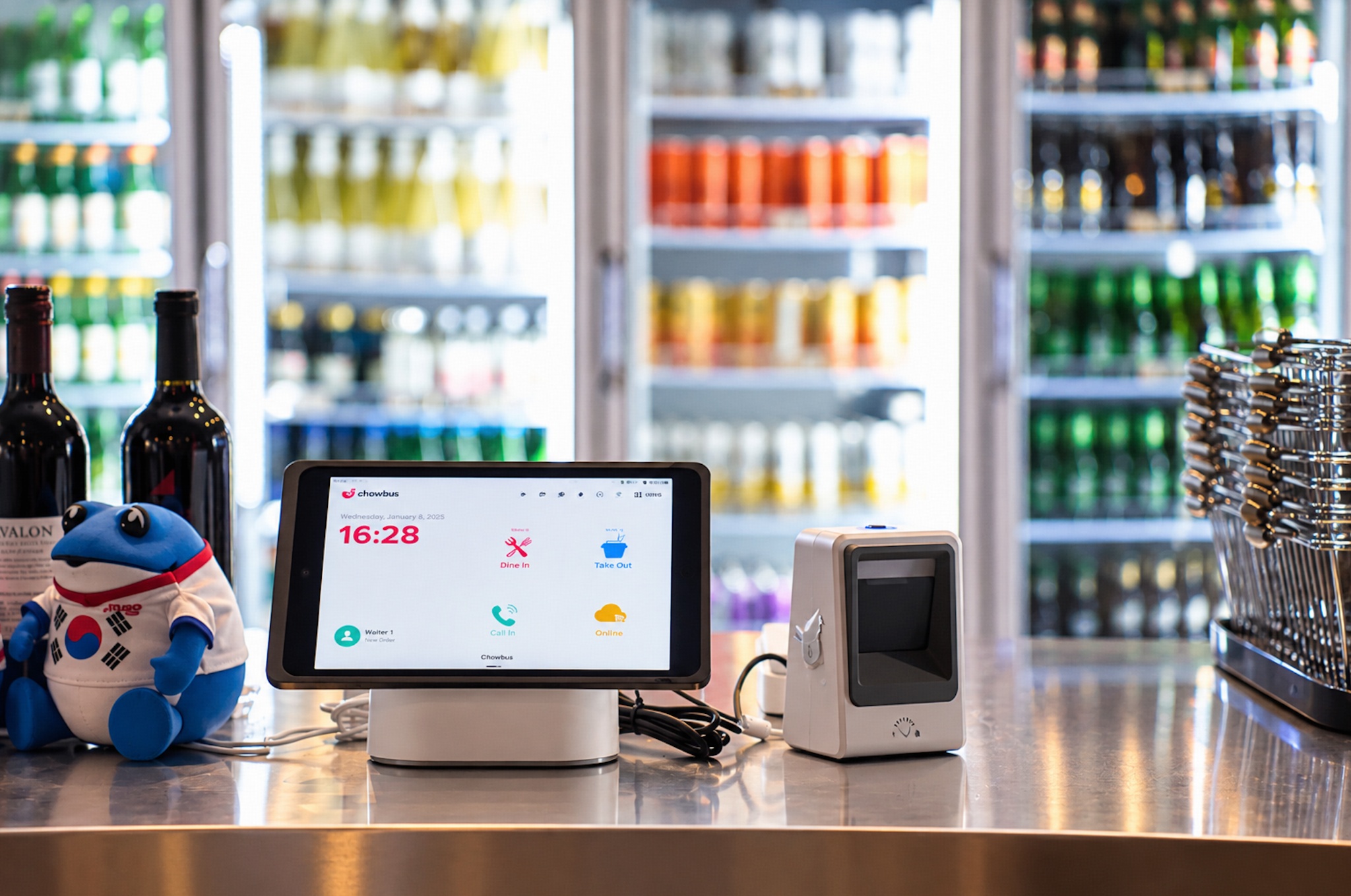
%20(1)%20(1).png)