Boba shop owners are regularly quoted the same POS pricing as a 100-seat restaurant — despite running an operation with twice the transaction velocity, smaller ticket sizes, and fundamentally different workflow requirements. That pricing mismatch is just the beginning of what makes evaluating POS costs for a bubble tea business genuinely complicated.
Chowbus processes nearly $4 billion in annualized restaurant transaction volume, and bubble tea shops consistently rank among the fastest-growing segment. What that data makes clear: boba shops that choose a POS based on sticker price — without accounting for transaction fees, modifier limitations, and support costs — routinely pay more in total than operators who made a slightly higher upfront investment in a purpose-built system.
In this guide, you'll understand exactly how boba POS pricing works, what drives the real cost, and how to evaluate your options without getting burned by the numbers you weren't shown.
The math isn't hard once you know which numbers to look at.### How Boba POS Pricing Is Structured
Most POS vendors present pricing in terms of monthly software subscription fees. For a boba shop, this is the least important number in the total cost calculation.
POS pricing for a boba shop has three real components: the monthly software fee, the payment processing rate, and the cost of any features (modifiers, loyalty, online ordering, reporting) that are either included or sold as add-ons.
Monthly software fee: Ranges from $0 (Square free tier) to $149+/month for full-featured systems. This is the number vendors advertise.
Payment processing rate: Typically 2.3%–2.9% per transaction plus a flat fee per swipe ($0.10–$0.30). This is the number that determines your real annual cost. For a boba shop doing $400,000/year in revenue, the difference between a 2.4% and a 2.9% processing rate is $2,000/year. That dwarfs any monthly software fee difference.
Add-on features: Generic POS systems often charge extra for loyalty programs, advanced reporting, online ordering, and — critically for boba shops — enhanced modifier depth. A system that advertises $0/month but charges $40/month for loyalty and $30/month for online ordering is actually costing $840/year before processing fees.
A standard coffee order has two or three variables. A boba drink can have five or more: drink base, milk type, sugar level, ice level, temperature, topping selection (often multiple toppings), and size. This isn't a menu curiosity — it's the core product.
Generic POS systems handle modifiers as an afterthought. They allow simple add-ons with flat prices, but the nested logic that boba requires — "if sugar level is 0%, remove sweet topping recommendation; if hot, disable certain ice levels; if oat milk, add $0.75" — often requires workarounds or simply isn't available.
The practical cost of inadequate modifier support: orders go out wrong, staff spend time clarifying at the window, and the kitchen (or prep station) needs verbal communication to fill gaps the system can't handle. Each of those friction points costs time, and time in a boba shop rush translates directly to lost transactions.

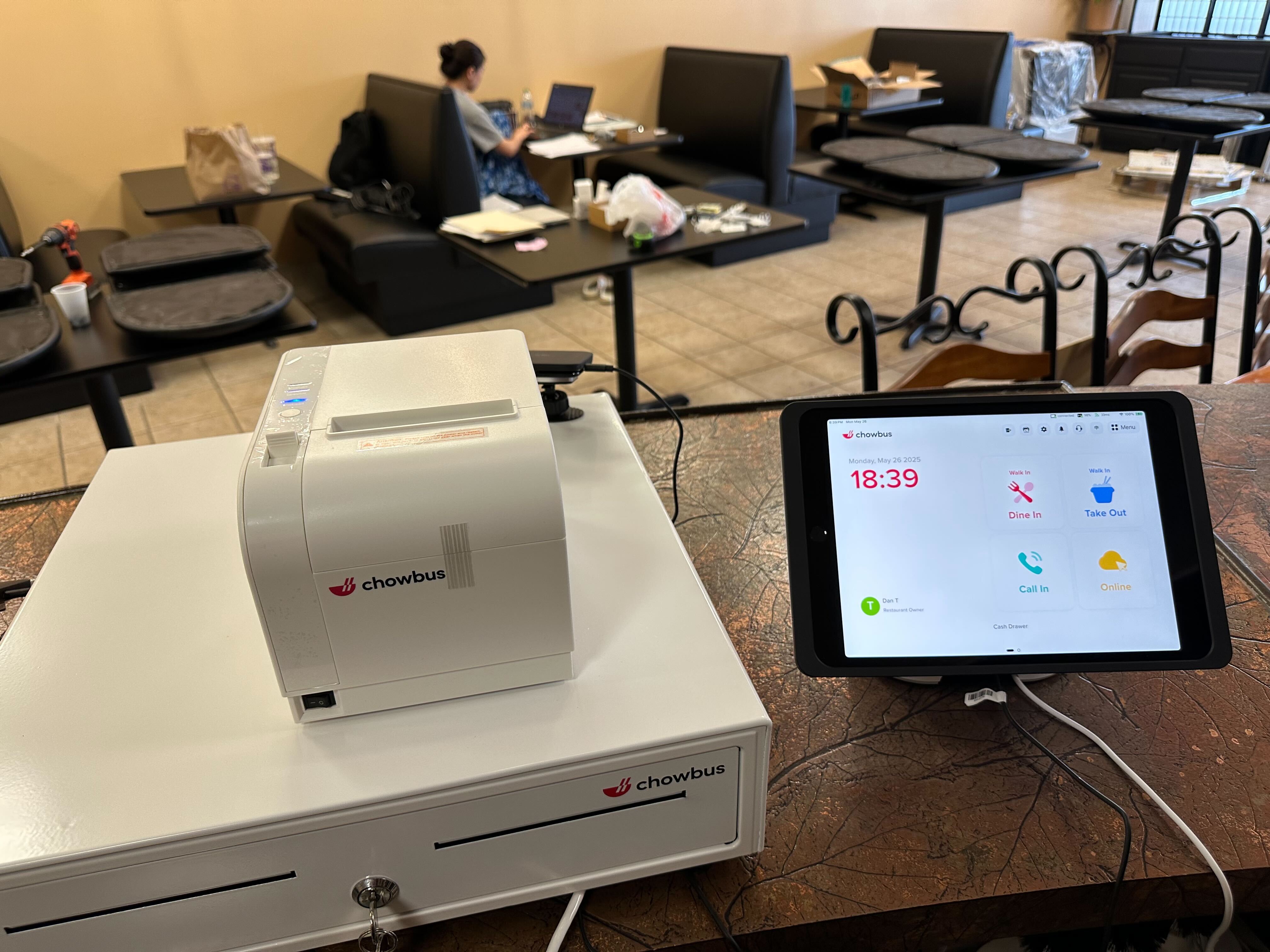
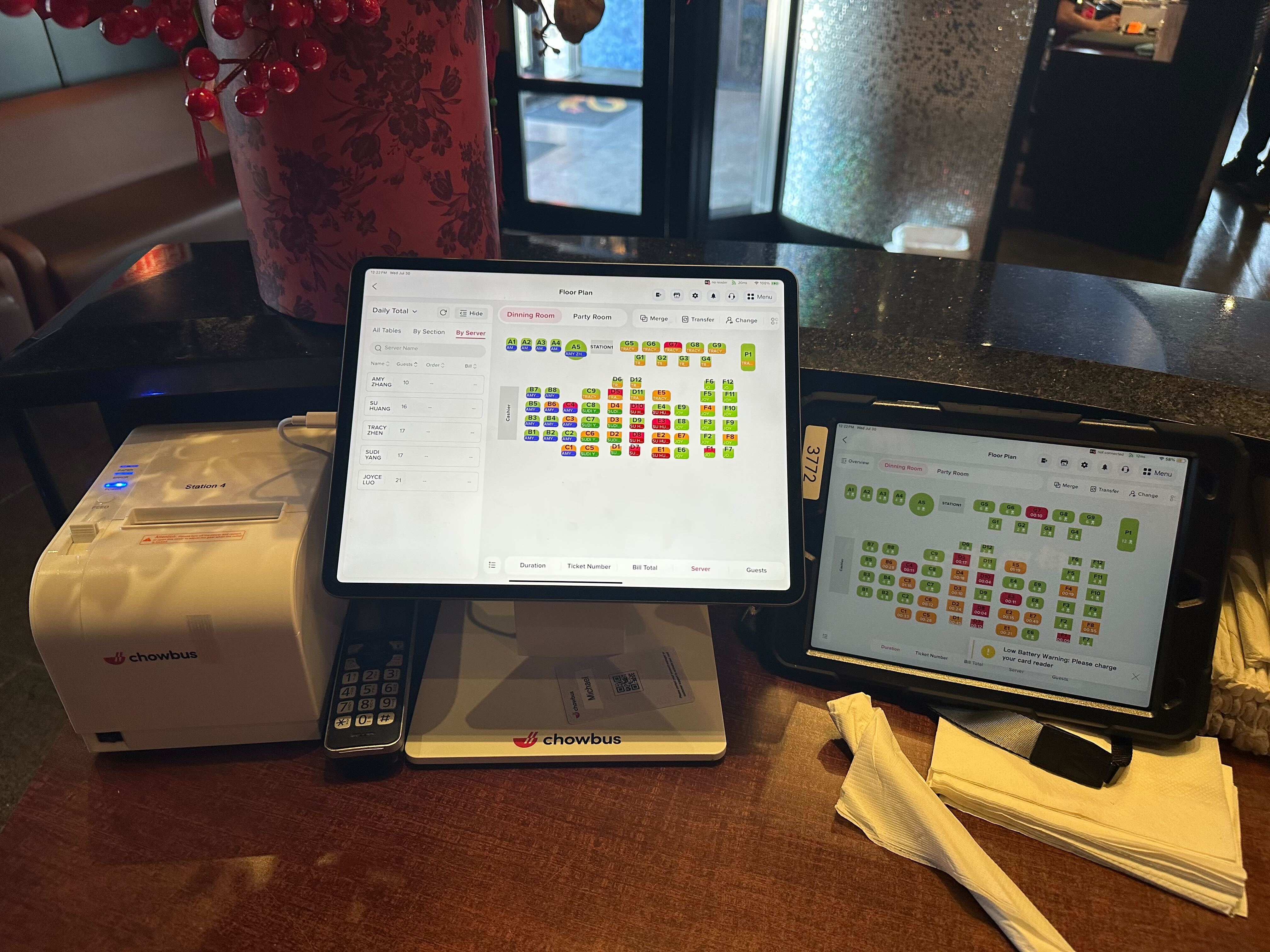
A complete boba shop POS hardware setup includes a tablet or terminal (iPad or dedicated POS device), a cash drawer, a receipt printer, and a payment card reader. Optional additions include a customer-facing display, a separate tablet for drive-through or walk-up ordering, and kiosk hardware for self-order.
Expected hardware costs: budget $800–$2,500 for a basic single-station setup; $2,500–$6,000 for a complete setup with customer-facing display and kitchen display. These are one-time costs — but watch for vendors that require proprietary hardware, because replacement and expansion become permanently vendor-priced.
The right way to evaluate a boba POS isn't by comparing monthly fees — it's by calculating the two-year total cost of ownership across all components.
Take any system you're evaluating and add up: (monthly software fee × 24) + (annual revenue × processing rate) + (add-on fees × 24) + hardware cost + onboarding fee. Run that calculation for every system you're considering, and rank by the two-year total, not the monthly sticker.
For a boba shop doing $400,000/year: a system with a $99/month software fee at 2.3% processing with modifiers and loyalty included costs approximately $14,776 over two years. A "free" system at 2.75% processing with $40/month in add-ons costs approximately $15,960 over the same period — and provides a fraction of the operational capability.
Hardware lock-in penalties: Some vendors charge fees if you switch systems and return their hardware. Read the equipment clause carefully.
Per-location fees: Charged when you open a second location. For growth-minded boba operators, this matters — some systems charge $50–$100/month per additional location.
Support tiers: Support is often excluded from base pricing. Emergency support during a service crisis may require a paid support plan to get a real human on the phone.
Processing rate escalators: Some contracts include provisions to raise processing rates after an introductory period. Verify whether your rate is fixed or can change.
Boba POS pricing is not simple, and vendors know it. The most common outcome when operators choose based on the advertised monthly fee is discovering six months later that the real cost — including processing, add-ons, and the operational cost of a system that can't handle the modifier volume — is far higher than expected.
The right framework: calculate the two-year total cost of ownership across the full pricing stack, evaluate whether the system natively handles your modifier logic, and factor in what you'll pay per hour of staff time when the system requires workarounds.
For a boba shop doing meaningful volume, the difference between the right and wrong POS system is measured in thousands of dollars annually — not hundreds.
Q1: How much does a POS system cost for a boba shop? A: All-in costs for a complete boba POS setup (hardware + software Year 1) typically run $3,500–$8,000. Monthly ongoing costs range from $100–$250/month depending on software, processing fees, and feature tier. Use a two-year total cost of ownership model rather than comparing monthly software fees in isolation.
Q2: Is the cheapest boba POS really the most affordable? A: Rarely. Free or low-monthly-fee systems typically charge higher payment processing rates (2.6–2.9%) and charge separately for features like loyalty and online ordering. At $400K annual volume, a 0.4% higher processing rate costs $1,600/year — more than the software fee difference.
Q3: What is a fair payment processing rate for a boba shop? A: A competitive processing rate for a boba shop is 2.3%–2.5% for card-present transactions. Rates above 2.6% are worth negotiating or shopping around. High-volume shops may qualify for interchange-plus pricing, which typically results in lower effective rates.
Q4: Do all POS systems support boba-specific modifier customization? A: No. Most general-purpose POS systems support basic modifiers but lack the nested logic required for boba's multilevel customization (sugar × ice × temperature × toppings). Purpose-built systems for Asian restaurants and beverage shops handle this natively.
Q5: What should I budget for POS when opening a new boba shop? A: Budget $5,000–$8,000 for a complete first-year setup including hardware and software. Factor in payment processing fees separately as a variable cost tied to your revenue volume. Plan for the system cost to be recouped through labor savings and order accuracy improvements within the first six months.