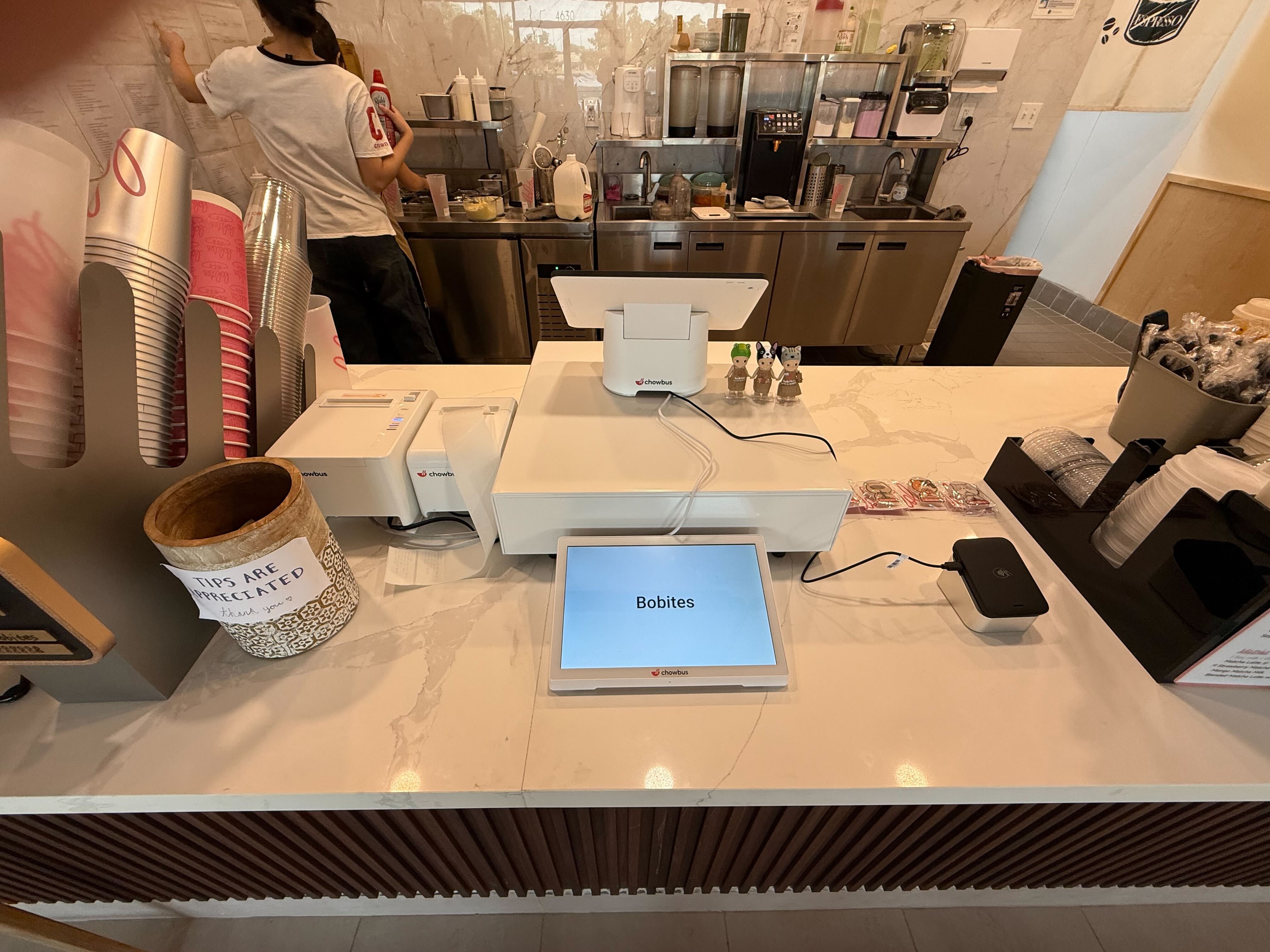
When a food truck's payment screen freezes in the middle of a 40-deep lunch line, the cost isn't the missed sale at the window. It's the next twenty customers who watch the line stall, do the math on their lunch break, and walk away. By the time the system reboots, the day's revenue has a hole in it that the rest of service can't refill.
Across 9,000+ restaurants now running on cloud-based platforms — including mobile and pop-up operators — the food truck has become a category where category-fit POS finally exists. The "use a Square reader on an iPad" era worked when food trucks did $400 a day. It strains at $2,000. It snaps at $4,000.
In this guide, you'll see what a real mobile POS for food trucks looks like, the connectivity and hardware choices that decide reliability, and how to compare options against the metrics that matter at the window.
The starting point: a food truck is a restaurant with no walls and no second chance.
A food truck is a restaurant with no walls and no second chance. Service is a 90-minute window most days. The line is in front of strangers. The wifi is whatever LTE you can borrow from a cell tower a block away. The cook, the cashier, and the owner are sometimes the same person, often the same shift.
The implication for POS choice is direct:
Battery, not power outlet. The system has to run on rechargeable hardware for a full lunch and dinner without scrambling for an outlet.
Cellular and offline mode, not wifi. A POS that depends on a stable internet connection will fail at least once a week. Offline mode that syncs when connectivity returns is mandatory, not optional.
Speed over polish. The interface needs to ring a $14 order in three taps. The aesthetic isn't the product.
24/7 support that actually answers. Food trucks operate at hours when most B2B support is closed. The window of "we cannot serve customers until support picks up" needs to be near-zero.
A mobile POS designed for a quick-service food truck is a different product from a tabletside restaurant tablet, and the food trucks that pick the right system on day one don't end up rebuying in year two.
Four hardware decisions matter more than the software vendor:
Handheld vs. fixed tablet. Handheld terminals (Sunmi, Clover Flex, dedicated handhelds) are the right answer for food trucks. They go to the customer at the window if needed, they fit in a small space, and they have integrated card readers. A 10-inch fixed tablet with a separate reader is two devices that can fail independently.
Battery life. Realistic expectation: a full lunch service is 4-6 hours. A full lunch and dinner is 8-10 hours. The terminal should last that long without charging, and ideally accept hot-swap battery packs.
Cellular built in, not tethered to a phone. A POS that piggybacks off your personal phone's hotspot is a POS that goes down when you take a call. Built-in cellular (with a $20-40/month data plan) is more reliable.
Receipt printing — Bluetooth, not USB. A USB-tethered printer is a tripping hazard in a 6-foot truck. Bluetooth printers, mounted, win.
The software vendor matters second. Reliability is built on the hardware and connectivity stack first.
Beyond the basics of taking an order and a payment, the systems that food trucks keep using have five features that make the difference:
Quick-pick menus by category. Most food trucks have 15-30 items. The menu should be on one screen, sorted by category, with modifiers one tap away.
Cash and card flexibility. Cash drawer integration on the truck, contactless payments at the window, and tip prompts that don't enrage customers in a fast-service line.
Real-time stock tracking on key items. When the truck has 30 portions of the day's protein, the system tracks them and 86s automatically. Manual 86ing during a rush gets forgotten.
Online ordering for pickup. A food truck with online ahead ordering can clear the line by 30-40% on busy days. The order shows up on the truck screen with a pickup time, the customer comes back at the right time, no line wait.
Reports on the phone after service. Sales, top items, hours of operation, cash vs. card. By location if the truck moves. End-of-service in three minutes, not 30.
These five aren't add-ons. On a food truck doing $1,500-4,000 a day, they're the difference between a clean operation and a chaotic one.
Three questions narrow the field fast:
What's the total monthly cost for one handheld with cellular, software, and payment processing? You should be able to get this in writing in under 10 minutes. If you can't, the vendor isn't built for transparency.
Does the system have a true offline mode that processes payments and queues them for sync? Watch this on demo by toggling airplane mode mid-transaction. If the system stalls, walk away.
What does the typical food truck customer of this vendor look like? Ask for two references. Call them and ask one question: "What happens when you have a problem in the middle of service?"
Three questions, three vendors, one Saturday. Decision made.
Chowbus is the only cloud-based modern POS built specifically for Asian restaurants, which makes it the category-fit answer for Asian food trucks and pop-ups — bao trucks, pho trucks, Korean BBQ trucks, dumpling pop-ups, bubble tea carts, Taiwanese street food, and the like. Multilingual menu support (EN/ZH/JP/KO/ES) matters more for a food truck staff that may be first-generation immigrants than it does for a brick-and-mortar with a longer training runway. 24/7 bilingual support in EN, ZH, and ES is the deciding factor when something breaks during service and there's no plan B.
For non-Asian food trucks, Toast, Square, and Clover have strong food-truck offerings with cellular handhelds and offline mode. The "best" comparison shifts based on the operator's specific concept and team.
What stays consistent: the right product for a food truck is one designed for the unit economics of a food truck, not a stripped-down tablet POS borrowed from a restaurant.
A food truck POS isn't a smaller restaurant POS. It's a different product solving a different operational shape — service through a window, on battery, on cellular, with one or two people doing everything. The systems built for it disappear into the work. The systems borrowed from another category create friction every shift, until the operator finally rebuys in year two.
The math on a food truck is unforgiving. Lunch is 90 minutes. Bad service in the first 20 customers loses the next 40. The POS isn't a back-office tool — it's a frontline asset that earns or burns money in real time.
For Asian food trucks and pop-ups operating with multilingual staff and shifting locations, the category-fit answer reduces the failure modes that matter most: language gaps, support gaps, and connectivity gaps. The right product is the one that's been through that service shape before.
Q1: What is the best mobile POS system for food trucks in 2026? A: For Asian food trucks specifically — bao, pho, dumplings, bubble tea, Korean BBQ — Chowbus offers category-fit features including multilingual menus and bilingual support that matter on small teams. For general food trucks, Toast Go, Square Mobile, and Clover Flex are strong options. The right system depends on concept, team, and volume.
Q2: How much does a mobile POS for a food truck cost? A: Plan for $69-$150 per month in software fees, plus payment processing at 2.6-2.9%, plus $300-$900 for the handheld hardware. A cellular data plan adds $20-$40 per month. Total year-one cost should land at $2,000-$3,500 including hardware.
Q3: Does a food truck POS work without internet? A: A good one does. Offline mode should queue transactions and sync when connectivity returns. Test this on demo — toggle the system into airplane mode and process a transaction. If the system can't, it isn't built for food trucks.
Q4: Can a food truck use the same POS system as a brick-and-mortar restaurant? A: Yes, if the vendor offers a mobile/handheld version of the same platform. This is ideal for operators running both a truck and a restaurant — one set of menus, one customer database, one reporting view across all locations.
Q5: What's the best mobile POS payment processor for food trucks? A: The processor matters less than the rate. Aim for 2.6% or lower on card-present transactions. Avoid vendors that bury foreign card, AmEx, or keyed-in transaction surcharges in the fine print.
Q6: How long does it take to set up POS on a food truck? A: With a modern cloud-based mobile POS, 24-72 hours from hardware delivery to live service. Menu setup is the bulk of the work. Vendors that handle menu migration as part of onboarding remove most of the friction.