Bubble tea shops now operate in all 50 U.S. states, and the fastest-growing ones share a specific operational characteristic: their POS system was designed for high-volume, modifier-heavy drink orders — not adapted from a coffee chain template or a general restaurant platform that never anticipated managing 80 drink customization combinations simultaneously.
Yet most bubble tea operators still evaluate POS systems using the same criteria as a pizza restaurant — price, basic features, and brand recognition. That mismatch explains why so many boba shops are running on systems that technically work but create daily friction that accumulates into real operational cost.
In this guide, you'll get a direct, category-by-category comparison of the best POS systems for bubble tea shops in 2026 — so you can evaluate your options against criteria that actually matter for how a boba shop runs.
Here's what the field actually looks like.### The Five Criteria That Actually Matter for a Boba POS
Evaluating a POS system for a bubble tea shop requires different criteria than evaluating one for a sandwich counter or a full-service restaurant. The five categories that matter most for boba are: modifier system depth, order throughput speed, payment processing rate, multilingual menu capability, and online ordering integration.
Any system that scores well across all five is worth a serious look. Systems that score well on one or two but poorly on the others will create daily friction — and daily friction in a high-volume boba shop compounds into thousands of dollars of real cost over a year.

This is the category that eliminates most general-purpose POS systems from consideration. A boba modifier system needs to support: multiple choice categories per item (base × milk × sugar × ice × temperature × toppings), conditional pricing (oat milk adds $0.75; extra pearls adds $0.50), conditional availability (hot drinks disable certain ice level options), and defaults that can be set per item (standard sugar is 70%, standard ice is regular).
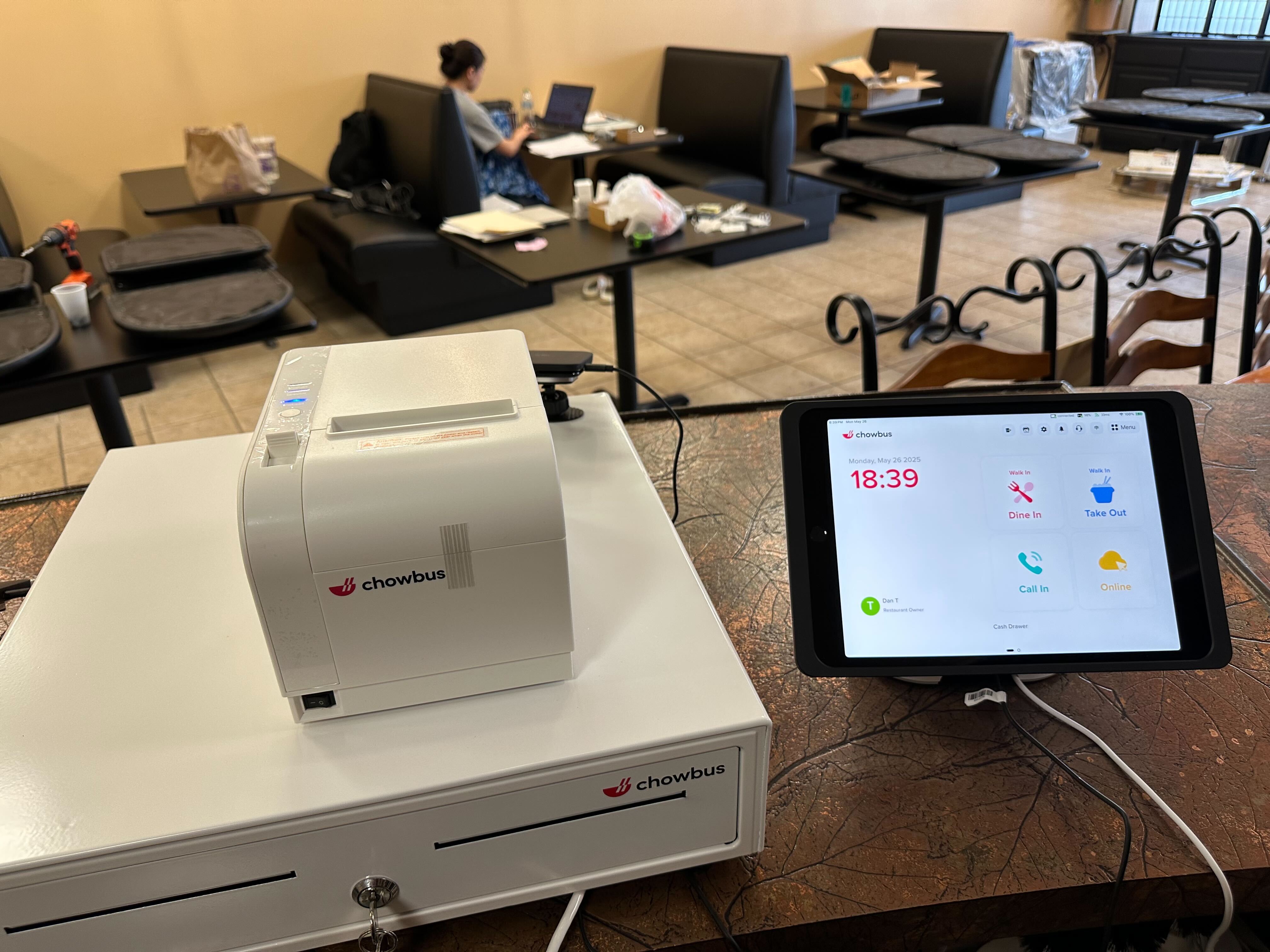
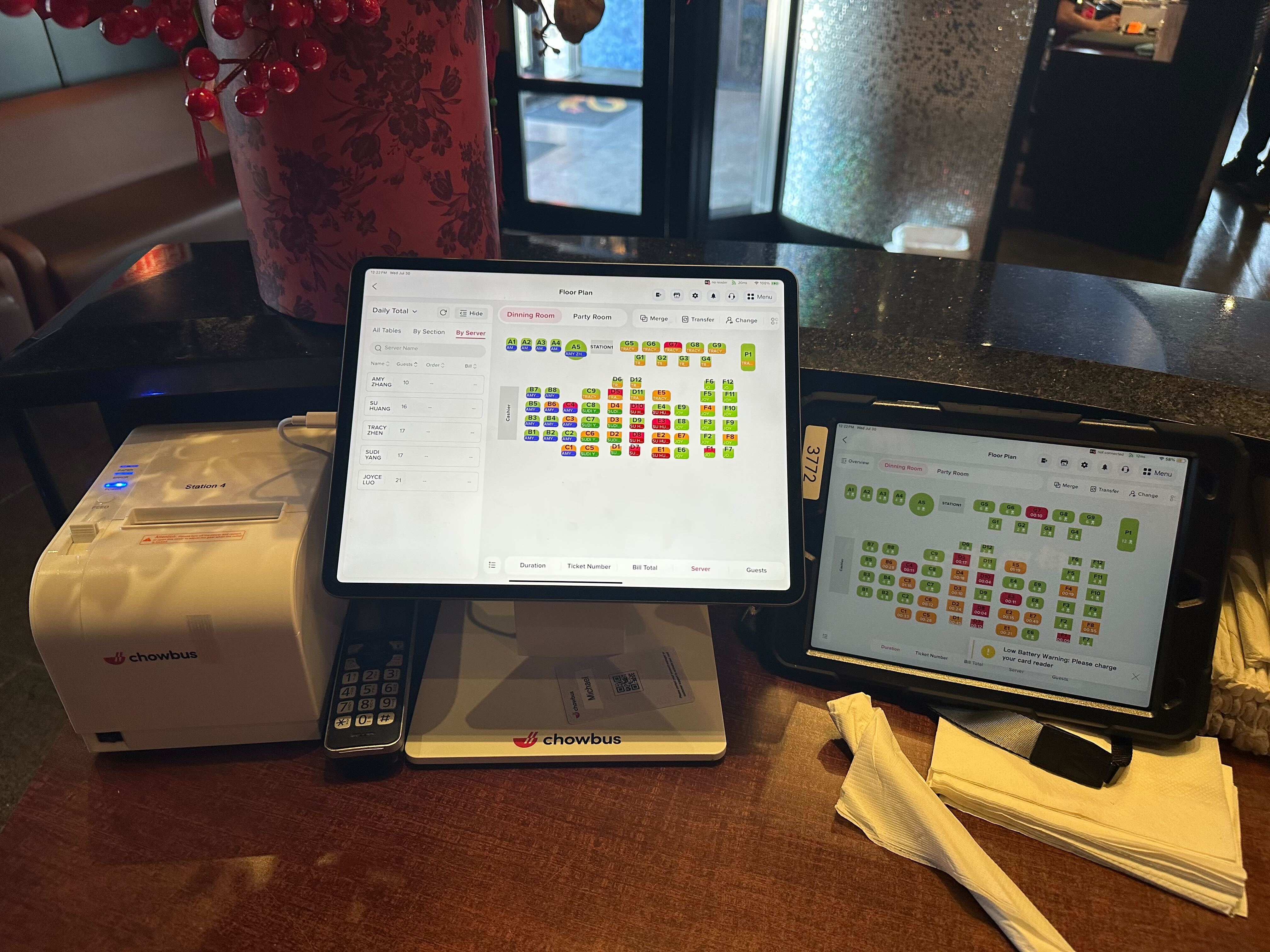
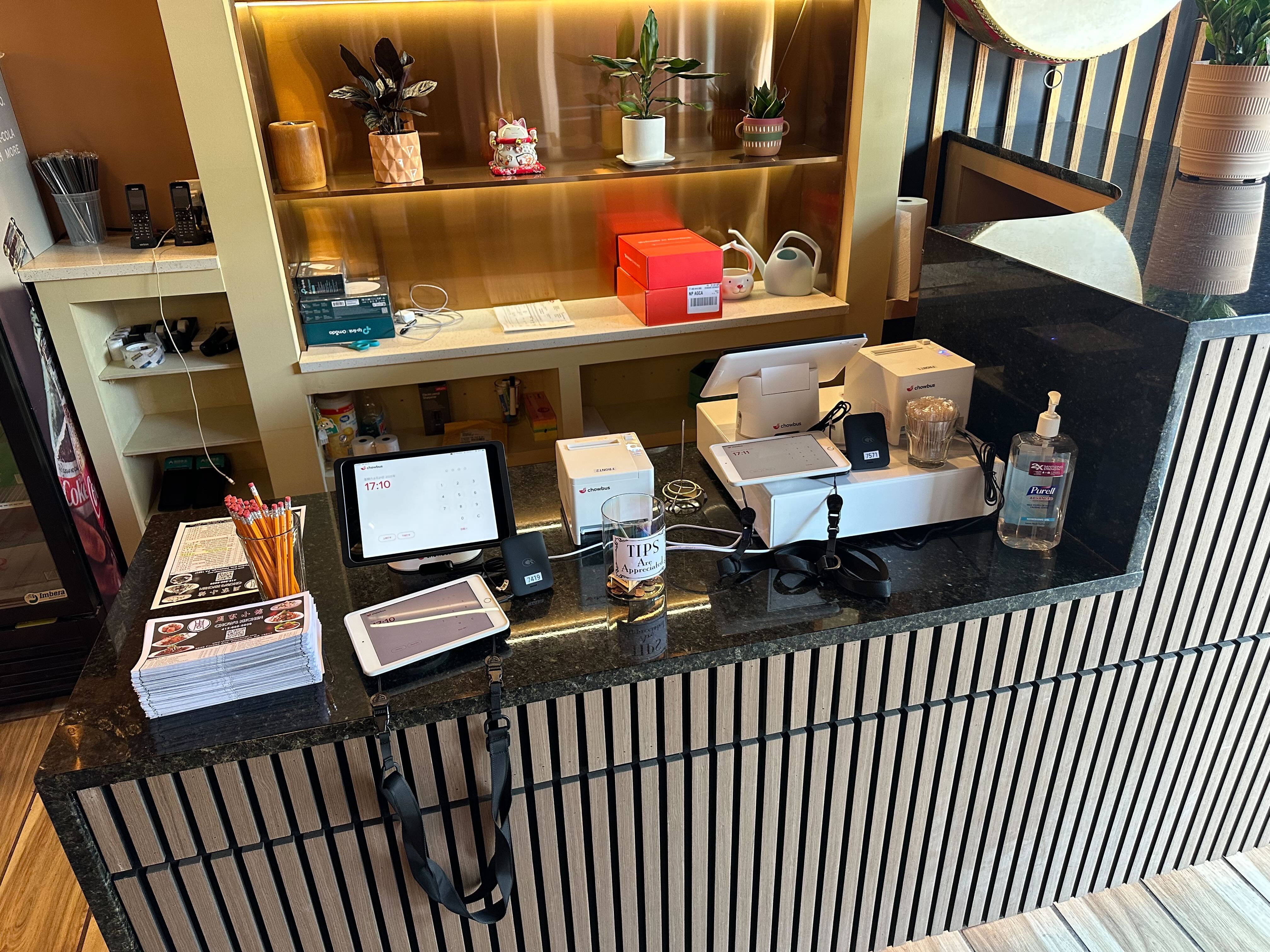
Chowbus: Built for Asian restaurant formats, including beverage-forward concepts. Handles the nested modifier logic that boba requires natively — no workarounds, no add-on module required.
Square for Restaurants: Supports basic modifiers. Nested conditional logic and pricing conditionals require workarounds or are unavailable at the standard tier.
Toast: Better modifier support than Square, but requires configuration that isn't optimized for boba's specific customization patterns. Works, but creates setup complexity.
Lightspeed: Strong on inventory and modifier management for complex menus. Less tailored to the high-speed transaction environment of a busy boba counter.
Generic tablet POS apps: Numerous options exist at the $50–$100/month price point. Most lack the modifier depth or the support infrastructure to handle a busy boba shop without daily operational friction.
During a Friday afternoon rush, a well-run boba shop processes 3–5 orders per minute at peak. The POS must not be the bottleneck. Order throughput speed is determined by three things: how quickly staff can build a customized drink order on the screen, how fast the payment processing completes, and how reliably the order routes to the correct prep station.
Systems with deep modifier trees that are also fast require intentional UX design — not just feature availability. The best boba POS platforms put the most commonly modified attributes (sugar, ice, toppings) on the primary order screen rather than buried in secondary menus. This sounds like a minor design detail. In a rush, it's the difference between a 20-second order entry and a 45-second one.
If your staff includes Mandarin, Cantonese, Korean, or Vietnamese speakers, a POS that operates natively in those languages reduces training time and error rates. If your customer base includes a significant non-English-speaking population — common in markets like Flushing NY, the San Gabriel Valley, or Houston's Chinatown — a customer-facing display in their language improves the ordering experience.
Chowbus supports English, Chinese, Japanese, Korean, and Spanish natively across staff-facing and customer-facing interfaces. No other major POS in the U.S. market matches this coverage at the same price point.
Online ordering for boba shops has grown significantly, but the 25–30% commission charged by third-party platforms (DoorDash, Uber Eats) on every transaction is an enormous margin drain. A POS system with built-in online ordering — where customers order directly through your website or app and orders route to your POS without a third-party intermediary — directly recovers that margin.
The calculation: a boba shop doing $8,000/month in third-party delivery revenue at 27% commission is paying $2,160/month to the platform. Shifting even half that volume to direct online ordering saves over $12,000/year.
When your POS goes down at 2 p.m. on a Saturday, how quickly can you reach someone who can help? Support quality is the most inconsistently delivered feature in the POS industry, and it's the one you'll care about most on the day it matters.
Ask every vendor you evaluate: what are your support hours, what is your average response time, and is support included in my plan or metered per incident? Chowbus offers 24/7 bilingual support in English, Chinese, and Spanish with an average response time of under two minutes — a differentiator that matters specifically for operators whose primary language isn't English.
The best boba POS isn't necessarily the most feature-rich or the most expensive — it's the one that handles your modifier logic without workarounds, processes orders fast enough not to create a bottleneck at peak, and costs the least in total when you add up processing fees and add-ons.
For most independently owned bubble tea shops in the U.S., that evaluation leads to a short list. The operators who run the most efficient boba operations have almost always made the choice based on operational fit rather than the lowest monthly rate.
If your current system requires any workaround to handle your drink customizations — at all — that's worth pricing out what a purpose-built alternative would actually cost in total.
Q1: What is the best POS system for a bubble tea shop in 2026? A: For boba-specific requirements — multilingual menus, deep modifier support, high transaction speed, and bilingual support — Chowbus is the purpose-built option. For general-purpose needs with simpler modifier requirements, Toast and Square are capable alternatives. Evaluate based on your modifier complexity and language requirements first.
Q2: Does a boba shop POS need to support online ordering? A: Yes — and ideally with direct online ordering (without third-party commission) built in. Third-party platforms charge 25–30% per transaction, which erodes margins significantly at scale. A POS with native online ordering allows you to capture that revenue directly.
Q3: How important is multilingual support for a boba shop POS? A: Depends on your market and staff. In markets with large Chinese-speaking customer or staff populations (Flushing, San Gabriel Valley, Houston Chinatown), multilingual support reduces errors and improves the customer experience measurably. For shops in predominantly English-speaking markets with English-fluent staff, it's less critical.
Q4: Can I use Square for a high-volume boba shop? A: Square works well for lower-volume or newer boba shops. At high volume (200+ transactions/day) with complex modifier requirements, Square's modifier system and reporting become limiting factors. Operators at that scale typically benefit from transitioning to a system with deeper modifier logic and stronger reporting.
Q5: What should I look for when switching boba POS systems? A: Prioritize modifier depth, order speed, processing rate, and support quality. Verify that menu migration is handled by the new vendor. Plan to run parallel systems for at least two shifts before fully cutting over.