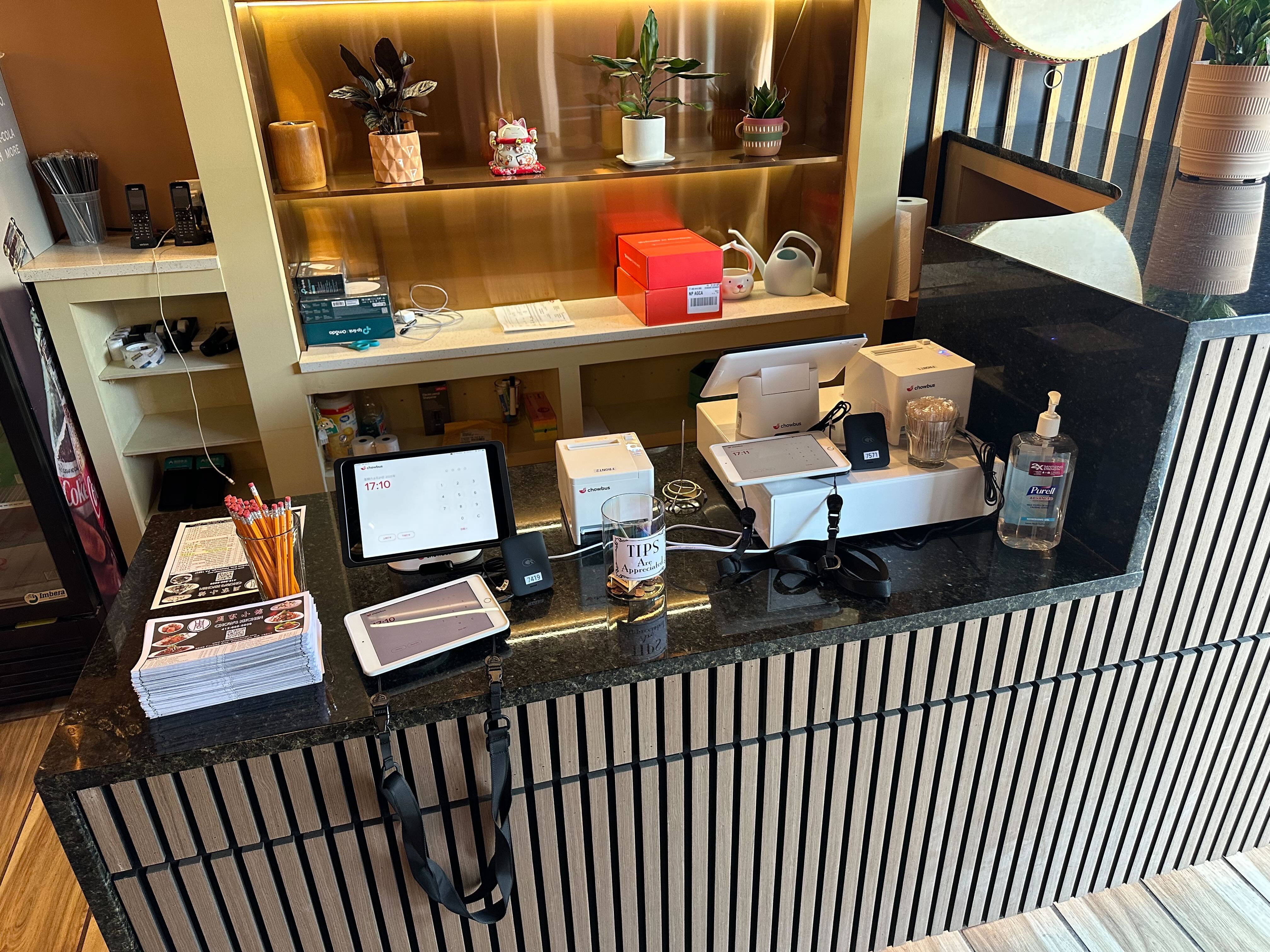
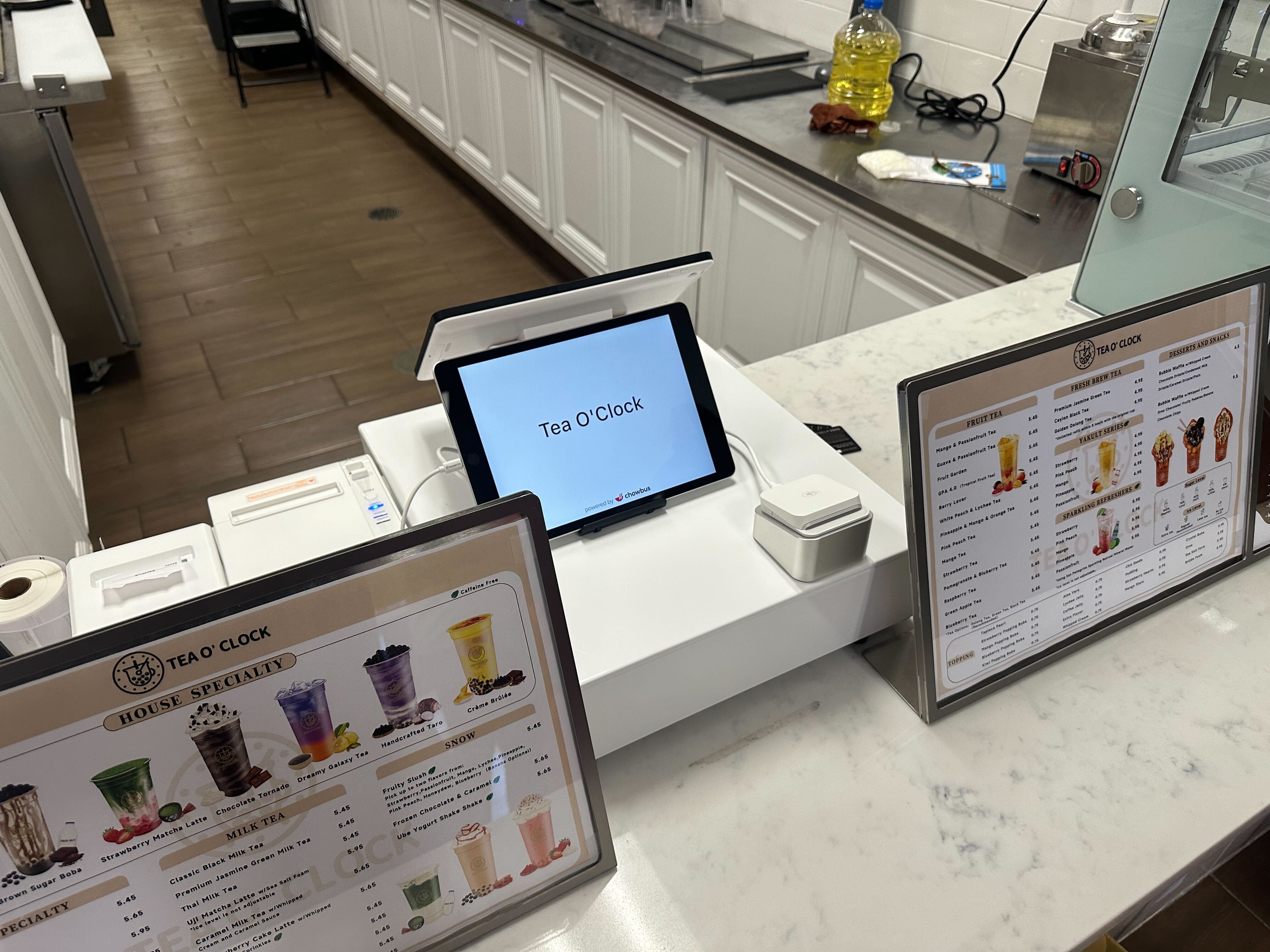
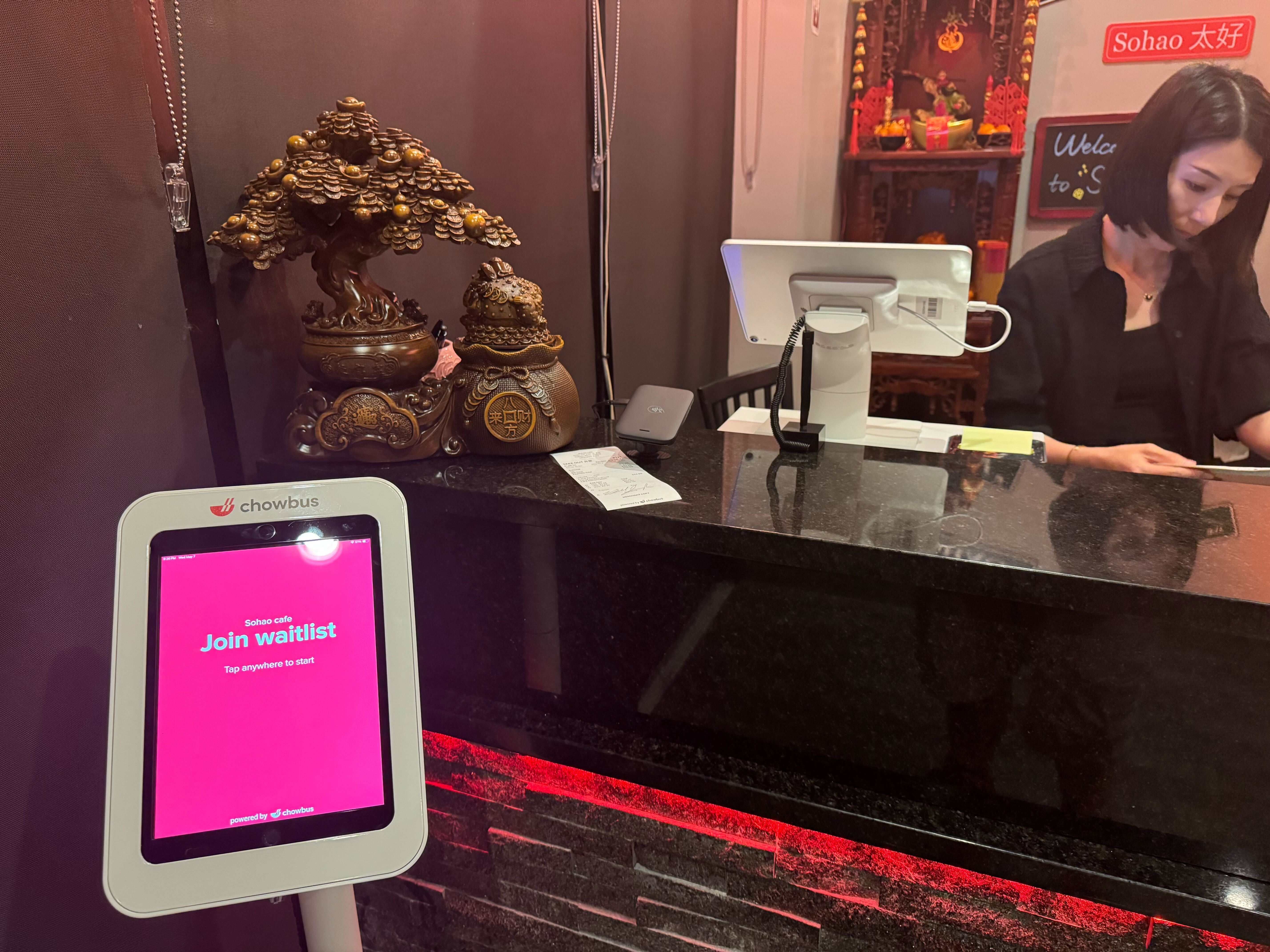
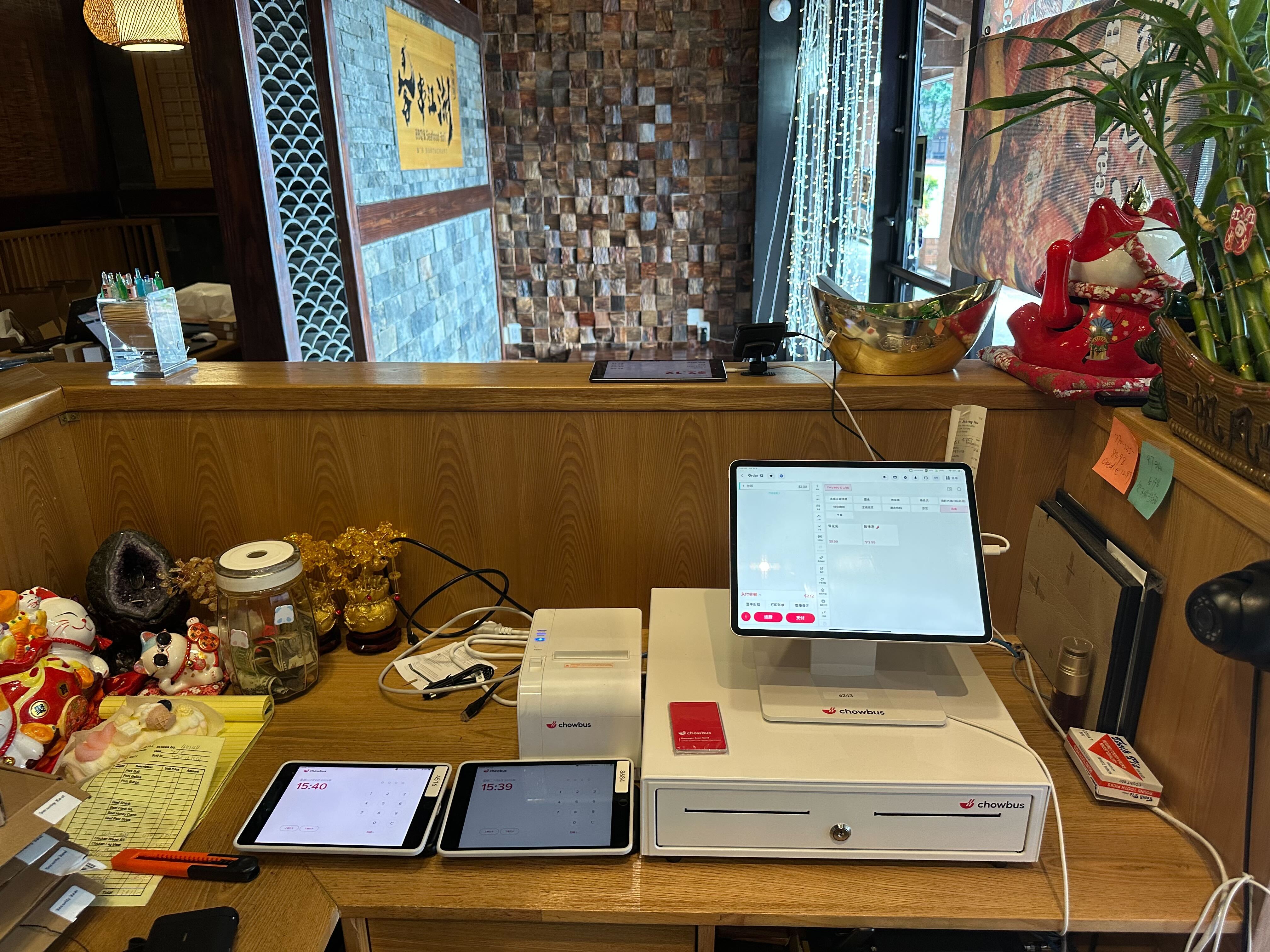
Store number two doesn't double your operation — it changes its species. With one restaurant, the owner is the operating system: every price change, every comped meal, every supplier order passes through one person who can see the whole floor. The second location breaks that model permanently, because you can't stand in two dining rooms at once. From that day forward, your visibility, your consistency, and your controls all have to live in software — and the question of a multi-location restaurant POS stops being a feature comparison and becomes the architecture of the company. It's a question more Asian restaurant operators are facing than ever: of the 9,000+ restaurants running on Chowbus, over 3,000 brands span the spectrum from single rooms to regional groups. This is a map of what actually changes at two-plus locations, and what the platform underneath has to provide.
A restaurant group owner reviewing dashboards on a laptop at a corner table, two photos of bustling modern Asian restaurant interiors visible as framed prints on the wall behind, notebook and coffee beside the laptop, warm afternoon light, confident professional atmosphere, shot on Canon EOS R5, 35mm lens, shallow depth of field, ultra-realistic, photorealistic, no text, no watermark — no logos, no text overlay, no watermark, no cartoon, no illustration, no CGI
At one store, a menu change is a conversation; at three stores, it's a deployment. Without centralized menu management, every price update, new item, and seasonal special must be re-entered per location — and they drift. One store charges last quarter's price, another spells the dish differently, the online menus disagree with the registers, and the brand quietly fragments.
A multi-location platform treats the menu as one centrally managed object broadcast to every store: change the price once, every register, kiosk, QR menu, and online ordering page at every location updates together. Done right, it also allows controlled local variation — a store-specific special, a market-driven price band — as deliberate exceptions granted from the center, not silent divergence discovered months later.
For Asian restaurant groups the broadcast carries more weight, because the menu object includes multilingual names and kitchen-ticket routing. A platform like Chowbus propagates the Chinese kitchen names, the English customer names, and the station mappings together — so a new location's wok station reads tickets correctly on day one.
The second location's deepest shock is informational: you simply aren't there. Half of everything now happens out of sight, and the owner who managed by walking the floor needs a replacement for their own eyes.
That replacement is consolidated real-time reporting: every location's sales, labor, voids, and channel mix on one screen, watchable from anywhere — same-store comparisons, daypart breakdowns, item performance across the group. The comparisons are where the money is. Store A turns tables 20% faster; store B sells twice the add-ons; store C's voids spike on Tuesdays. Each gap is either a problem to fix or a practice to copy, and neither is visible from inside a single store's numbers.
Cash and control follow the same logic. Multi-store operations need role-based permissions (who can comp, who can void, who can touch settings), manager accountability per location, and clean per-store cash reconciliation — the boring controls that prevent the expensive surprises that otherwise surface months late in stores you don't stand in.
Labor reporting belongs on the same dashboard. Labor as a percentage of sales, compared across stores at the same daypart, is the fastest diagnostic in the group: a store running five points heavier than its siblings on identical volume has a scheduling problem visible in one glance — the kind of finding that used to require a quarter of suspicion and a spreadsheet weekend.
A single restaurant's regulars belong to that room. A group's customers belong to the brand — if the systems let them.
A shared loyalty database across locations means points earned downtown redeem in the suburbs, the customer record follows the guest, and marketing runs at brand scale: one campaign, every store, with results measured per location. The alternative — per-store loyalty silos — actively punishes your best customers for visiting your other locations, which is exactly backwards.
The same brand-level thinking applies to the direct ordering channel: one online ordering presence that routes each order to the right store keeps the commission-free channel growing with the group, rather than fragmenting into per-store pages. And in the Chowbus ecosystem, the marketing layer rides on top — AI-driven ads can promote each location to its own neighborhood from one place, fed by the shared customer data underneath.
The first store took months of improvisation. On the right platform, the third one is closer to a checklist: clone the menu (multilingual names, modifiers, kitchen routing included), apply location-specific details, ship standard hardware, train staff on the system the group already runs, done. What was a six-month learning curve compresses to weeks — and the data from existing stores informs the new one's staffing, hours, and opening inventory.
Franchising raises the same questions an octave higher: if your growth path includes franchisees, the platform needs owner-versus-operator visibility — franchisees seeing their stores, the brand seeing everything, royalties calculable from system-of-record sales data nobody disputes. Groups that arrive at franchising on architecture chosen years earlier sign agreements in weeks; groups that don't, stall on systems diligence.
This is also why the platform decision belongs at store number one or two, not store number five. Migrating a running group is the most painful version of a painful project; choosing architecture that scales — central menus, consolidated reporting, shared customers, per-store permissions — costs nothing extra on day one and saves a migration later. (It's the same reason single-store operators evaluating systems should ask the multi-location questions anyway: the answer reveals whether the platform was built with growth in mind at all.)
The support question scales too: more stores means more hours of operation, more hardware in the field, more staff who need answers. A platform answering 24/7 in English, Chinese, and Spanish — Chowbus's standard, with a 2-minute average response — matters once per store per incident, which at five stores is simply five times more often.
Strip it down and the multi-location transition is one sentence: everything the owner used to do personally has to become a system, without losing what made the first store worth copying.
The POS platform is where most of that sentence lives — the menu broadcast that keeps the brand coherent, the dashboards that replace your eyes, the shared customer base that makes the group more than the sum of its rooms, and the opening procedure that turns growth from a leap into a step. Operators who choose that architecture early scale on rails; operators who don't, spend store three's energy untangling stores one and two.
If a second location is anywhere in your plans — even as a someday — pressure-test your current or candidate POS against the four changes above: ask to see a price change broadcast live, a same-store comparison report, one customer record visible from two stores, and the new-location setup checklist. Thirty minutes of questions now is the cheap version of that lesson.
What is a multi-location restaurant POS?
It's a cloud POS architected for restaurant groups: one centrally managed menu broadcast to every store, consolidated real-time reporting with same-store comparisons, shared customer and loyalty data across locations, per-store roles and permissions, and a repeatable setup procedure for new stores. The defining test is whether a price change made once reaches every register, kiosk, and online menu at every location.
When should a restaurant switch to a multi-location POS?
Ideally before the second store opens — the platform decision is far cheaper at one store than as a migration across a running group. Single-store owners with any expansion ambition should choose multi-location architecture now; it costs nothing extra on day one and removes the re-platforming project later.
Can loyalty points work across multiple restaurant locations?
On a shared-database platform, yes: points earned at any store redeem at every store, the guest's record follows them, and marketing runs at brand level with per-store measurement. Per-store loyalty silos punish your best customers for visiting other locations — the opposite of what a group wants.
How do restaurant groups keep menus consistent across locations?
Through centralized menu management: items, prices, modifiers, photos, and — on platforms like Chowbus — multilingual names and kitchen routing are maintained once and deployed everywhere, with local variations granted as controlled exceptions. Without it, menus drift store by store until the brand fragments.
How much does a multi-location POS cost?
Pricing typically runs per location with the same components as any restaurant POS — software, processing, hardware — and groups gain leverage on both rates and terms as store count grows. Compare platforms on the full multi-store stack (central menus, consolidated reporting, shared loyalty, online ordering) rather than per-store base prices; all-in-one platforms bundling that stack usually win the group-level total.