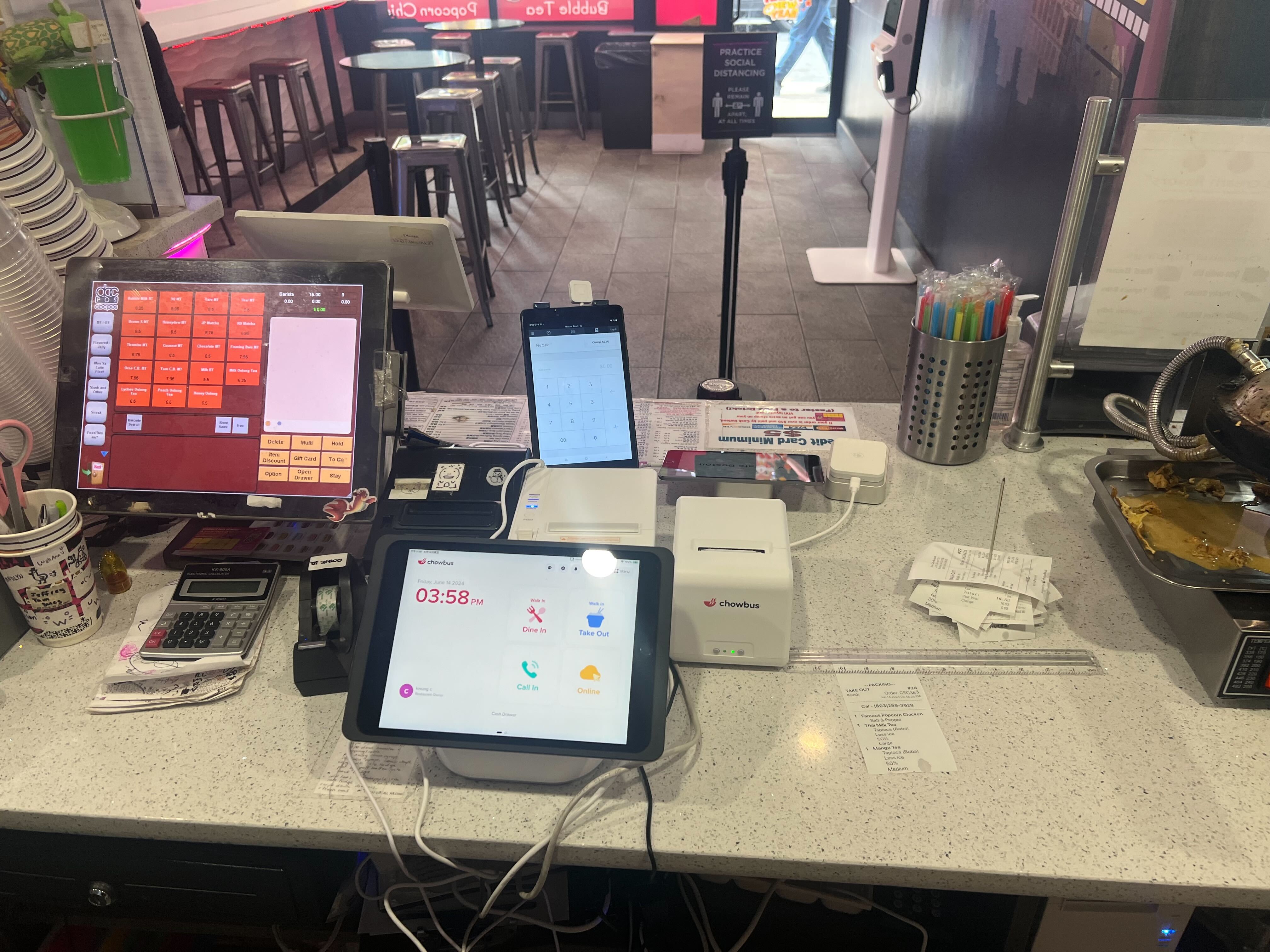
A fixed POS terminal costs less per unit than a handheld one, sitting at a counter or a host stand where it never needs a battery charge or a screen protector. That lower price tag is the entire argument for sticking with fixed terminals, and it's a real one — right up until the terminal itself becomes the bottleneck, because every order or payment has to travel to wherever that terminal is bolted down instead of happening wherever the guest actually is. Sticker price alone answers the wrong question. The one that actually matters is which option earns back its cost faster, and that answer depends entirely on how far orders and payments currently have to travel before they reach a screen.
Both answers are correct for different restaurants, which is exactly what makes this a framework question rather than a universal recommendation. A payback calculation — how long it takes the extra cost of one option to be recovered through time saved, table turns gained, or errors avoided — gives an owner a concrete number to compare instead of a gut feeling about which hardware "seems more modern."
Payback period is simply the extra upfront cost of one option divided by the recurring value it generates per week or per month, expressed as a length of time. If a portable terminal costs $600 more than a fixed one and it saves a restaurant $50 a week in labor time or captures $50 a week in orders that would otherwise walk away, the payback period is twelve weeks. Below that threshold, the portable device is still paying itself off. Past it, the device has already paid for itself and everything afterward is pure gain. The framework doesn't assume portable is better — it just makes the actual break-even point visible instead of leaving the decision to a hunch.
A fixed terminal wins the payback calculation cleanly in one specific scenario: when the physical distance between where an order is taken and where the terminal sits is already close to zero. A quick-service counter where guests order and pay at the same screen, or a small dining room where a single terminal near the kitchen pass is only steps from every table, doesn't have a distance problem for a portable device to solve. In that setup, the lower upfront cost of a fixed terminal has nothing to compete against — there's no walking time being saved, because there wasn't much walking time to begin with.
A portable terminal wins the calculation specifically where the gap between order and payment is large enough to cost real minutes — a patio thirty or forty feet from the register, a full-service dining room with a long walk back to a single POS station, or line-busting during a counter-service rush where a server can take and close out an order without ever making a guest wait in a line that's already backed up. In these settings, the extra per-unit cost of portable hardware is competing against a real, recurring cost: staff time spent walking, and table turns delayed by exactly that walking time.
The math only needs three numbers: the price difference between the portable and fixed option per unit, an honest estimate of the extra table turns or labor-hours saved per week once the distance problem is solved, and the average value of a table turn or an hour of labor at that restaurant. Divide the cost difference by the weekly value of the time saved, and the result is the payback period in weeks. A restaurant that estimates even one extra table turn a night from faster tableside payment, multiplied by an average check, often finds the payback period is measured in weeks rather than months — but the calculation only holds up if the distance problem being solved is real, not assumed.
Jongro BBQ, a Korean BBQ restaurant in New York's Koreatown, saw a 25% improvement in table turn times after switching to Chowbus POS Handheld, largely by eliminating the repeated walk between tables and a fixed terminal for payment and menu changes — a case study that illustrates exactly the kind of distance-driven gain the payback framework is built to capture. The pattern shows up most reliably in a specific set of situations: outdoor patio seating, food trucks and pop-ups with no fixed counter at all, off-site catering and banquets, and line-busting during a counter-service rush. Chowbus's separate breakdown of exactly which scenarios justify a handheld POS covers each of these cases in more depth for a restaurant trying to confirm its own situation matches the pattern before buying.
A payback framework has to be honest about the cases where the faster-paying-back option isn't portable at all. A small counter-service restaurant with guests ordering and paying at one register has no distance gap to close, so a portable terminal's extra cost has nothing to compete against — the payback period is effectively infinite, because there's no recurring value being generated to divide it against. The same logic applies to a back-office terminal used only for reporting or end-of-day reconciliation, where mobility adds cost without adding any corresponding time savings.
Few restaurants end up choosing exclusively one hardware type once they run the numbers honestly. A full-service restaurant commonly keeps a fixed terminal at the host stand and bar while adding two or three portable units for the dining room floor and patio — putting portable hardware specifically where the distance problem is real and leaving fixed terminals where it isn't. That mixed approach usually produces the fastest blended payback, because it avoids paying the portable premium in the exact spots where a fixed terminal was already the cheaper, equally fast option.
For a group running several locations, the payback calculation should be run per location rather than assumed to be uniform across the whole group — a location with a large patio or banquet business will hit payback on portable hardware much faster than a small storefront location with a single register and no outdoor seating. Chowbus's POS system supports a mixed hardware fleet across every location from one back end, so a group doesn't have to standardize on one hardware type everywhere just to keep reporting and management simple.

Q1: What is a payback period for restaurant POS hardware, and how do you calculate it?
Payback period is the time it takes for the extra cost of one hardware option to be recovered through the value it generates — time saved, table turns gained, or errors avoided. Calculate it by dividing the price difference between two options by the weekly or monthly value of the time or revenue that option is expected to save.
Q2: Does a portable POS system pay back faster than a fixed terminal?
Only in specific situations — when there's real distance between where an order is taken and where a fixed terminal sits, such as a patio, a large dining room, off-site catering, or line-busting during a rush. Where that distance is already small, like a small counter-service setup, a fixed terminal usually has no gap for a portable device to close, and the extra cost of portable hardware doesn't pay back any faster.
Q3: Is it better to buy all portable POS devices or all fixed terminals for a restaurant?
For most restaurants, neither extreme wins the payback calculation across every part of the operation. A mixed fleet — fixed terminals at a host stand or bar, portable units on the floor and patio — usually produces the fastest overall payback, since it puts the more expensive hardware only where there's a real distance problem to solve.
Q4: How much does a handheld POS system cost compared to a fixed terminal?
Handheld units typically carry a higher per-unit cost than a fixed terminal, but the more useful comparison isn't the sticker price — it's that price difference divided by the weekly value of the time or table turns the handheld unit is expected to save at that specific restaurant.
Q5: My restaurant has a large patio — would portable POS pay back quickly for us?
Very likely, since a patio is one of the clearest cases where a real distance gap exists between where orders are taken and where a fixed terminal sits. Restaurants that have made this switch, including a Korean BBQ restaurant using Chowbus POS Handheld, have reported table turn time improvements of around 25% from eliminating that repeated walk.
Q6: What's the first step to deciding between portable and fixed POS terminals?
Measure the actual distance problem before buying anything: how far is the average order or payment traveling from where it's taken to where a fixed terminal sits, and how many times an hour does that walk happen during a typical rush. That single measurement determines which side of the payback calculation a specific restaurant actually falls on.
Fixed terminals and portable devices aren't competing for the same job. A fixed terminal wins on cost wherever the distance between an order and a payment screen is already short, and a portable device wins on payback wherever that distance is long enough to cost real minutes across a shift. Running the actual numbers for a specific restaurant — the price difference, the time saved, the value of that time — turns a hardware decision that often gets made on instinct into one with a real, calculable answer.