
Korean BBQ asks more of its staff than any comparable restaurant format: grills to manage, banchan to refill, meat arriving in waves, ventilation, plate changes, and — at most operations — an all-you-can-eat clock ticking on every table. It's also one of the most beloved growth stories in American dining, expanding with an Asian restaurant sector that now spans every state and every major city. The operators thriving in KBBQ share a pattern: they've automated everything that doesn't require human hands, because everything else does. Their tool for that is a POS built for the format — AYCE tiers, round-based ordering, station-aware kitchen routing, and support that answers in the language the team speaks, around the clock. In this guide, you'll learn where Korean BBQ breaks generic POS systems, which capabilities pay for themselves fastest, and how to pressure-test a vendor demo. Start with the clock, because in KBBQ the clock is the business model.
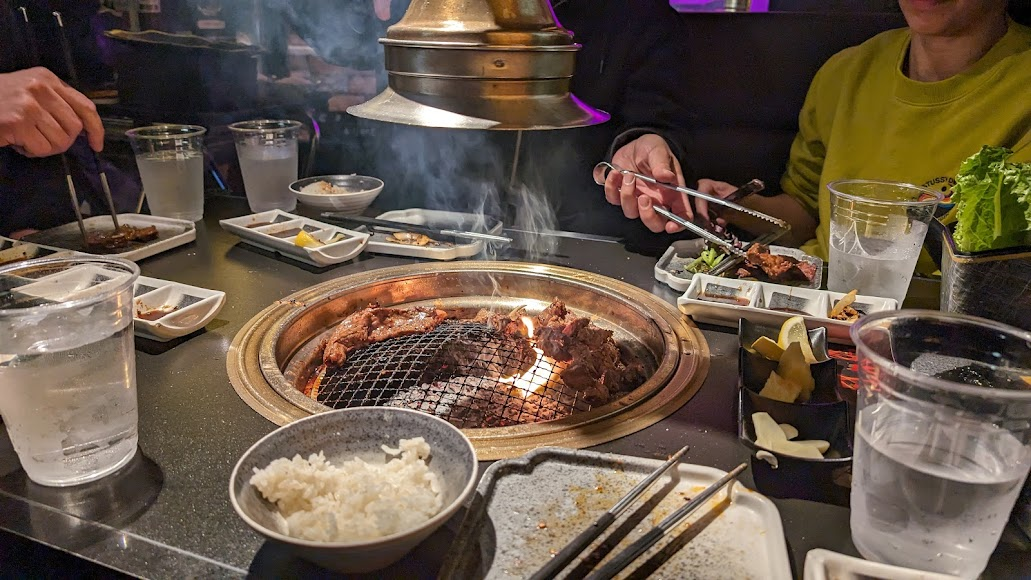
A Korean BBQ table with marbled short rib sizzling on a built-in grill, an array of colorful banchan side dishes surrounding the grill, tongs turning meat, diners' hands with chopsticks, smoke rising into a vent hood, warm ambient restaurant lighting, shot on Canon EOS R5, 35mm lens, shallow depth of field, ultra-realistic, photorealistic, no text, no watermark — no logos, no text overlay, no watermark, no cartoon, no illustration, no CGI
Most American KBBQ runs all-you-can-eat in pricing tiers — a standard tier with the classics, premium tiers adding marinated short rib, brisket, seafood — typically with a time limit and per-person pricing, kids priced separately.
The model's profitability sits on three controls. Tier integrity: a table on the standard tier ordering premium galbi is direct margin loss, and at scale it's not an edge case — it's a nightly pattern. Time discipline: KBBQ tables linger; without a managed clock, your Saturday waitlist eats the profit the dining room was supposed to produce. Waste control: unlimited ordering invites over-ordering, and meat hitting the trash is the most expensive failure in the building.
Enforcing all three by hand turns servers into referees at exactly the moment they're busiest. A Korean BBQ POS system encodes the model instead: per-person tiers assigned at seating, each guest's menu filtered to their tier automatically, visible timers with last-call alerts, round-size limits that meter the meat flow, and automatic surcharges when a table orders off-tier. Chowbus builds these AYCE controls natively — the same engine that powers its hot pot operations — so the rules your margins depend on execute themselves, politely and identically, at every table.
KBBQ service is continuous by design. Meat arrives in rounds so it hits the grill fresh; banchan refills never stop; lettuce, rice, and stews flow throughout. Every one of those requests traditionally requires catching a server's eye — and on a packed Friday, eye-catching is the slowest protocol in the restaurant.
QR table ordering rebuilds this flow. Guests order their next round of meat the moment they see the grill clearing — in English, Korean, Chinese, or Spanish — with their AYCE tier applied automatically. Banchan refills become a tap instead of a wave. The kitchen sees demand in real time and sequences the meat station accordingly, so proteins land at tables grill-ready rather than queueing behind whoever flagged a server first.
Two operational effects follow. Service labor redistributes toward the work that actually needs hands — grill swaps, vent checks, plate changes — which means the same staff covers more tables at higher quality. And rounds accelerate: tables that order the next wave instantly keep their two-hour window dense with eating rather than waiting, which is better for the guest and decisively better for table turns.
Kitchen routing has to match: meat-station tickets separated from stew and fried items, rounds grouped by table with clear sequence, kitchen displays in the language the line actually reads. Chowbus prints and displays kitchen tickets multilingually — English, Chinese, Korean, Japanese, Spanish — which in a KBBQ kitchen is the difference between flow and constant clarification.
Weekend KBBQ is a waitlist business, and the dining math is unforgiving: long-arc meals, large parties, limited grill tables. Recovering minutes per table is the highest-value optimization available.
The POS attacks it end to end. Waitlist management with SMS keeps parties accurate and lobbies calm; AYCE timers give tables a neutral, visible clock that staff never has to be the bad guy about; QR ordering strips the lag out of every round; kitchen timing keeps the meal moving; and when the window closes, the check is already computed — per-person tier pricing, drinks, surcharges — and splittable by guest in seconds, with QR payment at the table erasing the final wait-for-the-check dead zone.
Add the demand side: loyalty by phone number captures every guest across dine-in and takeout, birthday and win-back campaigns refill soft nights, and — in the Chowbus ecosystem — AI-driven ads put your restaurant in front of nearby diners on Google and Meta automatically. Full tables make turn time matter; the system works both levers.
KBBQ exposes generic systems fast, so script the demo yourself. Seat a party of six: two premium AYCE, three standard, one child. Verify each guest's QR menu matches their tier. Run three meat rounds and a banchan refill through QR; watch the meat-station ticket sequence and language. Let the timer hit last call. Order a premium item from a standard seat and check the surcharge prompt. Split the check by guest with one card and one cash payment.
Then the infrastructure questions: offline mode for a full house, hardware durability around grease and heat — KBBQ environments are harder on terminals and printers than almost any other format, so ask specifically about replacement pricing and turnaround — loyalty enrollment at the table, and support. KBBQ peaks on weekend nights — support with 24/7 availability, bilingual staff (English, Chinese, Spanish at Chowbus), 2-minute average response, and 95% resolution is the spec sheet line that saves an actual Saturday.
Korean BBQ is the rare format where the guest does the cooking and the restaurant still runs harder than anyone — because the service model is continuous and the pricing model needs constant enforcement. Both burdens are exactly what software is for.
A purpose-built KBBQ POS turns tier rules, timers, and round limits into things that simply happen, moves ordering to the table where the demand actually is, and gives the kitchen a clean, sequenced, readable signal. What's left for your team is the human part — the grill, the banchan, the hospitality — which is the part guests remember.
If your servers spend their nights as referees and your meat station works from ambiguous tickets, bring your six-top scenario to a purpose-built demo. Twenty minutes will show you what your current system has been costing.
What is a Korean BBQ POS system?
It's a POS built for KBBQ's specific operating model: per-person AYCE tier pricing with timers and round limits, QR table ordering for continuous meat rounds and banchan refills, station-aware multilingual kitchen routing, and per-guest check splitting. Generic systems can ring up KBBQ sales but can't enforce the AYCE mechanics the format's margins depend on.
How does AYCE tier pricing work in a KBBQ POS?
Staff assign tiers per guest at seating — standard, premium, child — and the system prices per head automatically. Each guest's ordering menu filters to their tier, time limits run with alerts, round sizes are metered to control waste, and off-tier orders trigger automatic surcharges. The rules execute in software, so servers never have to police tables.
Is QR ordering worth it for a Korean BBQ restaurant?
It's one of the strongest fits in the industry. KBBQ tables order continuously — meat rounds, banchan refills, drinks — and QR removes the flag-a-server delay from every request while applying each guest's AYCE tier automatically. Results show up as faster rounds, better-utilized staff, more add-on sales, and measurably shorter table times.
How much does a POS system for a Korean BBQ restaurant cost?
The structure is standard — monthly software, processing, hardware — but insist on AYCE controls, QR ordering, and waitlist tools being native rather than add-ons, since stacked module fees on generic platforms typically double advertised prices. All-in-one Asian-restaurant platforms like Chowbus bundle these natively; quote your real configuration including kitchen displays for the meat station.
Can Toast or Square handle a Korean BBQ restaurant?
They process payments capably, but neither was designed for per-person AYCE tiers, table timers, round metering, or tier-filtered menus — so operators on generic systems enforce the business model manually, which leaks margin or guest experience. Purpose-built platforms like Chowbus encode KBBQ logic directly, with multilingual operation across 9,000+ restaurants in all 50 states.
What should I look for in kitchen display systems for KBBQ?
Station routing (meat versus stew versus fry), round grouping by table with clear sequencing, timing visibility so meat lands grill-ready, and language flexibility so the line reads tickets natively. In KBBQ the meat station is the heartbeat — if the KDS can't sequence it cleanly, the dining room feels it within one seating.


