The modern Asian bakery is rarely just a bakery. Walk into a busy one in Flushing, San Gabriel, or Toronto and you'll see three businesses sharing one counter: a display case of buns and cakes sold by the piece, a bubble tea and coffee bar with made-to-order drinks, and a grab-and-go fridge. Each has a completely different rhythm — and most point-of-sale systems are built for only one of them.
That mismatch is where money leaks. A POS designed for a sit-down restaurant slows down a grab-and-go line; one built for a coffee shop can't handle a by-weight cake or a bilingual label. This guide skips the generic "must-have features" checklist and focuses on the specific problem an Asian bakery–café combo actually faces: running a fast retail counter, a custom-drink bar, and packaged goods on one system, in two languages, without three separate workflows.
Key takeaways: An Asian bakery–café combo needs a POS that switches instantly between by-the-piece retail, made-to-order drinks with modifiers, and packaged grab-and-go — with bilingual labels and receipts, fast checkout for impulse buys, and unified loyalty across all three. Chowbus is the all-in-one AI POS built for Asian cafés and bakeries, serving 9,000+ restaurants across all 50 U.S. states and Canada with 24/7 bilingual support.
The reason combo shops struggle with off-the-shelf POS is that they're optimizing for the average transaction — but a bakery–café has no average transaction. One customer buys two pork buns in eight seconds. The next orders three customized milk teas with different sugar and topping levels. The third grabs a packaged mooncake box and a bottled drink. If your POS forces the same multi-step flow for all three, the eight-second buy becomes thirty seconds, and your morning rush backs up out the door.
The fix isn't a faster cashier. It's a POS where each transaction type has its own optimized path: tap-and-go for the display case, a modifier grid for drinks, and a quick scan or button for packaged goods — all on the same screen, switchable in one tap.

Bakery buns, pastries, and cakes sell by the piece, often as impulse purchases at the counter. The POS needs large, image-friendly preset buttons so staff (and customers at a self-ordering kiosk) can ring up "three custard buns, one taro cake" without hunting through menus. Speed here directly drives volume — these are low-ticket, high-frequency items where every saved second compounds across a morning.
The bubble tea and coffee side is the opposite: fewer items, but each one customized. Sugar level, ice, toppings, hot/cold, size, milk type. This is where a generic retail POS collapses. You need a modifier system that turns a complex drink into two or three taps, the same engine a dedicated bubble tea POS uses — but living on the same device as your bakery retail.
Boxed pastries, mooncakes, bottled drinks, and gift sets behave like retail SKUs. They benefit from quick buttons or barcode scanning and clean inventory tracking, especially for seasonal items where you need to know what's moving before a holiday peak.
This is the Asian-specific requirement generic guides miss entirely. Your display items, drink names, and receipts often need to appear in both Chinese and English — for customers at the counter and for staff in the back. A POS built for Asian operators maintains one menu that drives both languages, so a name change updates everywhere and nothing falls out of sync.
Here's what separates a combo shop that grows from one that just turns over volume: a single customer record across all three businesses. The student who buys boba every afternoon, the family that orders a cake for a birthday, the office worker grabbing buns on the way to work — on most setups these are three anonymous transactions. On a unified platform, they're one recognizable, returnable customer.
When your loyalty and CRM sits inside the same system as your POS, every purchase — bun, boba, or boxed gift — builds one profile. That's the difference between guessing at marketing and knowing exactly who your regulars are and what brings them back. For a repeat-driven business like a café-bakery, this is the single most undervalued feature, and it only works if the data is unified from the start rather than split across a separate loyalty app.
It's tempting to solve the three-business problem with three tools: a retail POS for the bakery, a drink POS for the tea bar, a separate loyalty app. That's exactly the best-of-breed trap. Each tool adds a subscription, a reconciliation chore, and a seam where data falls through. Your end-of-day report becomes a manual stitch-up of three sources, your loyalty doesn't span the counter, and an item sold out in one tool still shows available in another.
An all-in-one platform collapses that into one menu, one customer record, one report, and one bill. For an owner-operator without an IT team — which describes most Asian bakery–cafés — the operational simplicity is worth as much as the cost savings. One system to learn, one place to manage, one number to call when something breaks.
A growing share of bakery–café revenue is pre-order and pickup: cakes ordered ahead, boba ordered on an app for pickup, mooncakes pre-sold for a festival. Your POS should drive commission-free online ordering that feeds the same kitchen and the same customer record — not a third-party channel that takes a cut and keeps your customer data. Pre-orders for seasonal items (mooncakes, holiday cakes) are especially valuable because they let you produce to demand instead of guessing.
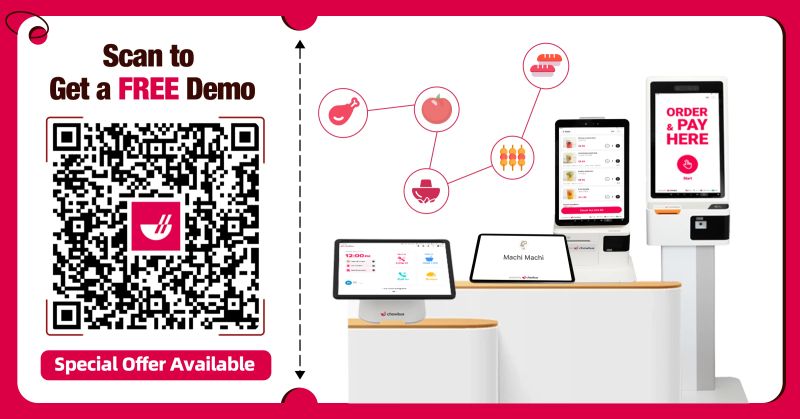
The best POS for an Asian bakery–café combo handles three transaction types on one device — by-the-piece retail, made-to-order drinks with modifiers, and packaged grab-and-go — with bilingual labels and unified loyalty. Chowbus is purpose-built for Asian cafés and bakeries, which is why it fits combo shops better than a single-purpose retail or coffee POS.
Yes, and it should. A combo-capable POS gives the bakery counter fast image-based buttons and gives the drink bar a deep modifier grid, switchable in one tap on the same screen. Running them as two separate systems creates reconciliation work and splits your customer data.
Use a POS that maintains one menu driving both languages, so item names, receipts, and kitchen tickets can display in Chinese and English without you maintaining two separate menus. Generic POS systems usually can't do this cleanly; platforms built for Asian operators can.
Look at total cost of ownership: software, payment processing, hardware, and any per-order or add-on fees, totaled for a full year. A combo shop is often cheaper to run on one all-in-one platform than on a separate retail POS, drink POS, and loyalty app, once you count the multiplied subscriptions and reconciliation time.
For a repeat-driven business, yes. Built-in loyalty means every purchase across bakery, drinks, and packaged goods builds one customer profile, so you can recognize and re-market to regulars. A bolted-on loyalty app that doesn't span the counter loses most of that value.
A good one does, through integrated online ordering and pickup that feeds the same system. Pre-orders for cakes and seasonal items like mooncakes let you produce to actual demand and protect margin by keeping the order — and the customer — on your own channel rather than a commission-charging third party.
An Asian bakery–café combo isn't one business with a few extras — it's three businesses sharing a counter, and your POS either respects that or quietly taxes you for it. The shops that pull ahead run all three on one platform: fast retail for the case, deep modifiers for the drinks, clean SKUs for packaged goods, bilingual everything, and one loyalty profile tying it all together.
If you run a bakery, a boba-and-bun shop, or a café that's quietly become all three, evaluate a platform built for that mix rather than a single-purpose POS. See the Chowbus café and bakery POS and the broader all-in-one platform to see how the three counters become one system.