餐饮资讯
/
POS系统
/
Best POS for Coffee Shop: What to Look for When Every Order Has Five Modifiers

Best POS for Coffee Shop: What to Look for When Every Order Has Five Modifiers

A coffee shop order is rarely just "one coffee." It's oat milk, extra shot, half-sweet, light ice, for here or to go — and if you run a bubble tea counter, multiply that by sugar level, ice level, and topping choices, and a single drink can have dozens of possible combinations. Most point-of-sale systems handle "add a modifier" fine. Far fewer handle a modifier tree that deep without slowing down the line or confusing new staff.

Coffee and tea concepts are one of the fastest-growing restaurant categories in North America, and a large share of that growth is coming from Asian-owned cafés and bubble tea shops that need more customization logic than a typical drip-coffee POS was built for. Systems serving this space at scale — Chowbus works with 9,000+ restaurants across all 50 U.S. states, including a large base of bubble tea and Asian café concepts — have had to solve for exactly this kind of order complexity.

In this guide, you'll learn what actually separates a good coffee shop POS from a mediocre one, so you can pick a system that keeps your line moving instead of fighting your menu. Before comparing specific systems, it's worth understanding why coffee shop POS needs are different from a typical restaurant's.

Why Coffee Shops (and Bubble Tea Shops) Need a Different Kind of POS

A sit-down restaurant might take twenty orders an hour. A busy coffee or bubble tea shop can take that many in fifteen minutes, often with a line out the door during morning or afternoon rushes. That volume changes what matters in a POS:

  • Speed of entry — every extra tap per order adds up across hundreds of transactions a day
  • Modifier depth — milk type, syrup pumps, temperature, sweetness level, ice level, and toppings all need to be quick to select, not buried in submenus
  • Order naming and call-out — baristas need a fast way to identify whose drink is whose, especially with rush-hour volume
  • Mobile and counter flexibility — many shops need to take orders both at a counter and via handheld devices during peak hours

Bubble tea shops add another layer entirely: sugar level (0%, 30%, 50%, 70%, 100%), ice level (no ice, less ice, regular, extra ice), and topping combinations (boba, popping boba, grass jelly, pudding, cheese foam) can multiply into hundreds of order variations per drink type. A POS that treats this as a single "customize" button rather than a structured, fast-selecting modifier system will slow down exactly the shops that need speed the most.

Modifier Logic: The Feature That Makes or Breaks a Coffee Shop POS

This is the single biggest differentiator between a "fine" coffee shop POS and a genuinely good one. Look specifically at:

  • How many modifier tiers the system supports — some platforms cap out at one or two levels, which doesn't cover milk + syrup + temperature + sweetness + toppings simultaneously
  • Default selections — can you set common defaults (e.g., "regular ice, 100% sugar") so staff aren't re-selecting the same options for every order
  • Combo and set pricingbakery-café hybrids and combo deals (drink + pastry) need pricing logic that a basic modifier system often can't handle correctly
  • Speed under pressure — the real test isn't the demo, it's whether a new hire can ring up a fully customized bubble tea order in under ten seconds after a week of training

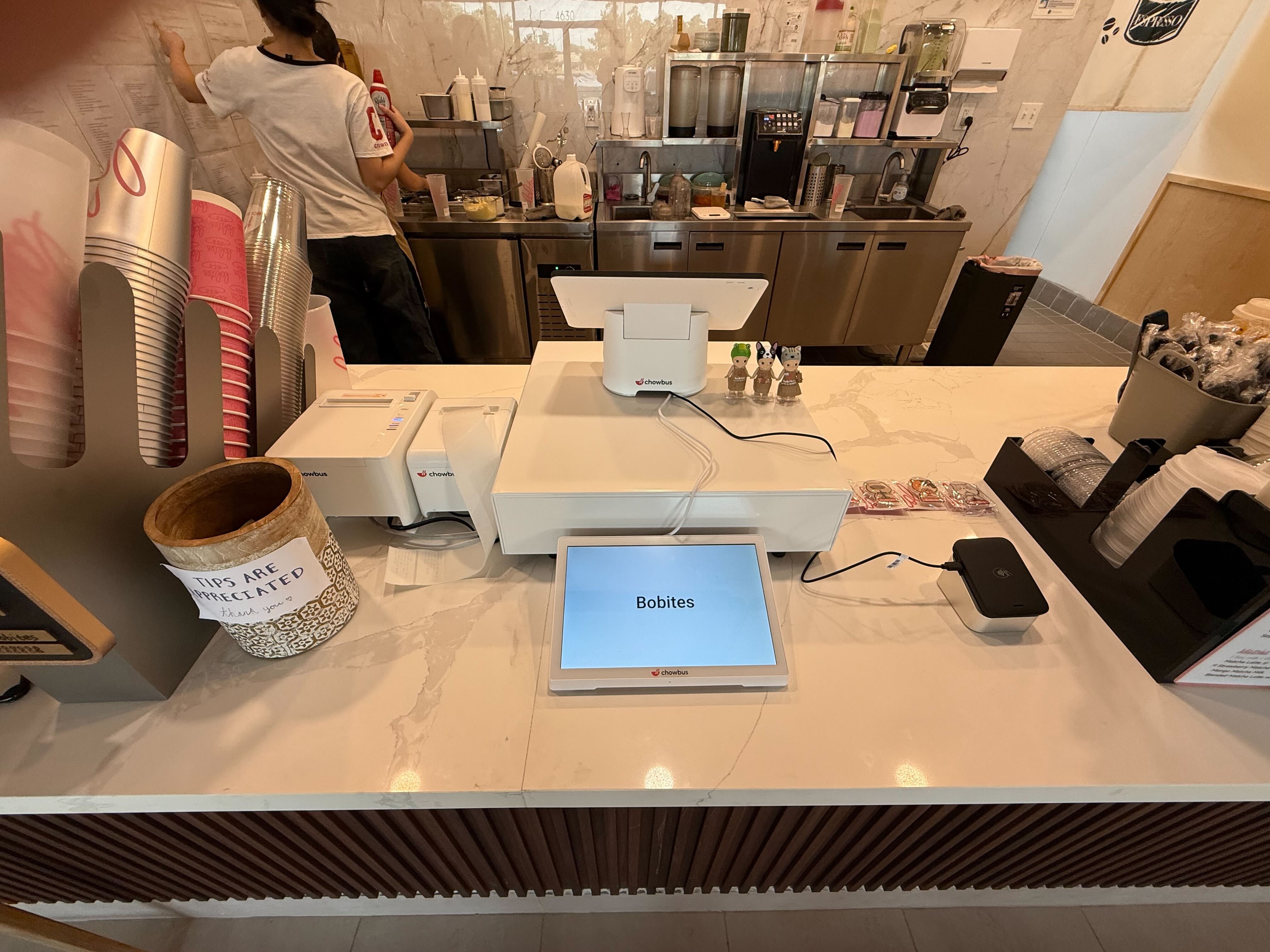
Generic small-business POS platforms often support basic modifiers but weren't designed around beverage-heavy, high-modifier-count menus. This is a specific area where Chowbus's cafe and bakery-focused POS was built with that order structure in mind, rather than treating tea and coffee customization as an edge case bolted onto a retail-first system.

Speed at the Counter: Where Minutes Turn Into Lost Sales

In a coffee shop, the POS is the bottleneck or the accelerant for your entire line — there's no back-of-house buffer to absorb a slow register the way a sit-down restaurant kitchen might. A few concrete things to evaluate:

  • Screen layout — can your most popular items and modifiers be reached in one or two taps, or does staff have to hunt through nested menus
  • Line-busting support — during rush hours, can a second staff member take orders on a handheld or tablet while the main register keeps moving
  • Kitchen/bar display integration — orders should route straight to the bar or kitchen without a staff member re-entering anything by hand
  • Payment speed — tap-to-pay and stored customer profiles reduce the seconds spent per transaction, which matters enormously at volume

A coffee shop doing 300 transactions a day loses meaningfully more time to a clunky POS than a restaurant doing 80 covers a dinner service, simply because of how compressed the ordering window is.

Online and Mobile Ordering for Coffee Shops

Pre-ordering has become a real driver of coffee shop revenue, letting customers skip the line entirely for pickup. But this only works if the online ordering system is genuinely connected to the in-store POS — otherwise you end up printing out web orders and re-entering them by hand, which defeats the purpose and introduces errors.

For bubble tea and Asian café concepts specifically, this matters even more, because a large share of customers may prefer to browse and customize a drink order in Chinese or with drink names they already know from apps back home. A POS with integrated, bilingual-friendly online ordering — where a customer's saved "usual order" carries over automatically — removes friction that a generic online-ordering bolt-on can't replicate.

Loyalty and Repeat Business: Where Coffee Shops Live or Die

Coffee and bubble tea are habit businesses — a shop's economics depend heavily on repeat visits, not one-time customers. A POS that captures customer data at every transaction and turns it into a usable loyalty program is doing real work for the business, not just a nice-to-have feature.

Look for:

  • Automatic profile creation at point of sale, not a separate sign-up flow customers have to opt into manually
  • Punch-card or points-based rewards that staff can apply without slowing down the line
  • Targeted marketing tools — the ability to message lapsed customers or push a promotion to regulars without needing a separate marketing platform

This is where all-in-one systems have an edge over a bare-bones POS paired with a separate loyalty app: when loyalty and POS live in the same system, data flows automatically instead of requiring manual reconciliation between two disconnected tools.

Support and Reliability When the Morning Rush Depends on It

A frozen register at 7:45 AM during the morning commute rush is a worst-case scenario for a coffee shop — there's no slow period later in the day to recover the lost sales. This makes support responsiveness one of the most practical (if unglamorous) things to evaluate before choosing a system.

Ask any vendor: what are your actual support hours, is bilingual support available if your staff needs it, and what's the average response time during a live outage? Systems offering 24/7 bilingual support with fast average response times exist specifically because "call back during business hours" isn't good enough when your business hours are the emergency.

Frequently Asked Questions

What is the best POS for a coffee shop or bubble tea shop?It depends on your menu complexity and order volume, but for shops with deep modifier needs (milk types, sweetness levels, ice levels, toppings), a system built around beverage-heavy menus — like Chowbus's cafe and bakery POS — tends to outperform generic small-business platforms that treat customization as an afterthought.

How much does a coffee shop POS system cost?Expect a monthly software fee (commonly $50-$150+ per location), hardware costs (registers, card readers, kitchen/bar display screens), and payment processing fees. Systems with integrated online ordering and loyalty tools may bundle these or charge separately, so ask for an all-in monthly estimate at your actual volume.

Is a coffee shop POS different from a regular restaurant POS?Yes, mainly in modifier depth and transaction speed requirements. Coffee and bubble tea shops process high volumes of highly customized, lower-ticket orders, so the POS needs fast modifier selection and quick payment flow more than it needs complex table management.

Can a coffee shop POS handle bubble tea customization (sugar level, ice level, toppings)?A good one should — look specifically for multi-tier modifier support with default settings, since bubble tea orders often require three or more customization layers per drink. Not all POS platforms support this depth natively.

How do I switch POS systems without disrupting daily operations?Plan the switch during a lower-traffic period, have your new provider help build your modifier-heavy menu in advance, and run a short staff training session before going live. Providers with dedicated onboarding support typically get shops running within one to two weeks with minimal disruption.

Does a coffee shop need online ordering built into its POS?If pre-order pickup is (or could be) part of your business, yes — a POS with integrated online ordering avoids the double-entry and errors that come from a disconnected web ordering tool, and keeps your loyalty data in one place.

Bringing It Back to Your Counter

The best POS for a coffee shop isn't the one with the flashiest screen — it's the one that keeps your line moving when six customers are waiting and every drink has a different modifier combination. That means prioritizing modifier depth, counter speed, and reliable support over generic feature checklists built for simpler retail businesses.

If you're running a bubble tea shop or an Asian café, pay particular attention to how a system handles multi-layer customization, whether it supports the languages your staff and customers use, and whether online ordering actually connects to your in-store system instead of creating a second workflow. These are the details that determine whether your morning rush runs smoothly or turns into a bottleneck.

Whatever you choose, ask for a real demo using your actual menu, not a generic one — watch how many taps it takes to ring up your most complicated drink, and how the system behaves during a simulated rush. That test tells you more about day-to-day fit than any spec sheet.

更多内容

了解更多
分类频道