In the fast-paced world of quick-service restaurants (QSRs), time is the only currency that truly matters. Whether you’re running a high-volume boba shop, a bustling sandwich counter, or a trendy fast-casual spot, the friction between a customer’s craving and their first bite needs to be as thin as possible.
In 2026, the stakes are higher than ever. With rising labor costs and the explosion of multi-channel ordering, your quick service restaurant pos system can no longer just be a digital cash register. It needs to be the central nervous system of your entire operation.
At its core, a quick service restaurant pos system is a specialized technology platform built for speed and high-volume transactions. Unlike full-service systems—which prioritize table maps, coursing, and long-duration guest management—a QSR POS is engineered to move a line.
It is designed to handle "counter-service" workflows where the guest pays before they eat. This includes everything from face-to-face counter orders and self-service kiosks to online orders coming from your website or third-party delivery apps.
A modern system doesn't just "take an order." it manages a complex data flow in real-time to ensure your kitchen stays sane and your customers stay happy. Here is the typical workflow:
If you are evaluating a new quick service restaurant pos system, skip the flashy marketing and look for these "must-have" core functionalities:
Labor is expensive and hard to find. A POS that offers native kiosk integration allows you to redirect your staff to higher-value tasks like food prep or customer service. A good kiosk doesn't just take orders; it uses AI-driven suggestions to upsell a drink or a side, often increasing average check sizes by 15-20%.
In a QSR, if your internet goes down for 10 minutes during a lunch rush, you don't just lose sales—lose your reputation. Your POS must be able to process payments and keep the kitchen running even when the Wi-Fi fails.
You shouldn't need five different tablets on your counter. A high-quality system aggregates orders from DoorDash, UberEats, and your own online ordering site directly into the POS and KDS.
The interface should be "smart." If a customer says, "I want a burger with no onions and a Coke," the cashier should be able to tap those items in any order without the system throwing an error or forcing them to restart.
Thinking about an upgrade?
Transitioning to a faster workflow doesn't have to be complicated.
Explore how our streamlined POS solutions can help you shave seconds off every transaction.
Investing in a dedicated quick service restaurant pos system isn't just a cost—it’s a strategy to reclaim your margins.
While many systems claim to be "all-in-one," QSR-specific systems are best suited for:
When comparing systems, don't just look at the monthly software fee. Consider the "Total Cost of Ownership":
Q: Can I keep my existing merchant processor with a new POS?
A: Some systems allow this, but most modern QSR POS systems are "integrated" to ensure maximum speed and data accuracy. Integrated payments usually lead to fewer reconciliation errors at the end of the night.
Q: How does a POS help with my "hidden" food costs?
A: By linking your menu items to specific recipes in the inventory module, the system tells you exactly how much product should be left. If the numbers don't match, you know you have a portioning or waste problem.
Q: Is it hard to switch systems if I have a huge menu?
A: Not with the right partner. Professional QSR POS providers often offer menu migration services to ensure your modifiers and categories are set up correctly for speed from Day 1.
Q: Do I really need a KDS, or are paper tickets fine?
A: Paper tickets get lost, greasy, and don't provide data. A KDS tracks "time to fulfill," allowing you to see exactly where the bottleneck is in your kitchen.
In the restaurant industry, the "quick" in Quick Service is a promise you make to your customers. If your current technology makes it hard for your team to keep that promise, it's time for a change. A powerful quick service restaurant pos system empowers your staff, delights your customers, and protects your profits.
Ready to see how the right tools can transform your daily operations?
Stop managing chaos and start managing growth.
Our team is ready to show you a system designed for the speed of modern dining.
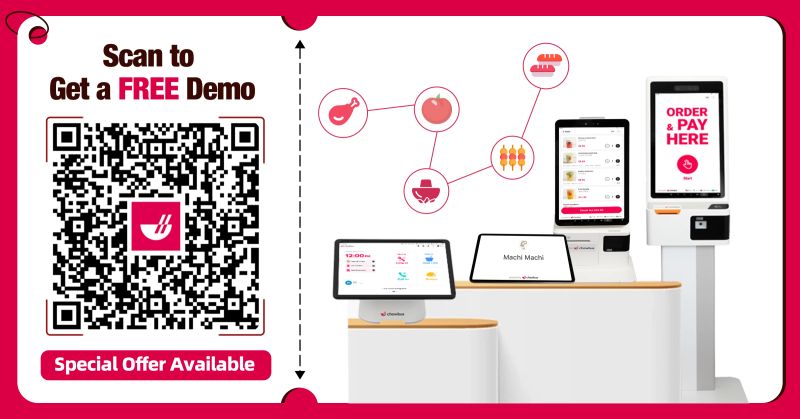
Scan here or click to book a 1-on-1 demo with our QSR experts.