餐饮资讯
/
手持POS系统
/
Handheld POS System: How Tableside Technology Speeds Up Service and Cuts Order Errors

Handheld POS System: How Tableside Technology Speeds Up Service and Cuts Order Errors

A server walking back and forth between the table and a fixed terminal isn't just slow — every one of those trips is a few minutes your dining room isn't turning over, and a few more seconds where an order sits unsent while the kitchen waits idle. A handheld POS system removes that walk entirely, and it's one of the simplest hardware changes a full-service restaurant can make with an immediate, measurable payoff.

Handheld POS adoption has moved from a novelty to a standard fixture in busy dining rooms across North America, and it's become a particularly natural fit for the fast-growing Asian restaurant sector — a category that's grown 135% over the past 25 years and is projected to reach $240 billion by the end of 2026. Chowbus supports 9,000+ restaurants across all 50 U.S. states, a meaningful share of them full-service and banquet-style operations where tableside technology handles high table counts and complex, multi-course orders.

In this guide, you'll get a clear, practical look at how a handheld POS system actually improves table turn times and order accuracy, how it applies specifically to AYCE hot pot, Korean BBQ, and banquet-style dining, and what to check before choosing one. From there, the specifics of how it changes day-to-day service.

What Is a Handheld POS System and Why Dining Rooms Are Adopting It

A handheld POS system is a mobile device — typically a ruggedized tablet or phone-sized terminal — that lets servers take orders and process payments directly at the table, rather than walking to a fixed terminal at a host stand or server station. Orders entered on the handheld route immediately to the kitchen display or printer, and payment can be completed tableside, including tap-to-pay and chip transactions, without the guest's card ever leaving their sight.

The appeal for restaurants is straightforward: every trip a server makes to a fixed terminal is time not spent serving other tables, and every minute a payment sits unprocessed after a meal is a minute that table isn't turning over for the next party. In a dining room running near capacity during peak hours, those minutes compound quickly across dozens of tables a night.

The Table Turn and Labor Case for Handheld POS

Table turn time is one of the highest-leverage numbers in full-service dining, since a restaurant with a fixed number of seats can only generate more revenue in a given night by serving more parties per table, not by raising prices indefinitely. A handheld POS system directly shortens two of the slowest parts of that cycle: the time between a guest deciding to order and the kitchen receiving that order, and the time between a guest asking for the check and actually paying it.

Both delays shrink when a server can enter an order or process payment from wherever they're standing, rather than making a dedicated trip to a terminal. Multiply that across a full section of tables during a busy Friday or Saturday night, and the cumulative time savings translate into either more table turns per night or reduced wait times for guests — both of which affect revenue directly.

There's a labor angle too: servers spend less time walking and more time actually serving, which tends to improve both the guest experience and tip performance, and reduces the physical toll of a shift that involves constant back-and-forth trips across a dining room.

How Handheld POS Changes Order Accuracy and Payment Speed

Order accuracy improves for a simple reason: an order entered directly at the table, in front of the guest, gets confirmed on the spot rather than relying on a server's memory during a walk back to a terminal. Modifications, allergy notes, and special requests are captured in real time rather than recalled minutes later from memory — a meaningful risk reduction for restaurants serving dishes with complex ingredient lists or common allergens like peanuts and shellfish.

Payment speed improves for a related reason: a handheld terminal lets a server close out a check the moment a guest is ready, rather than requiring a trip to retrieve a card, a trip to run it, and a trip back with the receipt. For guests, especially in fast-paced lunch service, this alone can shave several minutes off the total dining experience without rushing the meal itself.

Handheld POS in AYCE Hot Pot, Korean BBQ, and Banquet-Style Dining

Handheld POS systems have a particularly strong fit in Asian restaurant formats that involve frequent mid-meal ordering or complex table-based billing:

AYCE hot pot and Korean BBQ restaurants often see guests ordering multiple rounds of meat, vegetables, and drinks throughout a meal rather than placing one order upfront. A handheld POS lets servers take these rounds of add-on orders directly at the table and send them to the kitchen instantly, rather than collecting requests and walking back to a station — which matters when a table is waiting on the next round of protein to keep cooking.

Banquet and family-style dining, common in Chinese, Korean, and Vietnamese restaurants for large group bookings, often involves splitting a bill across multiple methods or guests. A handheld system lets a server manage that complexity right at the table rather than making repeated trips to sort out a split check at a terminal.

Bilingual order entry and receipts matter here too — a handheld POS that supports Chinese-language menu items and receipts reduces friction for bilingual staff working a bustling dining room, and Chowbus's handheld POS was built with this bilingual support as a core capability, reflecting its focus on Asian restaurant operations specifically.

Core Features to Look For in a Handheld POS System

Not every handheld device delivers the same value, and a few features separate a genuinely useful system from an expensive gadget:

  • Real-time kitchen routing — orders should hit the kitchen display or printer instantly, not after a delay or manual sync.
  • Offline reliability — a handheld that fails when Wi-Fi drops during a busy Saturday night creates more problems than it solves; look for systems with reliable offline order queuing.
  • Battery life built for a full shift — a device that needs mid-shift charging defeats the purpose.
  • Integrated payment processing — tap-to-pay, chip, and split-check handling directly on the device, without a separate card reader creating extra steps.
  • Menu and pricing sync with your main POS — a handheld running on outdated menu data creates the exact order errors it's meant to prevent.
  • Bilingual interface support — relevant for restaurants with bilingual waitstaff or a significant Chinese-speaking customer base, where servers may take orders more accurately when the interface matches their most comfortable language.

Chowbus's handheld POS integrates directly with the same backend as its full POS system, KioskPRO, and online ordering tools, so an order taken tableside feeds the same kitchen routing, reporting, and inventory data as every other channel in the restaurant.

Handheld POS vs. Fixed Terminals vs. Tablet-at-Table

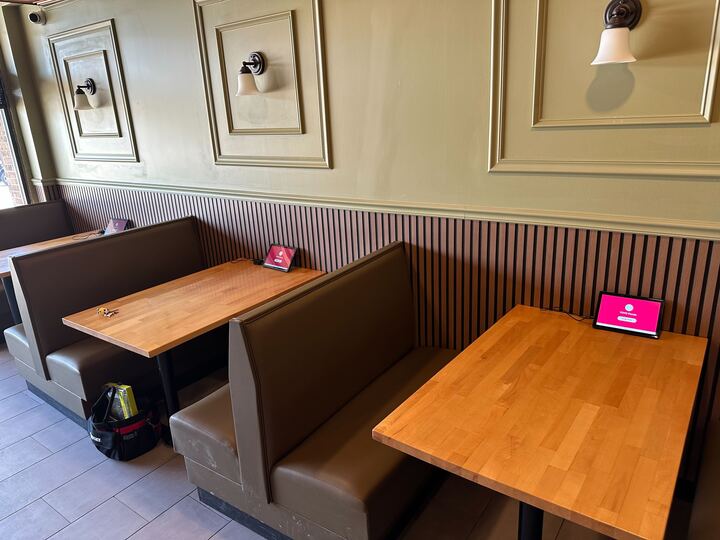
Restaurants generally weigh a handheld POS against two alternatives. Fixed terminals (the traditional model, with servers walking to a host stand or server station) require no additional hardware investment but carry the highest labor time cost per order and the highest risk of miscommunication during the walk back. Tablet-at-table systems, where a device stays mounted at each table for guests to browse or reorder, work well for certain fast-casual formats but don't offer the same mobility for a server managing an entire section, and don't help with payment speed the way a handheld carried by staff does.

Among dedicated POS providers, Toast and Square both offer handheld hardware as part of broader POS ecosystems and are reasonable general-purpose choices, though neither is built with bilingual order entry or AYCE/banquet billing complexity as a starting design point. Clover offers handheld options as well, but comes with notably higher hardware costs and more vendor lock-in, which matters if a restaurant expects to expand and needs pricing flexibility later. MenuSifu, with deep experience serving 15,000+ Asian restaurants, is familiar with the cuisine side of the business but has been slower to modernize some of its technology stack and charges per-order fees in some configurations, which can add up for high-volume, full-service dining rooms.

Chowbus's handheld POS was built specifically to unify with the rest of a restaurant's operations — kitchen routing, reporting, loyalty, and online ordering — so a tableside order doesn't live in a separate silo from everything else happening in the restaurant that night.

Rollout Tips

A handheld POS rollout is typically faster than owners expect. Start with a short staff training session focused on the core workflow — order entry, sending to kitchen, processing payment — rather than every feature at once. Run a brief overlap period where both fixed terminals and handhelds are available, letting staff build comfort with the new device during a slower shift before relying on it during peak hours. Expect a short adjustment period of a week or two before servers fully internalize the new workflow and stop defaulting back to old habits.

Frequently Asked Questions

What exactly is a handheld POS system?It's a mobile point-of-sale device — usually a ruggedized tablet or terminal — that lets servers take orders and process payments directly at the table, rather than walking to a fixed station. Orders route immediately to the kitchen, and payment, including tap-to-pay, can be completed tableside.

How does a handheld POS system actually improve table turn time?It removes the walking time between a table and a fixed terminal for both order entry and payment, two of the slowest points in a dining cycle. Across a full section during a busy shift, that time savings adds up to either more table turns per night or shorter guest wait times.

Is a handheld POS system better than a fixed terminal for a full-service restaurant?For most full-service and banquet-style restaurants, yes — the mobility reduces labor time per order and speeds up payment, both of which directly affect revenue in a seat-limited dining room. Fixed terminals still make sense for smaller, low-volume restaurants where the investment may not be justified.

How much does a handheld POS system cost?Costs vary by provider and whether the device is bundled with an existing POS system or purchased as standalone hardware. Systems like Chowbus's handheld POS, which integrate directly with your existing POS backend, are typically priced as part of your overall system rather than a separate, disconnected purchase.

Does a handheld POS system work well for AYCE hot pot or banquet dining with complex, split bills?Yes — handheld systems are particularly well-suited to formats with mid-meal add-on ordering (extra hot pot ingredients, drink refills) and complex billing (split checks across a large group), since servers can manage both directly at the table rather than making repeated trips to a fixed terminal.

What's the first step to adding a handheld POS system to my restaurant?Start by identifying where your current service is losing the most time — order entry, payment processing, or both — and confirm a candidate handheld system integrates with your existing kitchen routing and reporting rather than operating as a separate, disconnected device.

Bringing It Together

A handheld POS system addresses one of the most persistent inefficiencies in full-service dining: the time a server spends walking to and from a fixed terminal, multiplied across every order and every check throughout a shift. The restaurants seeing the clearest returns aren't necessarily running the busiest dining rooms — they're the ones that recognized how much of their labor time was going toward walking rather than serving, and fixed it with a piece of hardware that pays for itself in table turns alone.

If your restaurant runs a full dining room during peak hours, handles AYCE or banquet-style service with frequent add-on orders, or manages complex split checks for large group bookings, a handheld POS system built around those specific demands tends to deliver a faster, more measurable payoff than a generic setup borrowed from a different kind of restaurant.

Before choosing a handheld POS provider, it's worth confirming the system integrates cleanly with your existing kitchen routing, reporting, and menu data — since a handheld operating in isolation from the rest of your restaurant's systems rarely delivers the full benefit it's capable of.

更多内容

了解更多
分类频道