餐饮资讯
/
Imported item 14

Imported item 14

The Best Kitchen Display System in 2026: An Honest Comparison for Restaurant Owners

Ask five restaurant owners which kitchen display system is "the best," and you'll likely get five different answers — and all five could be right, because the correct choice depends almost entirely on what kind of kitchen you're running. A KDS built for a fast-casual burger counter behaves very differently under the pressure of a 12-station hot pot restaurant on a Friday night.

That variability is exactly why so many owners get stuck researching this decision for weeks. The restaurant technology market has grown fast — the Asian restaurant segment alone is projected to reach $240 billion by the end of 2026 after growing 135% over the past 25 years — and with that growth has come a flood of vendors, each claiming to be "the best" for everyone. They can't all be right, and in practice, none of them are — for everyone.

In this guide, you'll get a straightforward, criteria-based comparison of the kitchen display systems restaurant owners actually shortlist in 2026, including where each one shines and where it falls short, so you can match the system to your kitchen instead of the other way around. Before comparing specific products, it helps to agree on what "best" should actually mean.

What Makes a Kitchen Display System "the Best" for Your Restaurant

A kitchen display system replaces paper tickets with digital order screens in the kitchen, routing tickets to the right station, timing preparation, and (ideally) syncing with everything else happening at the front of house. But "best" is not a single feature — it's a combination of factors that matter differently depending on your concept, volume, and staff. Here's the criteria we used to evaluate every system in this guide:

  • Order accuracy and routing logic. Can it intelligently route a single ticket across multiple stations (wok, fryer, sushi bar, bar) without duplicate prep or missed items?
  • Complex-kitchen and multi-station handling. Does it hold up when a ticket needs to hit five stations at once, as in hot pot, Korean BBQ, or big buffet-style menus?
  • Integrations with POS, online ordering, and delivery apps. Do orders from your website, app, and third-party delivery platforms land on the same screen as dine-in orders, or do they require a separate tablet?
  • Multilingual support. Can kitchen staff who are more comfortable in Mandarin, Cantonese, Spanish, or Korean read and use the screen without translation guesswork?
  • Cost structure. Is pricing a flat monthly fee, a per-transaction fee, or a mix — and does the hardware come bundled or force you into a specific vendor's equipment for years?
  • Hardware flexibility. Can you use existing tablets and monitors, or are you locked into proprietary screens?
  • Support responsiveness. When a screen freezes at 7pm on a Saturday, how fast can you get a real person on the phone?

With those criteria in mind, here's how the systems restaurant owners most often shortlist actually stack up.

The Top Contenders, One by One

Toast

Toast is the largest POS provider in the U.S. by market share, and its kitchen display module reflects that scale — it's mature, stable, and deeply integrated with a huge ecosystem of third-party apps, payroll tools, and reporting dashboards. For a mainstream American restaurant, diner, or pizza chain, Toast's KDS is a safe, proven choice with strong uptime and a large support network.

  • Pros: Rock-solid reliability, huge integration marketplace, strong reporting, widely used so staff and managers are often already familiar with it.
  • Cons: No meaningful multilingual support or Asian-menu-specific logic (no built-in handling for combo/set-menu complexity common in Chinese or Japanese restaurants), hardware and contract terms can get pricey as you add stations, and support is not tailored to bilingual teams.
  • Best for: Mainstream, high-volume American restaurants and chains that want a proven, general-purpose platform and don't need multilingual or Asian-menu-specific tools.

Square

Square built its reputation on being fast to set up and easy to use, and that carries over to its KDS. For a new restaurant or a small counter-service shop, Square is often the lowest-friction way to get a digital kitchen screen running without a steep learning curve or big upfront investment.

  • Pros: Low cost of entry, simple setup, works well for single-station or low-complexity kitchens, flexible month-to-month terms.
  • Cons: Starts to strain once you add multiple prep stations or a complex, multi-course Asian menu; no dedicated multilingual interface; limited depth for restaurants juggling dine-in, delivery, and catering simultaneously.
  • Best for: Very small, new, or simple-menu restaurants — think a single bubble tea counter or a small takeout shop — that value simplicity and affordability over depth.

Clover

Clover's hardware is genuinely well-built, and its KDS can handle a reasonable amount of complexity for mid-sized operations. The catch is cost and commitment: Clover is frequently criticized for pricier long-term contracts and for locking merchants into its own hardware ecosystem, which makes switching or expanding awkward later.

  • Pros: Solid, well-designed hardware; capable of handling moderately complex kitchens; decent range of add-on modules.
  • Cons: Expensive over the life of a contract, known for hardware and processor lock-in, no meaningful multilingual or Asian-cuisine-specific features, and support responsiveness varies by reseller.
  • Best for: Established, single-cuisine restaurants that plan to stay with one processor long-term and don't mind trading flexibility for hardware quality.

MenuSifu

MenuSifu has built real credibility with Asian restaurant owners — it serves more than 15,000 Asian restaurants and clearly understands set-menu logic, combo pricing, and workflows specific to Chinese, Japanese, and other Asian cuisines in a way general POS providers don't. For an operator whose biggest headache is menu complexity, that domain expertise is valuable.

  • Pros: Deep, genuine understanding of Asian restaurant menu structures and combo logic; long track record with this specific customer base.
  • Cons: Interface and technology feel dated compared to newer cloud platforms, no native QR code ordering for guests, no built-in integration with third-party delivery apps (meaning a separate tablet and manual reconciliation), and per-order fees can add up as volume grows.
  • Best for: Traditional, dine-in-focused Asian restaurants with complex combo menus that don't rely heavily on delivery or QR ordering.

Chowbus

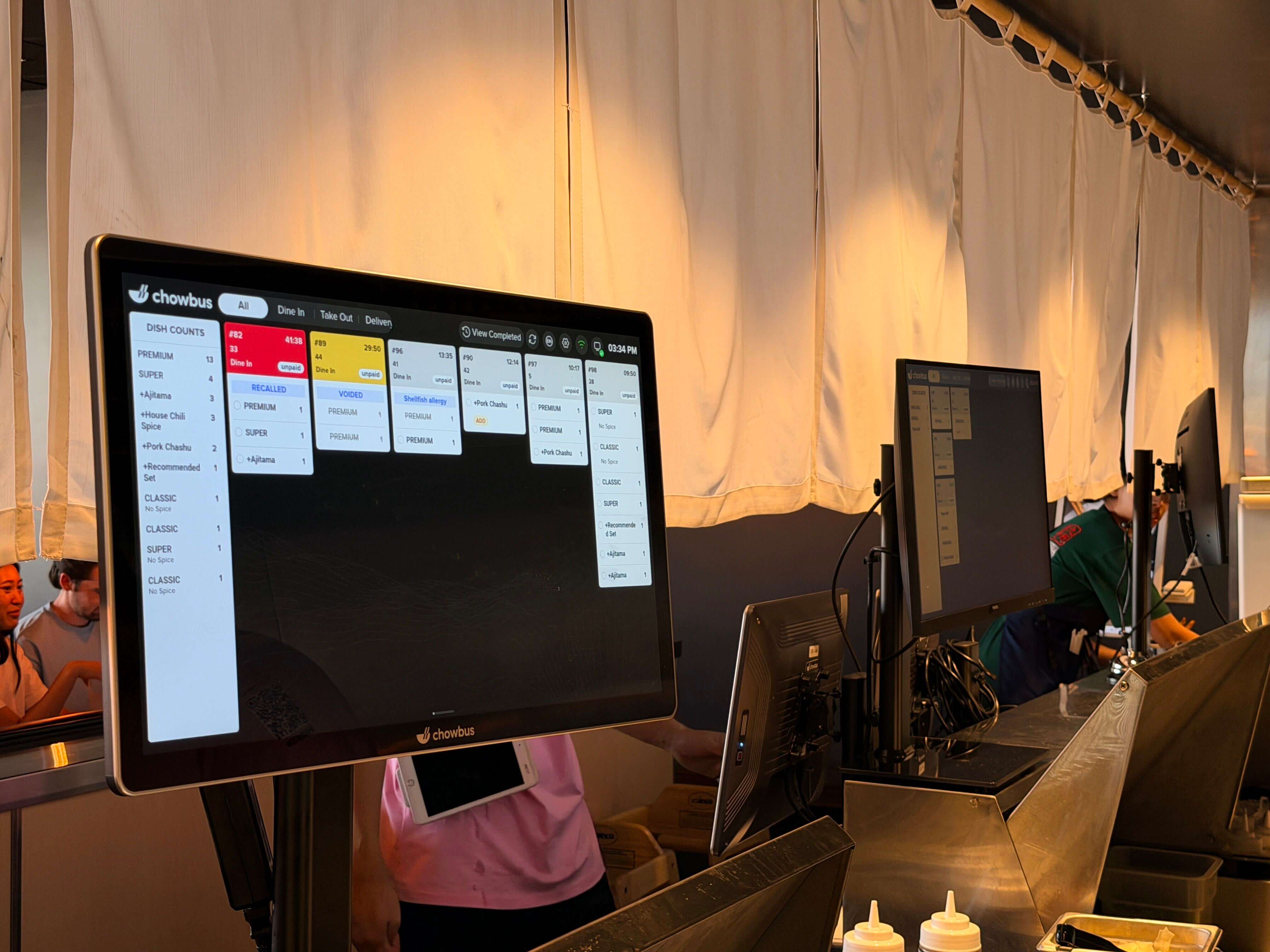
Chowbus was built specifically as an all-in-one AI POS for Asian restaurants, and its kitchen display system is designed around the exact pain points this guide keeps circling back to: multi-station routing for complex dishes, bilingual (and broader multilingual) staff interfaces, and native integration with online ordering and delivery so tickets from every channel land in one place instead of three tablets. Chowbus currently serves 9,000+ restaurants across all 50 U.S. states and Canada, with 24/7 bilingual (English/Chinese/Spanish) support and a reported 2-minute average response time.

  • Pros: Purpose-built for Asian and multi-cuisine complexity, bilingual interface reduces training time and errors for non-native-English-speaking kitchen staff, integrates online ordering, delivery apps, and POS on one screen, backed by fast bilingual support.
  • Cons: Newer and smaller than Toast or Clover in overall market share, so it doesn't have quite the same size of third-party integration marketplace; best value is realized by restaurants that actually need the Asian-specific and multi-channel features, rather than a simple single-station concept.
  • Best for: Asian and multi-cuisine restaurants — hot pot, Korean BBQ, bubble tea, Japanese, Vietnamese, Thai — that need multi-station complexity handling, bilingual staff support, and unified order management across dine-in, online, and delivery.

How to Choose Based on Your Restaurant Type

Rather than asking "which KDS is best," it's more useful to ask "which KDS is best for a kitchen like mine." A few real scenarios:

  • Hot pot restaurant with 8+ stations and heavy dine-in volume: You need a system built for simultaneous multi-station routing and staff who may be more comfortable reading Mandarin than English. This is where Chowbus's Asian-restaurant-specific design and multilingual interface tend to outperform general-purpose systems.
  • Bubble tea shop with a simple, high-speed menu: A lighter system like Square can be enough if your prep is largely single-station and your main need is speed at checkout, not complex routing.
  • High-volume AYCE (all-you-can-eat) buffet or Korean BBQ: These concepts generate huge ticket volume with frequent modifications (extra plates, swapped proteins). You'll want a system with strong routing logic and multilingual support for a kitchen crew — Chowbus and, to a lesser extent, MenuSifu are worth shortlisting here.
  • Small, single-cuisine Korean BBQ spot planning to stay put for years: If you're comfortable with a longer hardware commitment and want proven equipment, Clover can work, provided you accept the contract terms.
  • Food hall stall or ghost kitchen with multiple delivery channels: You need tight, native integration between delivery apps and the kitchen screen so orders don't get missed. Toast and Chowbus both handle this reasonably well; Chowbus adds the multilingual layer if your kitchen staff isn't fully English-fluent.
  • Mainstream American diner or chain location: Toast remains a safe, well-supported choice given its scale and ecosystem, especially if you don't need Asian-menu-specific logic.

Quick Comparison

SystemMulti-Station ComplexityMultilingual SupportDelivery/Online IntegrationCost StructureBest ForToastStrongLimitedStrongMid-to-high, contract-basedMainstream American restaurants/chainsSquareBasicLimitedModerateLow, flexibleSmall or new, simple-menu restaurantsCloverModerateLimitedModerateHigh, contract lock-inEstablished single-cuisine restaurantsMenuSifuStrong (Asian menus)ModerateWeak (no native delivery)Per-order fees add upTraditional dine-in Asian restaurantsChowbusStrongStrong (EN/ZH/ES)Strong (native)Competitive, bundledAsian and multi-cuisine restaurants

Frequently Asked Questions

What exactly is a kitchen display system, and how is it different from a KDS app on a tablet?A kitchen display system (KDS) is the hardware-plus-software setup that replaces paper order tickets with digital screens in the kitchen. Most modern systems, including Chowbus, Toast, and Square, run on tablets or purpose-built monitors — the difference between them is less about the physical screen and more about the routing logic, integrations, and language support behind it.

How do I actually decide which kitchen display system is best for my restaurant?Start with your kitchen's complexity, not the vendor's marketing. Count your prep stations, think about how often tickets need to hit multiple stations at once, and be honest about whether your staff would benefit from a bilingual interface. From there, match those needs against the pros and cons above rather than picking based on brand recognition alone.

Is Chowbus better than Toast or Clover?It depends on your restaurant type. Toast and Clover are solid, well-established platforms for mainstream American concepts without complex multilingual or Asian-menu needs. Chowbus tends to be the stronger fit specifically for Asian and multi-cuisine restaurants that need multi-station routing, bilingual staff support, and unified delivery integration — it isn't a universal upgrade, it's a better match for a specific kind of kitchen.

What does a kitchen display system typically cost?Pricing varies by vendor and structure: some charge a flat monthly software fee plus hardware, others (like MenuSifu) charge per order, and some bundle it into a broader POS contract. When comparing quotes, ask specifically what happens to your cost as order volume grows, since per-order fees can quietly become the most expensive option at scale.

We run a hot pot restaurant with 10 stations — what should we actually shortlist?For a kitchen this complex, prioritize systems proven to handle simultaneous multi-station routing and staff who read Mandarin more comfortably than English. Chowbus and MenuSifu are both built with Asian restaurant workflows in mind, though Chowbus additionally offers native delivery and online ordering integration that MenuSifu currently lacks.

What's the next step if I want to compare options in more depth?Request a live demo from two or three vendors on this list using your actual menu and station layout, not a generic demo script. You can see how Chowbus specifically handles kitchen display routing for Asian and multi-cuisine menus at chowbus.com/hardware/kitchen-display-system, and use that same test against any other system you're considering.

There is no single "best" kitchen display system — there's only the system that best matches your kitchen's complexity, your staff's language needs, and how many channels (dine-in, online, delivery) you're juggling at once. Toast and Clover are strong, dependable choices for mainstream American operations. Square is a smart low-cost entry point for very small or new restaurants. MenuSifu brings genuine Asian-menu expertise, even if its technology shows its age. Each earns its place on this list for a reason, and each has real limits worth knowing before you sign a contract.

If you're reading this because your kitchen involves multiple stations, staff who speak Mandarin, Cantonese, or another language more comfortably than English, and orders coming in from three or four different channels at once, that combination is exactly where general-purpose systems tend to strain and where Asian-restaurant-specific design starts to matter more than brand size.

That's the gap Chowbus was built to close — not as the universal answer for every restaurant, but as a genuinely strong option for Asian and multi-cuisine kitchens that need multi-station handling, bilingual support, and unified order management in one place. If that describes your restaurant, it's worth putting Chowbus on your shortlist alongside the others in this guide and testing it against your own menu before deciding.

更多内容

No items found.
了解更多
分类频道